



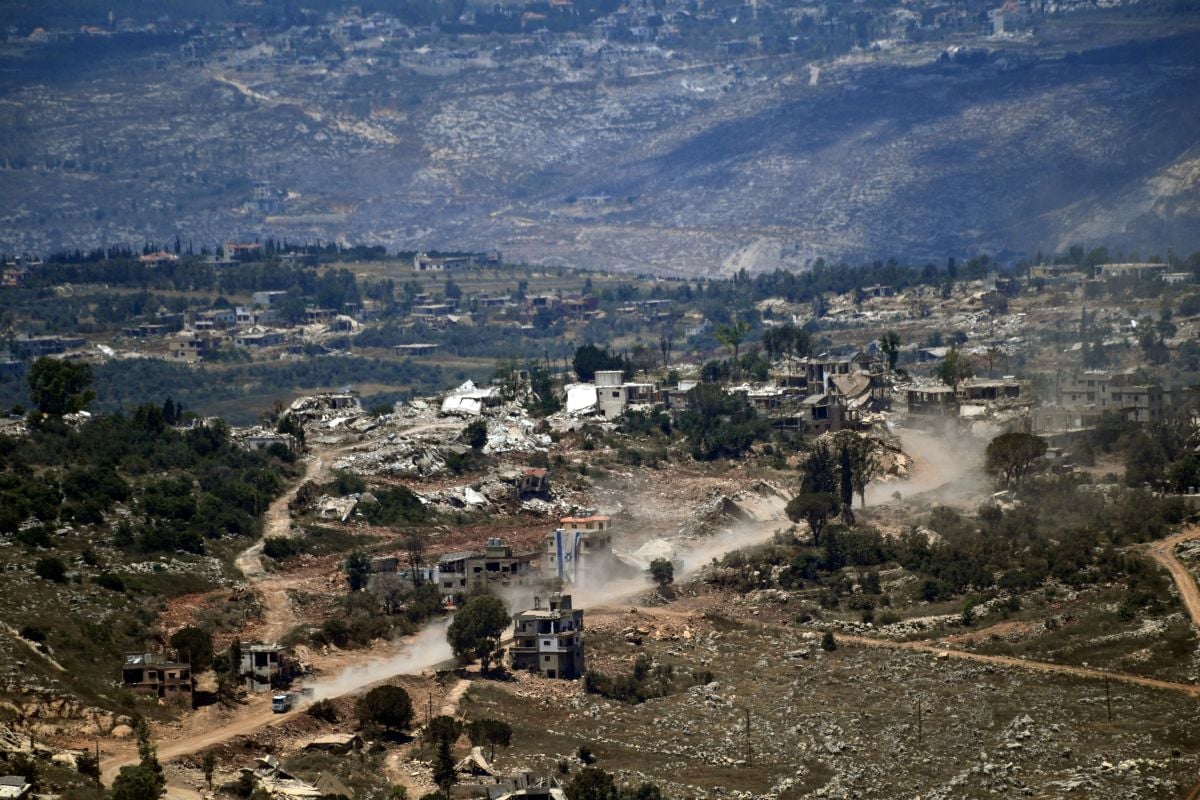
Israeli military vehicles and an Israeli flag are seen in a village in southern Lebanon near the border, as viewed from northern Israel, on June 18, 2026. (Credit: Gil Eliyahu/Reuters)






BEIRUT — The regional escalation following Iranian strikes in the Strait of Hormuz and a series of U.S. bombings on Iran has not spilled over into Lebanon.
Several Israeli attacks, mostly artillery fire, were nonetheless reported in southern Lebanon from Saturday evening through Sunday morning before a precarious calm set in during the afternoon, according to our correspondent in the region.
Only Israeli artillery fire targeting the outskirts of Kfar Tibnit, in the Nabatieh district, was reported later in the afternoon.
The artillery fire targeted the outskirts of Buyut al-Sayyad (Sour district) shortly after 11 p.m. Saturday.
On Sunday morning, it repeatedly struck Kfar Tibnit, the Hujeir Valley (Marjayoun district), and the Ain al-Samahieh area between Zawtar Gharbieh and Zawtar Sharqieh (Nabatieh district).
Machine-gun fire targeting Qantara (Marjayoun district) was also reported.
Another stun grenade was dropped near Mansouri (Sour district), where the Israeli army distributed leaflets Saturday ordering residents who had returned since the "cease-fire" announcement to leave the village.
In the coastal village of Mansouri, Israeli strikes Saturday killed at least one person and wounded several others, according to our correspondent.
At about 2 a.m. Sunday, a loud explosion was heard in Majdal Zoun (Sour district), coinciding with a large-scale Israeli sweep operation in the area.
Shortly after 9 p.m. Saturday in the Bint Jbeil district, the Israeli army also carried out explosions in the towns of Beit Yahoun and Kounin.
A drone also dropped a stun grenade over Haddatha.
Hezbollah, for its part, held funerals Sunday in Khirbet Selm, deep in the Bint Jbeil district, for 30 fighters killed since the war resumed on March 2.
Bint Jbeil municipality calls on the state to 'act immediately'
With Israel still occupying more than 600 square kilometers of southern Lebanon and no clear prospect of a withdrawal — which Israel has linked to the Lebanese state's disarmament of Hezbollah — several municipalities in the Bint Jbeil district, including the district capital, issued a statement Sunday calling on the state to act "immediately" to address the occupation and the destruction it has caused.
The Bint Jbeil municipality, whose town has been largely destroyed by the Israeli army, again condemned what it described as the "urbicide" of the city.
It called on "the Lebanese state to act immediately to put an end to what it described as an 'urban massacre' targeting the city and, more broadly, southern Lebanon."
It also urged the state to file a complaint with international bodies so that "those responsible for these violations are held accountable."
Without mentioning Hezbollah, the municipality of Aitaroun questioned "what the negotiation processes have brought to the residents of the border villages."
In a thinly veiled criticism of the framework agreement signed in late June in Washington between Beirut and Tel Aviv — particularly the absence of "a clear and binding timetable for ending the occupation" — it called on the state "to announce a clear national emergency plan specifically dedicated to the frontline villages, including a timetable for the return of residents, reconstruction, the restoration of essential services and fair, rapid compensation for all those affected."
Beyond identifying needs, the government has yet to address in depth the reconstruction of southern Lebanon.
Gulf countries — the main potential donors — remain reluctant to fund rebuilding, unlike after the 2006 war, largely because of the continuing Israeli occupation and, according to experts, concerns that reconstruction could strengthen Hezbollah despite the destruction caused by the war.
Reporting contributed by our correspondent in the South, Muntasser Abdallah

