


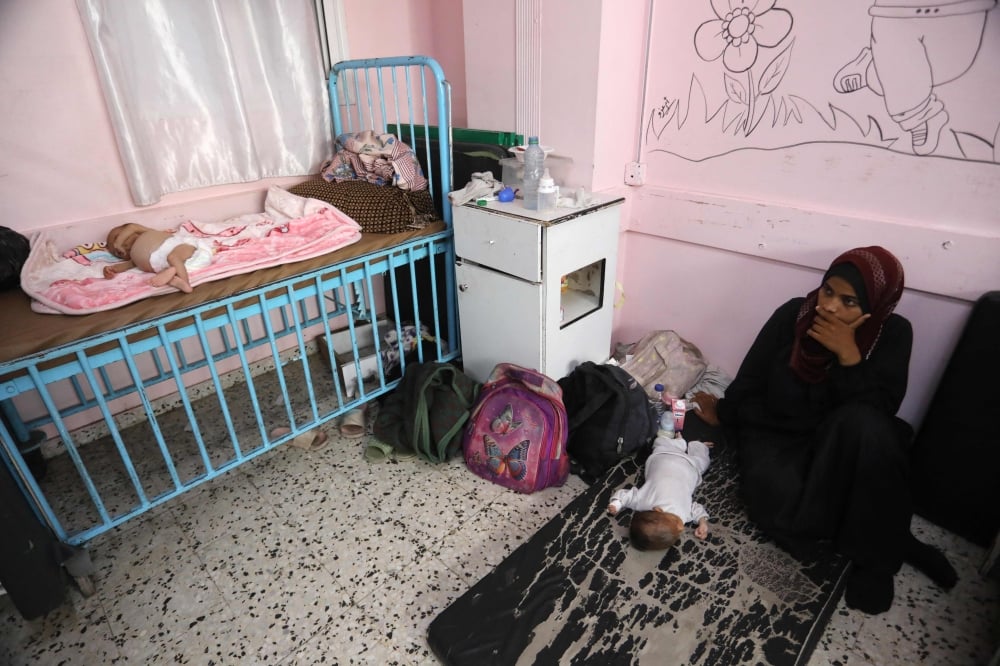
A Palestinian mother sits next to her malnourished infant at Nasser Hospital in Khan Younis, southern Gaza, on July 24, 2025. (Credit: AFP)






During a meeting in Paris, French Foreign Minister Jean-Noël Barrot and his Saudi counterpart, Faisal bin Farhan, announced the organization of an international conference aimed at promoting the two-state solution as a means to resolve the Israeli-Palestinian conflict, according to a joint statement released by media outlets in Lebanon and the Gulf.
"The two ministers discussed preparations for this international conference, scheduled for New York from July 28 to 30 under the joint sponsorship of France and Saudi Arabia," the statement said.
"They expressed hope that this conference will yield tangible results to improve peace and security in the region. They also reaffirmed their support for the efforts of mediator countries — Egypt, Qatar and the United States — to achieve a lasting cease-fire in Gaza and the release of hostages, emphasizing the need to ensure the passage and distribution of humanitarian aid."
Lebanon, Syria, Iran
A previous international conference on the same topic was supposed to take place at the U.N. headquarters in June and was expected to be a historic turning point before being abruptly canceled due to the regional escalation sparked by Israeli strikes against Iran. Diplomatic sources said in mid-July that the conference was postponed to the end of the same month. However, it is not certain if this new conference will have the same scope as initially planned.
59,587 Palestinians have been killed and 143,498 wounded by Israel since the beginning of the war triggered by Hamas’s offensive, which killed 1,200 Israelis on Oct. 7, 2023, on Israeli territory. More than 100 humanitarian and human rights organizations warned Wednesday that "mass famine" was spreading in Gaza, as the United States announced it was sending its top envoy to Europe for discussions on a possible cease-fire and aid corridor.
In their statement, the French and Saudi ministers also addressed the Lebanese issue, stressing "the importance of respecting the cease-fire" reached at the end of November between Israel and Hezbollah, now weakened by numerous violations, mostly by Israel. They also reaffirmed their support for Lebanese authorities for the implementation of urgent reforms – as Lebanon is in talks with the International Monetary Fund (IMF) for a financial assistance program – and for strengthening the sovereignty of the state, which notably involves the disarmament of militias, including Hezbollah. This issue is being closely monitored by U.S. envoy Tom Barrack, who was in Beirut at the start of the week.
The two diplomats also discussed the Syrian issue and intercommunal violence in Sweida, calling for respect of the cease-fire concluded on July 19. They emphasized the need to "protect civilians" and to sanction the perpetrators of abuses against them, in accordance with commitments made in the joint declaration adopted at the Paris Conference on Syria on Feb. 13, 2025. More than 1,300 people were killed in a week during clashes between Druze armed groups and Sunni Bedouin tribes.
Finally, the two ministers urged Iran to resume cooperation with the International Atomic Energy Agency (IAEA), as Tehran officially cut off relations with the organization at the start of the month in the wake of the war with Israel. Iran reaffirmed this week its right to enrich uranium before talks Friday with the European Union.

 7 p.m. recap: Netanyahu seeks mastermind behind Flydubai incident; Washington sanctions 2 French nationals; Ben Gvir's 'I want to kill you' threat
