


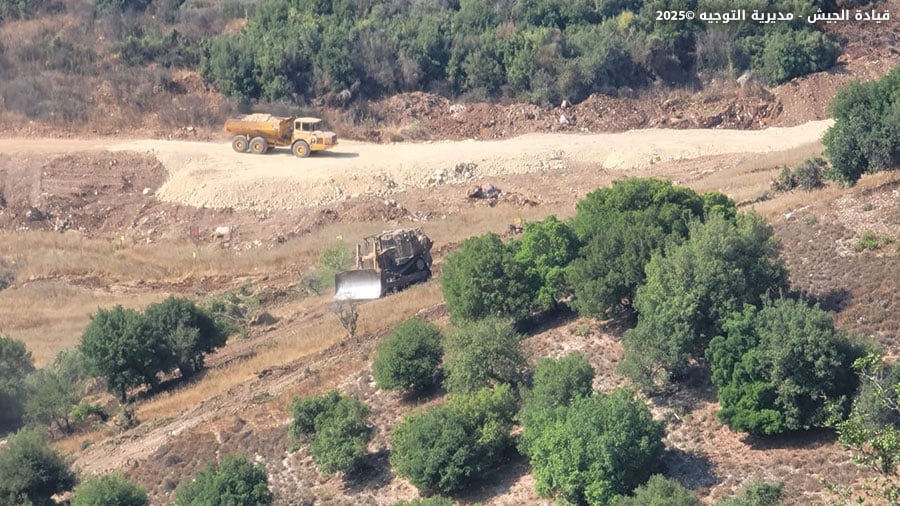
Israeli military and construction vehicles around Rmeish, southern Lebanon, July 20, 2025. (Credit: @Lebarmy/X)






The Lebanese Army has reinforced its deployment near the border village of Rmeish, in the Bint Jbeil district of southern Lebanon, after an incursion by Israeli military vehicles, the force announced in a statement.
The Israeli army has been carrying out regular infiltrations into southern Lebanon, where it continues to occupy five positions, despite the cease-fire that came into effect in late November 2024.
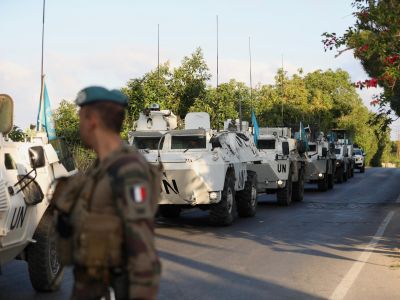
The Lebanese Army stated that Israeli military vehicles "crossed the technical barrier," used to demarcate sections of the border near Rmeish, and attempted to carry out excavation work. This prompted the United Nations Interim Force in Lebanon (UNIFIL) to mobilize on site and led to reinforced Lebanese military positions in the area "to face the enemy."
"This deployment forced enemy forces to retreat," the army said, accusing Israel of a new "flagrant violation of U.N. Resolution 1701 and the cease-fire agreement."
Lebanese Army, UNIFIL monitor
Resolution 1701, adopted in 2006, calls for a cessation of hostilities, the withdrawal of Israeli forces from southern Lebanon, the deployment of the Lebanese Army south of the Litani River and the disarmament of all illegal militias.
This text forms the framework of the November 2024 truce agreement, which ended two months of violent Israeli army offensives against Lebanon after several months of an attrition war between Hezbollah and Israel.
The statement added that the Lebanese Army command "continues to monitor the evolution of the situation along the southern border in coordination with UNIFIL."
Earlier in the day, Israeli artillery shells targeted the outskirts of Kfar Shuba (Hasbaya district), without causing any casualties.
During the night, the Israeli army destroyed a concrete factory in Yaroun, in the Bint Jbeil district of southern Lebanon, after infiltrating Lebanese territory at around 3 a.m., according to our correspondent in the South. Two loud explosions were heard in the area, sowing panic in the surrounding villages.
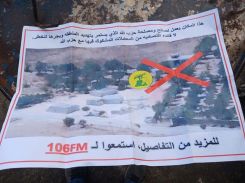
Several hours later, to explain the destruction of the factory, an Israeli drone dropped leaflets over Yaroun — a village that was heavily damaged during the last war between Hezbollah and Israel: "There is no economic benefit in dealing with Hezbollah. This place works for Hezbollah, which continues to threaten the region and drag it into danger," the leaflets read.
On Saturday evening, around 9 p.m., two Israeli boats crossed the maritime buoy line demarcating the Lebanese and Israeli exclusive economic zones. They approached a Lebanese fishing boat off Naqoura (Sour district). An Israeli drone then dropped a stun grenade toward the Lebanese vessel.
Nighttime artillery fire
Around 10 p.m., Israeli artillery bombarded the outskirts of Alma Shaab (Sour district) several times. Other artillery fire hit the outskirts of Aitaroun (Bint Jbeil district) with incendiary shells that started a fire.
The Arabic-speaking spokesperson for the Israeli army, Avichay Adraee, announced on X late at night that the Israeli military "carried out a strike and eliminated Ahmad Mohammad Salah," identified as "the Hezbollah unit commander in charge of the Yohmor area" in the Nabatieh district.
According to the statement, Salah was working on rebuilding Hezbollah infrastructure in the sector. Salah was killed Saturday in a drone strike while riding a moped in Yohmor Shqif, according to our information.
Another man was killed earlier in the day in a drone strike on Khiam (Marjayoun district), which the Israeli army claimed targeted a "fighter from the al-Radwan force," the party's elite unit.
Since the cease-fire went into effect on Nov. 27, the Israeli army has carried out almost daily strikes against Lebanon, mainly in the South and in the Bekaa. These attacks have so far killed more than 270 people.
Reporting contributed by Muntasser Abdallah.
This article was translated from L'Orient-Le Jour.
 The 7 p.m. recap: Houthis advance, government announces counteroffensive; Iran raises stakes; Israeli shells hit close to journalists in south Lebanon
 2 Israeli soldiers injured in 'operational accident,' as army continues attacks in the South