


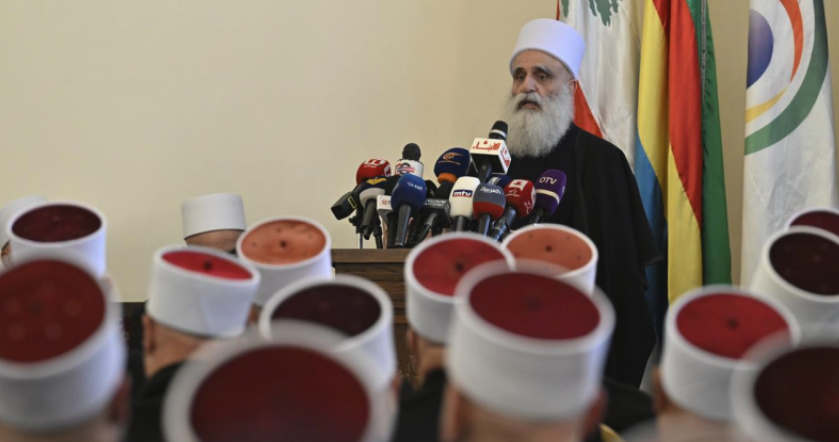
The spiritual leader of the Druze community in Lebanon, Sami Abi Al-Mona, during an “exceptional” meeting in Beirut, on March 3, 2025. (Credit: NNA)






BEIRUT — Druze Sheikh al-Aql Sami Abi al-Mona — the highest religious authority of the Druze community in Lebanon — condemned on Wednesday the deadly clashes in Sweida, southern Syria, where government forces are accused of launching a bloody offensive against Druze civilians. He also denounced the inability of the new regime of President Ahmad al-Sharaa to “contain” extremist elements within its ranks.
“The scenes of hatred perpetrated by extremists demonstrate the Syrian state's inability to control them,” the spiritual leader said in a statement. “The extremists instead poured out their hatred on the turban of this Druze sheikh or the mustache of this famous man, trampling on the symbolic flag and humiliating fathers before the eyes of their families,” Abi al-Mona continued on X, referring to videos circulating on social media showing a sheikh, amongst others, having his beard and mustache shaved by alleged regime fighters.
He then asked, addressing Syrian leaders and human rights organizations: “Is this how a modern state is built?”
'Cover for terrorism'
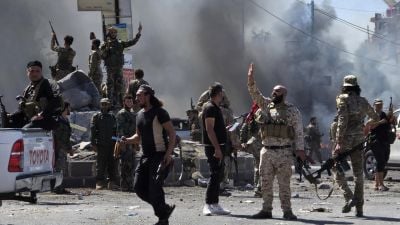
The clashes, which broke out Sunday in the Bedouin quarter of al-Maqous, killed nearly 250 people, including the Druze, Bedouins and Syrian army forces, according to the latest tally from the Syrian Observatory for Human Rights (SOHR). The fighting spread to other villages around Sweida before the Syrian Interior and Defense Ministry forces intervened to confront the armed Druze groups.
Government forces deployed in Sweida on Tuesday morning and announced a cease-fire, saying they aimed to restore calm after two days of fighting. However, the truce was short-lived, and clashes resumed Wednesday morning, according to the local media outlet Sweida24.
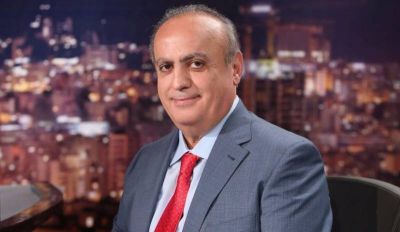
The media office of the Druze Tawhid party, founded by former Lebanese minister Wiam Wahhab, said that “the decision by the U.S. administration to remove the terrorist designation from the organization Hay’at Tahrir al-Sham [HTS], despite its bloody history and logic of annihilation, is an extremely dangerous signal, raising serious questions about the real intentions for the future of pluralism in Syria.”
“Such decisions do not promote peace, but provide cover for terrorism and legitimize assassinations,” the party statement added.
A 'bloody plan' targeting the Druze of Sweida
On June 23, Washington revoked the terrorist designation of al-Nusra Front organization, also known as HTS. The former head of the al-Nusra Front, current Syrian President Sharaa and previously known as Abu Mohammad al-Jolani, led a coalition of rebels that launched an offensive resulting in the overthrow of the Bashar al-Assan regime on Dec. 8, 2024.
The Tawhid Party also condemned what it described as a “bloody plan” targeting the Druze of Sweida. “This is neither a passing incident nor a simple detail in the complex Syrian landscape, but rather the methodical continuation of policies of elimination and exclusion targeting the very existence and identity of our Druze fellow citizens, as part of a bloody plan reminiscent of the massacres that took place on the coast and other dark episodes marked by the stamp of barbaric takfiri (Islamist extremist) ideology.”
Wahhab's party also condemned “a disturbing international silence,” which it said can now only be interpreted as “implicit complicity in a crime of genocide of civilians — children, women and the elderly — in Sweida, under the eyes of the international community and its institutions that claim to defend human rights.”
The party finally called on “the Druze inhabitants of Sweida to unity, vigilance in defending their land and dignity, to preserve their cohesion and honor and to reject any blackmail or threat from armed groups.”
The head of Tawhid again commented on the clashes Wednesday morning, calling on “all Lebanese” to join the Druze “of Galilee,” northern Israel, who “will begin to mobilize.”
Since the fall of Bashar al-Assad — overthrown by a coalition of Sunni Islamist rebels — violence against the Alawite community, resulting in more than 1,700 deaths, and attacks targeting the Druze, as well as an assault on a church in Damascus in June, have shaken confidence in the new government’s ability to protect minorities.
 7 p.m. recap: Flames, smoke reported near Aramco site near Riyadh; Houthis accuse Saudi Arabia of 56 strikes on Sanaa