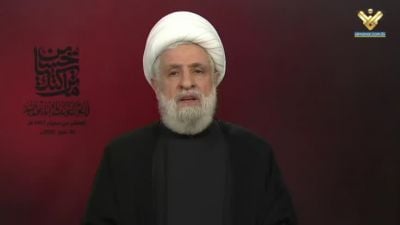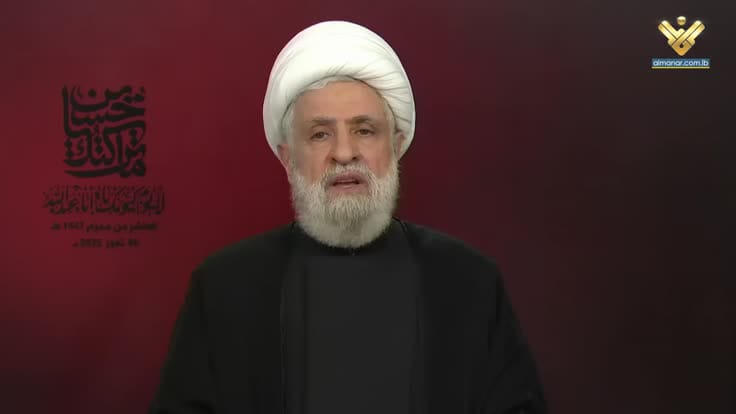
Hezbollah’s Secretary-General, Naïm Kassem, during a speech delivered on the occasion of Ashura. Photo taken from Hezbollah’s Telegram account.






In a wide-ranging interview aired Tuesday night on Al-Mayadeen, Hezbollah Secretary-General Naim Qassem acknowledged for the first time that the group failed to detect Israeli booby-trapped pagers that killed at least 40 people in September, including a child, and wounded nearly 3,000, most of them Hezbollah members.
“We didn’t know the supply chain was compromised, and we couldn’t detect the explosive,” Qassem said of the AR-924 model pagers, which were reportedly planted by Israeli intelligence and sold to Hezbollah through a front company posing as a Taiwanese manufacturer. He attributed the lapse to “negligence or oversight” during the purchase process.
The incident, which took place over Sept. 17-18, marked a deadly intelligence breach amid the 13-month war between Hezbollah and Israel that ended with a cease-fire in Nov. 2024. The war left more than 4,000 people killed and 16,000 injured in Lebanon.
Qassem said that 1,500 additional explosive-laden pagers were intercepted in Turkey shortly after the attack, through a warning reportedly relayed by former Prime Minister Najib Mikati to Turkish President Recep Tayyip Erdogan. Turkish intelligence had seized the shipment at Istanbul airport after it arrived from Hong Kong, just a day before the Beirut explosions.
“We’ve discovered that Israel had been collecting data on us for 17 years,” Qassem said, citing wiretaps and surveillance drones. He confirmed that Hezbollah had formed an internal investigative committee to uncover how deeply it had been infiltrated.
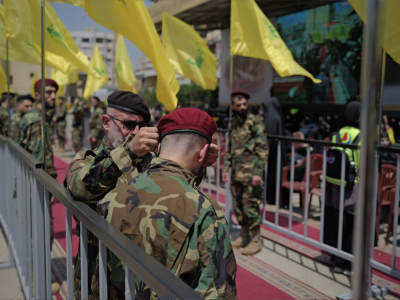
Hezbollah is recovered and ready
Turning to the current escalation, Qassem warned that Hezbollah “will not be patient indefinitely” in the face of Israel’s near-daily strikes on Lebanese territory, despite the cease-fire. While he gave no specifics on timing or targets, he insisted, “There is no third option between victory and martyrdom.”
“Hezbollah is recovering and is now ready. If Israel attacks, we will not stand idly by; we will fight,” he said.
On Tuesday, Israel carried out two deadly strikes: one in Bablieh, south of Saida, killing a Hezbollah Badr unit official; another in Tripoli — the first since the truce — targeting a senior Hamas member.
No on disarmament
Qassem flatly rejected calls to disarm Hezbollah, particularly the dismantling of 500 medium- and heavy-weapon depots in the South. “They talk about what they saw south of the Litani, but Lebanon is vast, thank God,” he said.
“Disarmament is not an acceptable project because it weakens Lebanon,” Qassem added. “Weapons are not what keep Hezbollah alive, but Lebanon’s strength lies in its resistance, its army and its people.”
He also revealed that “the United States and some Arab states” have been pressuring President Joseph Aoun to deploy the Lebanese Army against Hezbollah if necessary.
U.S. envoy issues warning
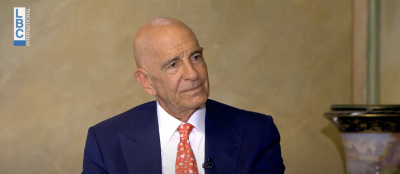
His comments come as the disarmament issue takes center stage in Lebanese and international politics. U.S. envoy Tom Barrack visited Beirut this week to promote Washington’s “roadmap” for disarming Hezbollah. In a separate interview with LBCI, Barrack said President Donald Trump had “no patience” and warned that if Lebanon continues to delay, “the United States will no longer be there to discuss it.”
On UNIFIL and Syria
Qassem reiterated Hezbollah’s support for the U.N. peacekeeping force in southern Lebanon (UNIFIL), but stressed it must stick to its mandate and coordinate movements with the Lebanese Army. “We do not accept UNIFIL entering villages or private properties unaccompanied,” he said.
Addressing regional developments, Qassem acknowledged that the fall of Syria’s Bashar al-Assad regime in December dealt a blow to the axis of resistance. He also warned that any potential normalization between Syria and Israel would be “very dangerous,” saying Damascus “should not engage in such a process.”