






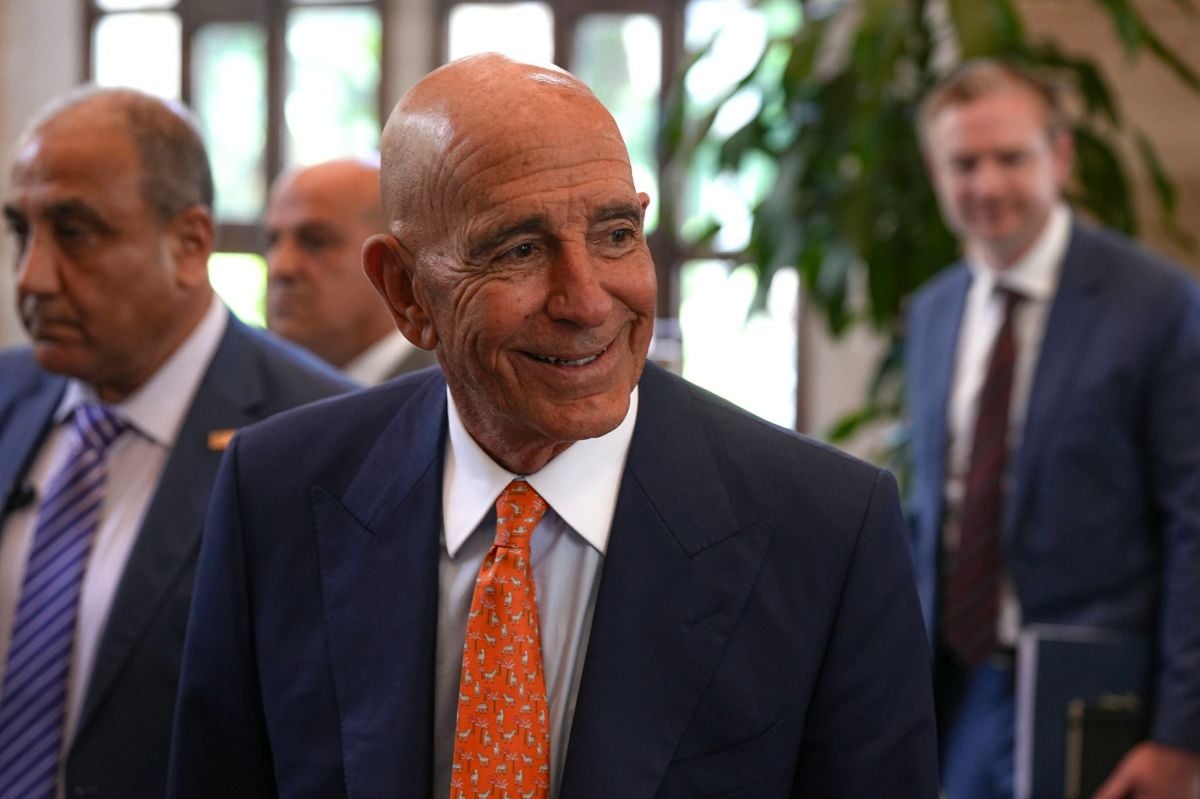
American envoy Tom Barrack during his visit to Beirut on July 7, 2025. (Credit: Mohammad Yassin)






The leader of the Lebanese Forces, the largest Christian party and a group firmly opposed to Hezbollah, strongly criticized in a statement on Monday the way the Lebanese presidency, Cabinet and Parliament arrogated the right to commit the whole of Lebanon on the issue of Hezbollah's disarmament in the response sent to the American emissary Tom Barrack.
Arriving that same day in Lebanon, the latter received, during the first stage of his visit, the country's official response to the American proposal concerning a plan to disarm Hezbollah and turn the Nov. 27 cease-fire between the party and Israel into lasting peace.
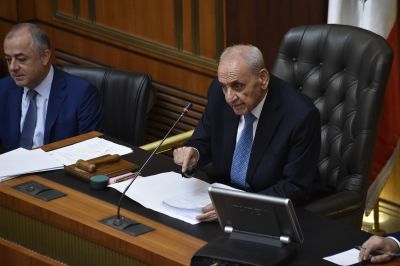
"Article 65 of the Constitution states that the executive power is entrusted to the government, which develops the general policy of the state in all areas, without exception. Therefore, the response that was handed over today by the three presidents to the American emissary Tom Barrack is contrary to the Constitution, the law, and cannot in any case be considered official," said the Christian leader, whose group is represented in the government.
"The Prime Minister is therefore required to convene a Council of Ministers meeting without delay, after informing the ministers of the content of Barrack's proposal. This document must be discussed in one or more full council sessions to adopt an official and constitutional position on it."
The head of the LF did not stop there, stating that "the fate and future of the Lebanese are being played out right now," and that "the slightest mistake or negligence by one of the main leaders could lead the country into the abyss, or, at best, doom it to immobility, blockage, and progressive regression."
"With its bluster, Hezbollah has already cost the country and its inhabitants what we have experienced over the past 30 years, and more particularly these last two years," added Geagea. Hezbollah began, as of Oct. 8, 2023, following the Gaza war, a sequence of confrontations with Israel at the border, which escalated into a full-scale war in September 2024, until the truce reached in November.
"It seems today determined to inflict even more losses, paralysis, and missed opportunities. If the position of Hezbollah is explained by fixed ideological foundations and known external ties, nothing justifies the current attitude of the Lebanese authorities," Geagea stated. He urged the government and Parliament to "fully assume their responsibilities in this critical phase."
On Sunday, the head of the LF had already criticized the lack of an official position from the Lebanese government in response to the American proposal which, according to him, aims "to advance the situation in the country by ending the Israeli occupation and the Israeli aggressions on the one hand, and the disarmament of all illegal forces on the national territory on the other hand."
As if Nasrallah was still alive
Geagea's stance was supported by LF MP Georges Okais who said on Monday on Free Lebanon Radio that his party was considering leaving the government, given how the issue of re-establishing the state's monopoly on weapons was being handled by Lebanese leaders.
"We observe evident confusion within the Iranian regime and the ranks of Hezbollah, but the greatest disarray concerns that of the Lebanese state," he explained, suggesting that the leaders act as if Hassan Nasrallah, the former secretary-general of the party assassinated last September by an Israeli bombardment on the southern suburbs of Beirut, was still alive and that the power dynamics on the ground had not changed. "They seem not to believe that they are now in a position to make appropriate national decisions, free from pressures and threats."
"We participate in the government based on its ministerial declaration (which stated that the state should have a monopoly on arms in the country and promised to liberate the entire territory from the Israeli invasion). If government action no longer reflects the objectives of this declaration, we may then reconsider our position. We will not play the role of passive witness," he said.
"For now, we are waiting to see how the state will act on the issue of weapons before drawing the necessary conclusions. We may decide to withdraw from the government and withdraw our confidence in it if it fails to translate its declaration into actions," added the MP.
However, he tempered his remarks by saying that "contacts between the Lebanese Forces and the president, General Joseph Aoun, have never been interrupted," and that his group supports the presidential mandate, without any "hostility" towards Aoun or the prime minister.
"We have several reservations about the management of affairs, particularly regarding the absence of an urgent and decisive decision to collect illegal weapons and extend the exclusive authority of the state over all its territory," he stated.
The issue of Hezbollah's disarmament constitutes the most critical sticking point of the cease-fire. The party has so far refused to consider this issue without a prior withdrawal of Israel from five positions that its army still occupies, while Israel does not wish to withdraw without guarantees that the party will be disarmed.
