


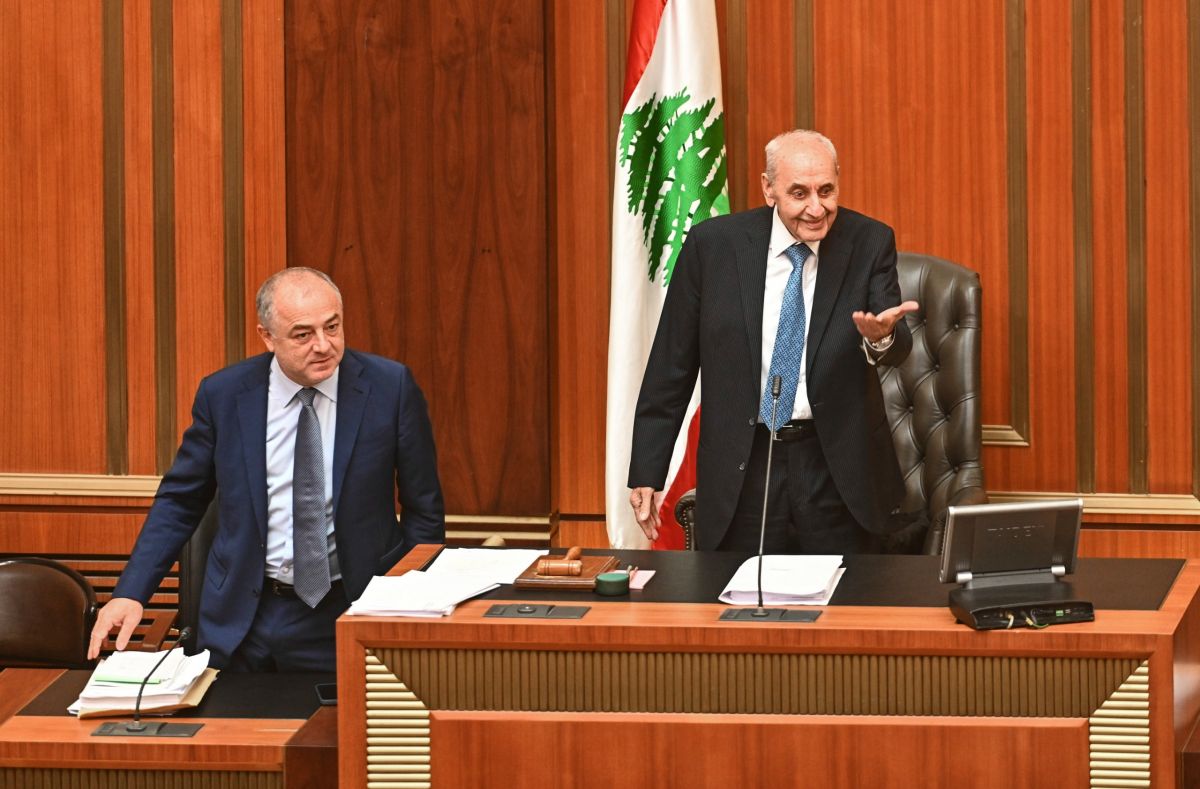
The head of Parliament, Nabih Berry (on the right), and the Deputy Speaker of the House, Elias Bou Saab, on July 1, 2025, in Parliament. (Credit: Mohammad Yassine/L'Orient Today.)






BEIRUT — After a one-hour delay, the Lebanese Parliament resumed its session on Tuesday at noon — continuing from Monday — after finally securing the required quorum of 65 MPs.
According to LBCI, contacts were made in the morning to ensure this quorum. Furthermore, Parliament passed five projects and proposals of laws, including allocations for the military, according to the state-run National News Agency (NNA).
Nonetheless, some confusion arose during the session, with some medias reporting that it had not taken place due to lack of quorum or that it had started despite the absence of quorum. NNA eventually confirmed the session did take place.
According to information from L'Orient Today, MPs from the Lebanese Forces, Kataeb, as well as MP Michel Moawad and independent deputies boycotted Tuesday's session after withdrawing from Monday's session to express their disapproval of the lack of debate on the proposed electoral law.
The session lasted less time than it took to start it.
Parliament began by voting on a bill to open an additional credit line in the 2025 budget, granting monthly financial aid of 14 million Lebanese pounds to active military personnel and 12 million pounds to retirees. The decision is set to take effect retroactively from today, although the law has not yet been officially published on NNA.
MPs also approved a bill included in decree 498, concerning obtaining a loan from the International Bank for Reconstruction and Development (IBRD, affiliated with the World Bank) to finance the green transition in the agro-industry sector. This loan agreement with the IBRD was discussed Monday, as well as another concerning the reform of the electricity sector in Lebanon, through rehabilitation projects of the network, partially destroyed by Israel during its war against Hezbollah.
Additionally, Parliament approved a bill to adhere to the Madrid Protocol on the international registration of trademarks, as well as a law granting more prerogatives to municipalities. MPs also approved the regulation of radiology practice in Lebanon.
'Justice for the military'
Parliamentarians postponed the examination of a bill by MP Adib Abdel Massih concerning the pharmacy profession and dietary supplements, at the request of Nawaf Salam. The session was adjourned at 1:10 p.m. by Parliament president Nabih Berri, as the examination of a bill on non-residential rents began.
The head of the Parliamentary Finance and Budget Committee, Ibrahim Kanaan, praised the aid granted to the military. "Doing justice to the military today is a step to ensure them a dignified life," he said. He also considered that the municipal law allowed local authorities to take financial initiatives and practice decentralization.
Finance Minister Yassine Jaber promised to prepare a detailed study on allocations for civilian public servants.
Diaspora vote
Meeting Monday morning, Parliament examined a dozen texts on the agenda. But a year before the legislative elections, the fact that the Speaker of the House, Berri, did not add the issue of expatriate voting to the agenda provoked a sharp protest, notably from Lebanese Forces (LF) MPs.
Joined by those from Kataeb and several independents, left the chamber to protest against the Speaker of the House's refusal to add to the agenda a fast-tracked bill. This text aims to amend the electoral law to allow Lebanese abroad to vote, just like residents, for the 128 parliament deputies, not for six reserved seats in a specific district. The session was adjourned around 2:30 p.m. and was to resume at 6 p.m., but was finally postponed to Tuesday due to a lack of quorum.
Reacting to the standoff over the electoral law and the diaspora vote, Lebanese Forces deputy Fadi Karam had assured in the morning that his party "will boycott in principle" Tuesday's meeting.
"The Speaker of Parliament does not put the laws with the urgent character on the agenda under the pretext that he has created a commission to discuss all the law proposals related to the electoral law," he said in a statement relayed by NNA. "This is a way to waste time, in order to keep the same situation regarding expatriate voting," he emphasized.
"We urgently need to make a decision regarding the diaspora vote. If they decide to implement a vote only for six seats, this means a new district will have to be set up. How is this beneficial for the Lebanese and the diaspora?" asked the LF MP, adding: "Some want to distance the expatriates and limit their influence on decisions in the country."
"There is a majority requesting that the diaspora vote for the 128 MPs, and we will win the battle. The withdrawal [Monday] from the session is to raise our voice because presenting us with a fait accompli will no longer work," said Kataeb deputy Elias Hankach.
'Silencing the Shiite voices'
Samy Gemayel, head of the Kataeb party, which boycotted the session, for his part, suggested that the procrastination around the electoral law, which was not even placed on Monday's plenary session agenda nor approached on Tuesday, aims "to silence the Shiite voices of the diaspora that could affect the upcoming elections and break the unilateral representation while promoting diversity within the Shiite community."
Gemayel, speaking at a meeting Tuesday in Saifi with deputy Marc Daou, also assured that his party "did not aim to paralyze the legislative session, especially since there were important points to vote on." "The attempt to push through the electoral law article on the diaspora led us to make this decision," he stressed.
Marc Daou echoed this sentiment, insisting on "the necessity for expatriates to vote in their original districts to elect 128 MPs, like Lebanese residents in Lebanon."
Commenting on the absence of certain deputies in the chamber, the Vice-President of Parliament, Elias Bou Saab, declared at the end of the session that Parliament cannot implement amendments to the electoral law if it does not function properly.
"MPs have the responsibility to go to Parliament and ensure that a quorum is reached," he emphasized. He also deemed it "Parliament's duty to grant rights to the military" and promised aid to public sector employees and praised the law granting more prerogatives to municipalities.
Shortly before the session, Bou Saab had called on protesting deputies "to reconsider their positions." "We are facing an important parliamentary deadline, and there are questions about the electoral law," he told MTV. "I can understand those who boycott, but I do not understand what is more important than legislating today [...] The main point of discord is that of the diaspora, and each party has demands on this. I will call for a meeting of the ad hoc parliamentary committee next week," he promised.
An online petition for the cancellation of article 112 of the electoral law, concerning the allocation of six seats to diaspora voters, circulated on Tuesday.
Anti-Hezbollah deputy Ashraf Rifi told L'Orient Today that MPs from his camp agreed on Monday to boycott Tuesday's legislative session. "The presidency of the Chamber took a full hour before it could ensure the quorum of 65 deputies required to hold the session," he said, welcoming what he calls "a start of victory" against those who refuse to amend the electoral law.

 7 p.m. recap: Netanyahu seeks mastermind behind Flydubai incident; Washington sanctions 2 French nationals; Ben Gvir's 'I want to kill you' threat