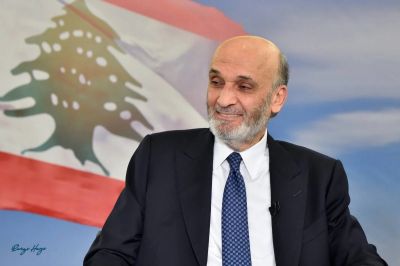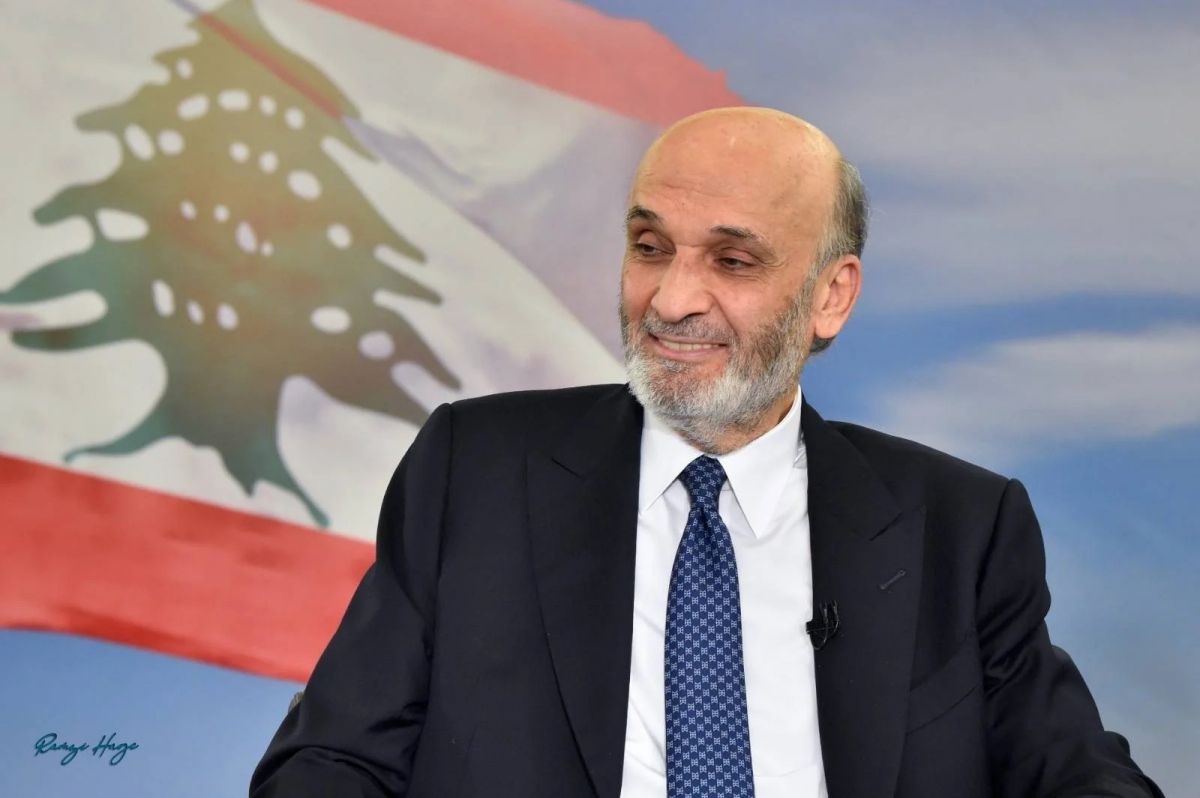
Leader of the Lebanese Forces, Samir Geagea. (Credit: LF)






The leader of the Lebanese Forces (LF), Samir Geagea, said Saturday that the handover of illegal weapons in Lebanon should take place before the end of 2025, arguing that the soft approach adopted by President Joseph Aoun “has reached its time limits.”
His remarks come as the Lebanese state seeks to reassert its monopoly over arms through a dialogue led from Baabda with Hezbollah, following the cease-fire reached with Israel in November. Meanwhile, other political factions are calling for a clear timeline for disarmament — an idea the party continues to reject.
‘Everything has its limits’
In an interview published by the daily Nidaa al-Watan, Geagea stressed the need to “gather all illegal weapons and hand them over to the Lebanese Army, so that Lebanon can once again become a real state.”
“President Aoun prefers to move at his own pace with a very soft approach, and we’re not opposed to that. But everything has its limits and deadlines. We have not opposed the approach he has taken over the past five months, but it has now reached its time limit. I hope these steps will be accelerated, especially since time and events will not wait for us,” he said.
Geagea also clarified that he had not proposed a fixed deadline to the president during their meeting, but emphasized that “the handover of illegal weapons should happen before the end of 2025.”
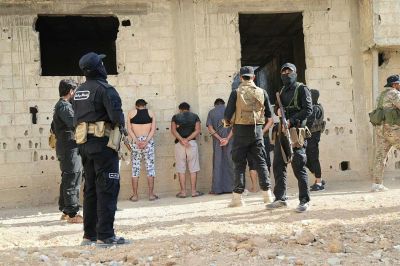
Regarding Palestinian weapons, Samir Geagea said, “Contrary to what some claim in the media, the Palestinians as an authority and the overwhelming majority of factions agree with President Mahmoud Abbas’ statements and fully recognize the sovereignty of the Lebanese state, but it is up to this state to set its priorities.”
The dismantling of Palestinian arms in Lebanon, initially scheduled for June, failed mainly due to the refusal of many Palestinian factions, including within the Palestine Liberation Organization (PLO), which remains deeply divided and opposed to giving up their weapons.
Geagea also criticized the coordination mechanism between the Lebanese Army and the cease-fire supervision committee in southern Lebanon as “unclear.” “There is no clear working mechanism, and since the cease-fire began on Nov. 27, 2024, work and reporting have been very slow,” he said.
‘No state because of the Iranian regime’
Geagea further argued that “actions by the Iranian regime have caused enormous damage that hindered the establishment of the state,” lamenting that “Lebanon was forced into several wars in which it had no supreme national interest, which also led to economic and financial deterioration based on alliances made by some corrupt individuals in the country.” “We do not have a state because of the current Iranian regime,” he added.
The Maronite leader also expressed doubt that Hezbollah is a bargaining chip for Tehran. “I don’t think that is possible,” he said.
He noted uncertainty over whether the Middle East has entered a phase of peace after the Iran-Israel war, “because there is still no clear assessment of the state of Iran’s nuclear infrastructure and the extent of the damage and destruction it has suffered.”
Commenting on photos displayed in some Tel Aviv streets showing Israeli Prime Minister Benjamin Netanyahu alongside Arab leaders and presidents, including Lebanese President Joseph Aoun, promoting the expansion of the Abraham Accords, Geagea said, “It is not the Israeli government that put up these photos, but organizations and supporters of peace with Arab countries.”
The Abraham Accords, signed in 2020, established diplomatic normalization between Israel and several Arab states, starting with the United Arab Emirates and Bahrain. They were negotiated by the U.S. during Donald Trump’s first term, who hailed them as a major achievement and said he would build on them during a second term.
Legislative elections and expatriate voting
Regarding the current electoral law, a year ahead of the next parliamentary elections, Geagea said that expatriate voting needs a “real revision.” “How can Lebanese living abroad vote only for six deputies allocated by continent?” he asked.
Currently, expatriates vote for six MPs (one Sunni, one Shiite, one Druze, one Maronite, one Greek Catholic, and one Greek Orthodox) divided among six continents. “It is unacceptable that the Lebanese diaspora is deprived of the right to vote in Lebanon, and we refuse that some erect a wall of separation between Lebanese residing in the country and the diaspora,” he added.
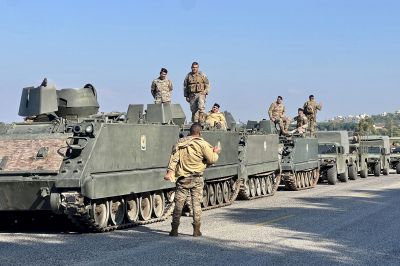
Geagea finally commented on the suicide bombing carried out last Sunday against a church in Damascus, which a little-known Sunni extremist group claimed responsibility for on Tuesday. He stated that he “does not fear a return of the Islamic State posing a threat to the security of Syria and the region.”