





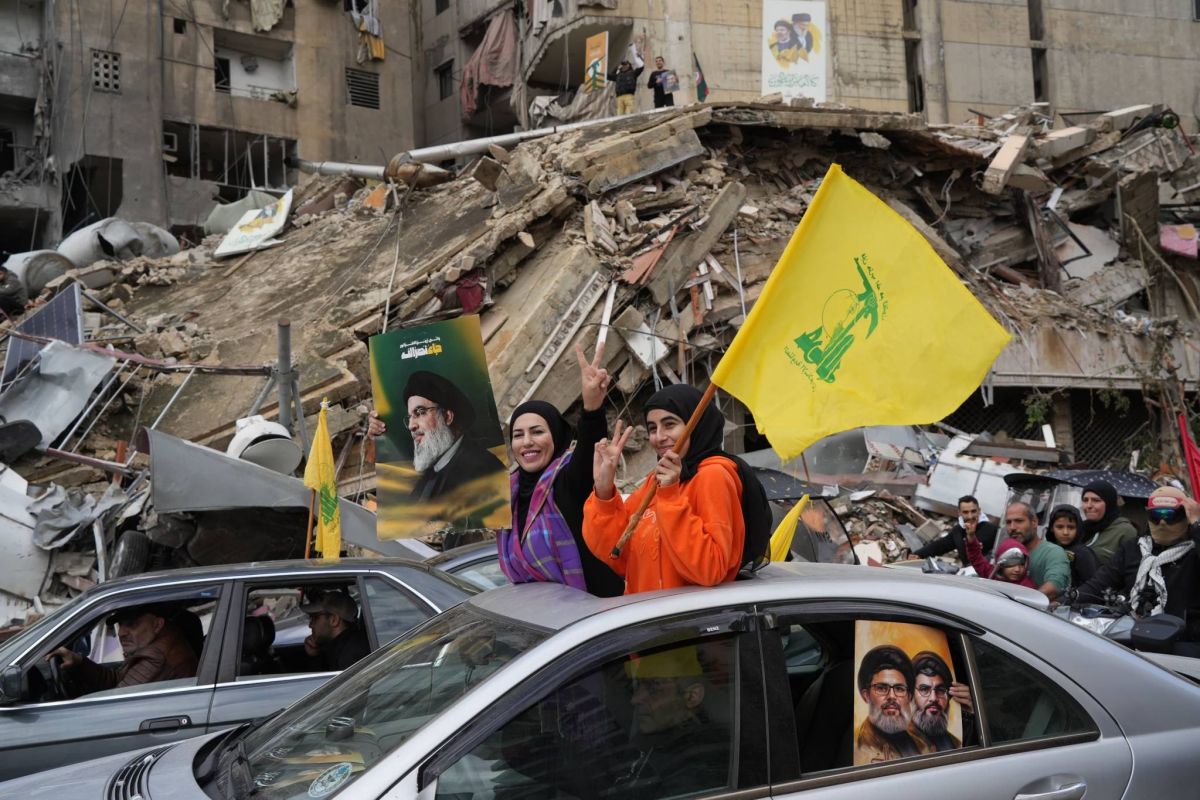
Women displaying a Hezbollah flag and making the victory sign on Nov. 27, 2024, in the southern suburbs of Beirut, on the first day of the cease-fire with Israel. (Credit: Mohammad Yassin/L'Orient-Le Jour archives)






A letter written by Hamas leaders Mohammad Deif, Yahya Sinwar and Marwan Issa (all three killed by the Israeli army), addressed to Hassan Nasrallah, head of Hezbollah assassinated in September 2024 by Israel, and to the commander of the Palestinian corps within the Al-Quds Force of the Islamic Revolutionary Guard Corps (IRGC) Saeed Izadi (also killed by Israel during the last war against Iran), was discovered by Israeli intelligence following the assassination of Mohammad Sinwar on May 13 in an Israeli strike on the Gaza Strip, reported the Jerusalem Post on Tuesday.
According to the Israeli site, this document, found in a bunker used by Hamas leaders, reveals that Hezbollah was not aware of the Oct. 7 attack carried out by Hamas, without saying whether Iran was aware or not. To date, several unofficial versions have circulated about Operation Al-Aqsa Flood, with some claiming that the party and Iran were aware of the attack before its launch.
According to others, Hezbollah and Tehran even took an active part in its preparation.
'Hesitation could lead to resistance axis collapse'
According to the letter mentioned by the Jerusalem Post, which was allegedly sent the morning of the attack, Hamas leaders apologized "profusely to Hassan Nasrallah for not informing him in advance, begging him to join the war effort." Hamas urges Nasrallah to intervene, citing "a moral duty to defend al-Aqsa and respond to the call of the martyrs of Gaza, Syria and Lebanon." The Palestinian movement reportedly concluded its letter with a warning: "Hesitation could lead to the collapse of the 'Axis of resistance.'"
The Jerusalem Post specifies that the letter described in detail the planned offensive and how Hamas envisioned Hezbollah's participation in its "campaign to destroy Israel." "When you read these words, thousands of jihad fighters from the al-Qassam Brigades will attack targets of the criminal Zionist occupation, bomb enemy outposts, population centers, airports and crossroads in the southern region of occupied Palestine. They will cross the separation barrier to confront and fight occupation forces and seize military and civilian positions in the region, capturing a large number of enemy soldiers."
According to the quoted words, Hamas believed this offensive would mark a decisive turning point, even envisioning the fall of Israel and the emergence of a new order in the region.
Last March, investigations conducted by Israeli intelligence services based on documents seized by the Israeli army in Gaza during its ground offensive on the enclave from October 2023 revealed that Hamas had sought financial support from Iran and Hezbollah and had discussed the possibility of a joint military attack aimed at "destroying" Israel.
A few hours after the beginning of Hamas's attack on Oct. 7, 2023, the Israeli army launched its offensive against Gaza. The war, which has claimed more than 55,000 Palestinian lives according to official figures, continues to this day, as Hamas has suffered heavy losses.
Hezbollah, in turn, launched its first attack from Lebanon against Israel on Oct. 8, following Operation Al-Aqsa Flood, stating it was opening a "support front" with Hamas.
The conflict between Lebanon and Israel then turned into open war from September to November 2024, during which Hezbollah's leader, Hassan Nasrallah, and the party's military command were assassinated.
Significantly weakened by the war, the group accepted a cease-fire between Lebanon and Israel on Nov. 27, 2024.
On June 13, Israel launched a series of bombings and assassinations against Iran, sparking a 12-day war during which Tehran retaliated by firing hundreds of ballistic missiles at Israel. Hezbollah did not intervene.

 Evening recap: Netanyahu announces West Bank offensive; 7 killed in Jordan church shooting; tents burned in south Lebanon