


U.S. Secretary of Defense Pete Hegseth and Chairman of the Joint Chiefs of Staff, Air Force General Dan Caine, holding their briefing at the Pentagon, in Arlington, Virginia, on June 22, 2025. (Credit: Reuters)






"An incredible and overwhelming success," U.S. Defense Secretary Pete Hegseth stated during a press conference at the Pentagon after the unprecedented American strikes on Iran, in the early hours of June 22.
These attacks targeted three nuclear sites: the Fordow facility, buried between 80 and 110 meters under a mountain, a larger enrichment plant at Natanz that Israel struck a few days ago, and a third site near the ancient city of Esfahan. He stated that the Iranian nuclear program had been "devastated" and Tehran's nuclear ambitions had been "annihilated."
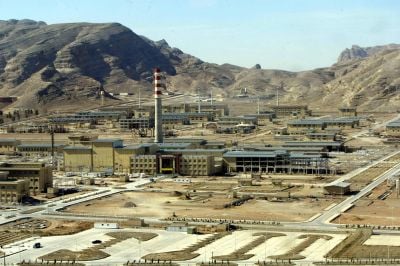
Hegseth said that the "Midnight Hammer" operation did not target military sites or the Iranian population, while the Iranian Red Crescent claimed that the American strikes on nuclear sites did not cause any casualties. The U.S. Defense Secretary also stated that Donald Trump seeks peace and that Iran should follow this path. "When the president speaks, the world should listen," he added.
According to him, the plan for these strikes required "months of preparation, in order to be ready whenever the president gave the order."
The three targets of the Iranian nuclear infrastructure were struck on Saturday "between 6:40 p.m. and 7:05 p.m.," or about 2:10 a.m. Sunday morning, Iranian time, explained General Dan Caine, Chief of the Joint Chiefs of Staff, who detailed to the press the modalities of this American attack. The operation required the dropping of 14 massive ordinance penetrators, also called GBU-57 bombs, on Iranian targets at 2:10 a.m. local time, followed by Tomahawk missiles, the last to hit, according to General Dan Cain. Seven stealth B-2 bombers were used for these strikes, making it the operation involving the highest number of these planes in the country's history, after Sept. 11, 2001.
In total, some 75 precision weapons were used by U.S. forces, along with 125 military planes. "No other army in the world could have done this," he said. General Cain specified that the United States was not aware of any Iranian gunfire targeting American warplanes as they entered Iranian airspace. The U.S. military remains on high alert, he added, estimating that retaliatory strikes would be "a poor choice" for Tehran.

Recapping the strikes, General Caine said that at midnight Saturday, several B-2s took off from their base in the United States, heading in different directions. "According to the plan to maintain tactical surprise, part of the group turned west and towards the Pacific for diversion," he said.
At the same time, the main strike group, comprising seven B-2 Spirit bombers, each with two crew members, discreetly headed east with minimal communications. Throughout the 18-hour flight to the target area, the planes conducted multiple in-flight refuelings, he explained. A maneuver "known only to a very small number of planners and key leaders here in Washington and in Tampa," Central Command headquarters, responsible for the Middle East, added the general. The United States also utilized an American submarine in the central command's area of responsibility, which launched more than two dozen Tomahawk land-attack cruise missiles at key surface infrastructure targets in Esfahan.
"The final damage assessment will take some time to analyze, but initial assessments indicate that the three sites suffered extremely severe damage and destruction," detailed the U.S. Joint Chiefs of Staff.
The attack involved "multiple flights of fourth and fifth-generation fighter jets, dozens and dozens of refueling planes, a guided-missile submarine, and a full range of intelligence, surveillance, and reconnaissance aircraft," explained General Caine. "The Tomahawk missiles were the last to hit Esfahan, to maintain the element of surprise throughout the operation," describing a meticulously planned choreography in utmost secrecy.
During the briefing, Hegseth, commenting on the Iranian response, acknowledged that "anything can happen in times of conflict," but specified that the scope of the operation was deliberately limited. He added that he could only confirm the existence of messages, both public and private, sent directly to the Iranians.
No link with regime change
The U.S. Defense Secretary said that the mission was not linked to a regime change in Iran. The same was echoed by U.S. Vice President J.D. Vance during an interview with NBC. Washington is "not at war with Iran, but against its nuclear program," he stated, assuring that the Iranian nuclear program had been destroyed or set back for a very long period.
Israel threatened to assassinate Iranian Supreme Leader Ali Khamenei, but Donald Trump vetoed.
Vance also stated that the Iranian ballistic program had turned out to be a failure. He added that the United States received certain indirect messages from Tehran. According to him, Trump did not take the decision to strike Iran "lightly," but that it offered an opportunity to reset relations and discussions with that country. The "final decision" regarding the strikes in Iran was made just before their execution, adding that the United States is ready in case of retaliation, he said.
"We want to discuss a long-term settlement with Iran," he added, emphasizing that the United States had no interest in deploying ground troops, as Trump had previously stated.
Vance added that he did not fear this would become "a long-standing conflict," that American intelligence had motivated the United States' action against Iran, and that it was false to say that the actions of the White House chief exceeded his presidential powers.
"We will now work to definitively dismantle the Iranian nuclear program over the coming years," he stated.
This article was originally published in French in L'Orient-Le Jour.
 The 7 p.m. recap: Houthis advance, government announces counteroffensive; Iran raises stakes; Israeli shells hit close to journalists in south Lebanon
 2 Israeli soldiers injured in 'operational accident,' as army continues attacks in the South