





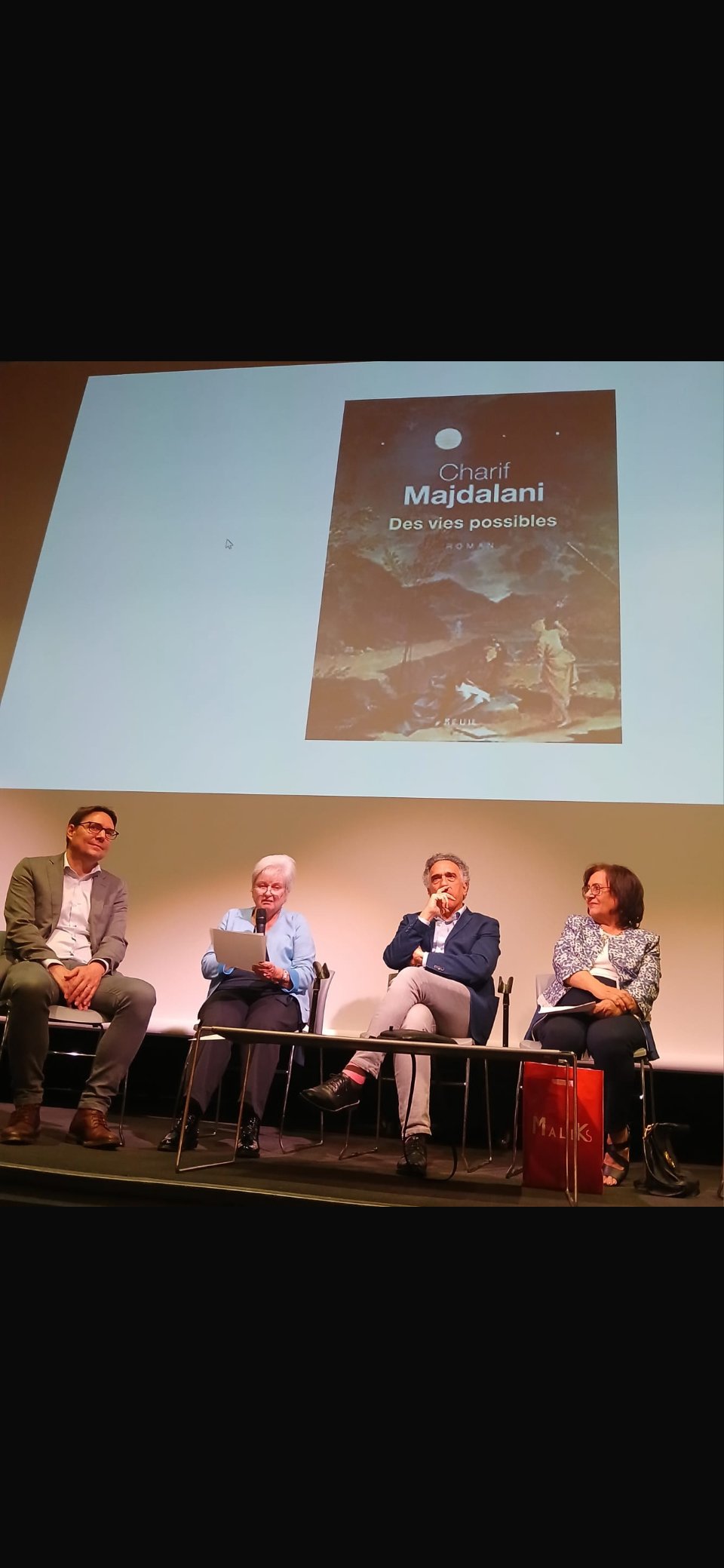
In a festive and relaxed atmosphere, students from different institutions have reinterpreted, in their own way, novels by Charif Majdalani.






In a festive and relaxed atmosphere, about 30 students from seven institutions — Lebanese University (Sections 1 and 5), the Islamic University, al-Massar International College, Greenfield College, Riad al-Solh Public High School, the Franco-Lebanese High School in Habboush, and Saint-Cœurs Ain Ebel — spent two hours reinterpreting two novels by Charif Majdalani: Beyrouth 2020, journal d’un effondrement et Villa des femmes (Beirut 2020, Diary of a Collapse and Villa of Women).
“The goals of this meeting were to encourage learners to read works of current French and Francophone literature, to discover Lebanese Francophone authors, to establish a dialogue between the writer and young Lebanese and to distinguish the narrative techniques used in the works they read,” explained Ilham Slim-Hoteit, secretary-general of the Lebanese Association of French Teachers (ALEF).
Using various creative approaches, students were invited to choose between several activities: writing a theatrical adaptation of selected passages, imagining an alternative ending to the plot, composing a back-cover blurb, translating into Arabic a passage that resonated with them, illustrating the title or specific excerpts from the novels or writing a song inspired by a scene from one of the two books.
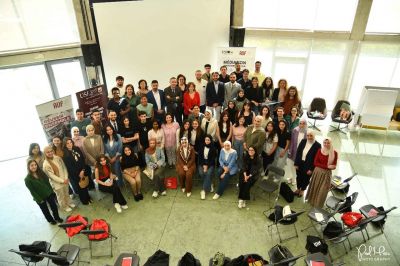
“The activities proposed in the project description sparked the strong interest of young readers, given the number of productions we received and which pleasantly surprised us,” said Sophie Nicolaïdès-Salloum, president of ALEF, in her opening speech. “This proves that motivation is certainly a source of creation, but above all, it arises from the desire of these young people to create, to express through words, images, music, everything they feel while reading a novel that touches them and awakens painful memories in them,” she added, thanking the teachers who guided the students, as well as the French Embassy and the French Cultural Institute for their moral and financial support, which made the event possible.
In his opening speech, Charif Majdalani spontaneously described the role of literature, which “allows not only to understand the world through the characters of novels but also to understand oneself, to project oneself and understand one's relationship with others and social ties with this world, through the experiences of literary writers.”
“But what is especially extremely important is teaching students to read contemporary literature today, like the novel Beirut 2020, which evokes the period of Aug. 4 that all the young people had to live through, allowing them to understand their feelings in the face of this disaster.”
It is therefore essential to encourage young people — in this case, students — to turn to literature, because it inspires them to become creators, to express themselves and, above all, to reflect and gain perspective.
Reinventing literature
Before an audience made up primarily of students, pupils and teachers from the participating institutions — along with members of ALEF’s central office, Ludovic Zmitrowicz, the French cooperation attaché at the French Embassy, and author Majdalani — the students took turns presenting their projects, grouped by school, as chosen by their teachers.
Some students translated one or more paragraphs from the two novels into Arabic, aiming to do so “in the style of Charif Majdalani.” Others reimagined the storyline, like one student who composed a poem titled "Debout Malgré Tout" (Standing Despite Everything), expressing her personal pain following the Aug. 4 Beirut Port explosion. Some chose to write a new back-cover blurb for the novels, while others composed songs to illustrate a passage or staged theatrical adaptations of selected scenes.
One student painted a piece titled "Cendres Vivantes" (Living Ashes), depicting a mother holding her infant, to symbolize that even in the darkest moments, life continues and hope can be reborn. A student from the Franco-Lebanese High School in Habboush played Li Beirut on the piano — a song by Fairuz that resonated widely after the Aug. 4 explosion.
Six students from the Saint-Cœurs Ain Ebel College used artificial intelligence to create “Le musée de Charif Majdalani” (The Museum of Charif Majdalani) a virtual space where visitors could explore the author’s complete body of work. Others developed a science-fiction story that highlighted the importance of technology and AI during crises, imagining flying robots that sprayed water to extinguish the fires triggered by the Aug. 4 blast.
As for the students from the two participating universities — Lebanese University (Sections 1 and 5) and the Islamic University — some expressed their emotions about the tragedy of Aug. 4 through theatrical adaptations inspired by Majdalani’s novels. Others staged a bilingual dialogue, alternating between French and Arabic, to recount the horrors of the 2024 war with Israel, the suffering of a forgotten people in southern Lebanon and the anguish of its residents haunted by the memory of those who were killed. It was a two-voiced cry that powerfully conveyed the anger and confusion of youth grappling with a world they struggle to understand.
What is literature for?
During a question-and-answer session moderated by Lama Arnaout-Tannir, the author discussed the motivations behind writing "Beyrouth 2020," shared his views on the country’s current state, reflected on his relationship with literature, and spoke about the message he hoped to convey through his work.
“In Beyrouth 2020, I wrote an intimate, collective narrative where I had many people speak about their personal experiences because I wanted them to find themselves in the book and find the violence I experienced. Many could not read it due to the desperate state they were in. And when they did read it two years later, they cried. That speaks to the cathartic effect of this novel. And that's the most beautiful thing one can say to me. There is no real message in this narrative, just often bitter observations of the helplessness of a people who have failed to overthrow the mafias that govern them.”
While the event revealed previously hidden talents among the students — as writers, illustrators, singers and performers — it also gave them the opportunity to momentarily escape the burdens of daily life and resist the despair threatening their future in a country to which they remain deeply attached, despite the ongoing crises.
“Expressing oneself in this way is a weapon of struggle and hope that allows them to escape from their daily lives into a dream world,” concluded the president of ALEF.
This article was originally published in French in L'Orient-Le Jour.
In partnership with

 Evening recap: Netanyahu announces West Bank offensive; 7 killed in Jordan church shooting; tents burned in south Lebanon
 US strike on Iran this weekend? ‘Absolutely,’ says Barrack; ‘I have no idea,’ says Trump