






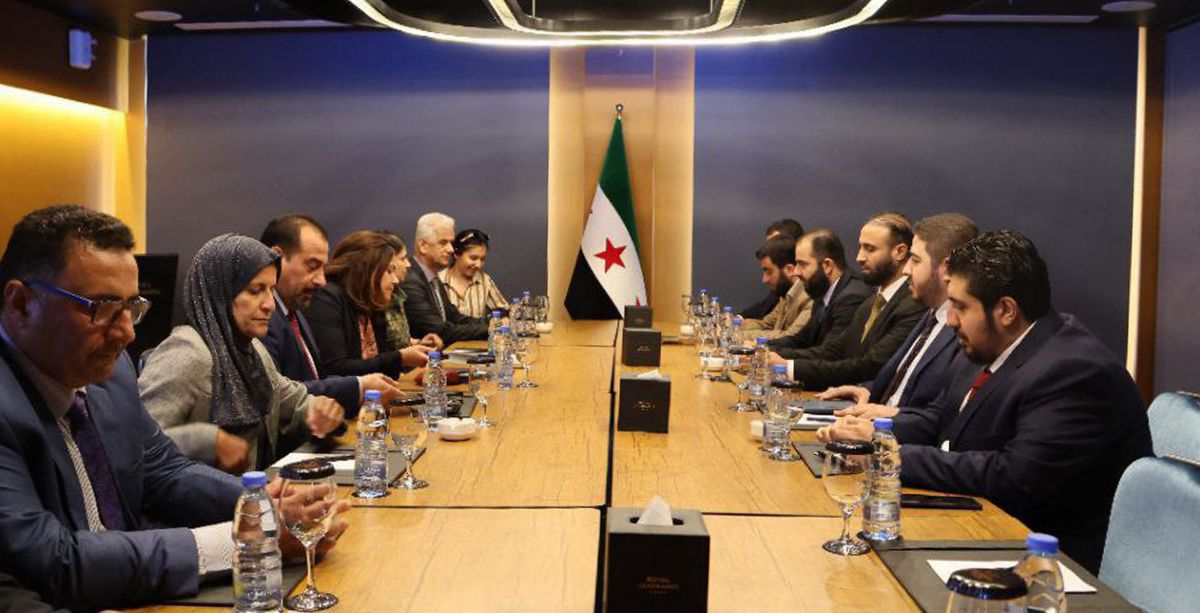
Representatives of the Syrian government and the Kurdish Autonomous Administration of the Northeast met in Damascus on June 1, 2025. Syrian Arab News Agency (SANA)/AFP






The rapprochement is advancing. In recent days, the autonomous administration of Northeast Syria engaged in discussions with Damascus to advance the agreement signed between the two parties on March 10. The objective of the agreement was ultimately to integrate the Kurdish-dominated Syrian Democratic Forces (SDF) into the new Syrian army, led by a government from Ha’yat Tahrir al-Sham (HTS).
On Monday, June 2, the two parties agreed on an exchange of nearly 470 prisoners held in northern Aleppo. This is another measure to establish trust following a first prisoner exchange in early April and the withdrawal of Kurdish forces from Aleppo’s Achrafieh and Sheikh Maqsoud neighborhoods, also in early April. The process is framed and supported by the United States, whose ambassador to Turkey, Thomas Barrack, was recently appointed special envoy for Syria.
After Donald Trump's visit to Saudi Arabia, where he announced on May 13 his intention to lift all U.S. sanctions on Syria before meeting the next day with interim president Ahmad al-Sharaa, Washington's policy toward Damascus has been shifting. Measures to ease sanctions have been taken, joint investments of 7 billion dollars with Qatar announced, and the integration of foreign jihadist fighters into the Syrian army approved, under the condition of transparency. These decisions were unthinkable a few months ago, but the combined influence of Saudi leader Mohammad bin Salman, Turkish leader Recep Tayyip Erdogan, and even Qatari leader Tamim bin Hamad al-Thani has borne fruit.
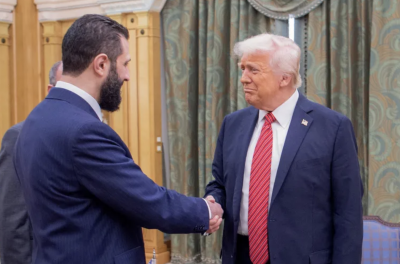
While Washington is allied with Kurdish forces in its fight against the Islamic State (IS) and initially showed mistrust of the new government in Damascus, it is now pushing for the integration of the Kurds into the Syrian state, as desired by Ahmad al-Sharaa.
According to information from the site al-Monitor, Thomas Barrack called the commander of the SDF, Mazloum Abdi, on Thursday during his visit to the Syrian capital, shortly before the meeting originally scheduled between the Kurds and Damascus, which was eventually postponed to Sunday. This was a way to assure him of continued U.S. support in the fight against terrorism as well as to urge him to progress on integration into the new Syrian state and continue de-escalation discussions with Turkey.
Turkey, new pillar of Washington
Washington is considering integrating Ankara into its security structure in Syria and the American president has thus described his Turkish counterpart as a "friend" and a "very intelligent man" whom he praised for having "taken control of Syria."
The U.S. is said to have approved the formation of a joint coordination center to combat IS between Turkey, Jordan and Syria, established in mid-May.
Meanwhile, the new president of Syria has softened his stance on the Kurdish forces along its border — particularly after securing the dissolution of the Kurdistan Workers’ Party (PKK). He has given the green light to an agreement for their integration into the Syrian army, while factions of the Turkish-backed Syrian National Army (SNA) signed a ceasefire with the Syrian Democratic Forces (SDF) in early March.
A meeting between Mazloum Abdi and senior Turkish officials was even proposed after the meeting between SDF representatives and Damascus, depending on the outcome of the latter, reported al-Monitor. While Recep Tayyip Erdogan recently made declarations indicating that he was following the issue of Kurdish forces in Syria "very very closely." Some observers saw this as a sign that the suggested meeting could announce the formal integration of the SDF under the aegis of the Syrian Ministry of Defense.

According to press reports, talks between Damascus and the Kurds have so far focused on recognizing high school diplomas issued by the Autonomous Administration authorities and on establishing a mechanism to facilitate the return of internally displaced persons — without making progress on the integration of armed forces.
Although he stated on Monday his intent to "guide them towards integration into a new Syrian government," U.S. envoy Thomas Barrack reassured the Kurds of continued American support, emphasizing that the SDF remain a key concern for the U.S. Congress. While Washington has begun a gradual military disengagement from Syria, "President Trump made it clear that there would be no withdrawal, but a gradual consolidation," he added.
In recent weeks, 500 American troops — nearly a quarter of the U.S. forces stationed in Syria — have left the country. The Pentagon aims to reduce its presence to fewer than 1,000 soldiers. In line with this plan, the United States has scaled down its number of military bases from eight to five, then to three, with the intention of eventually maintaining only one.
