





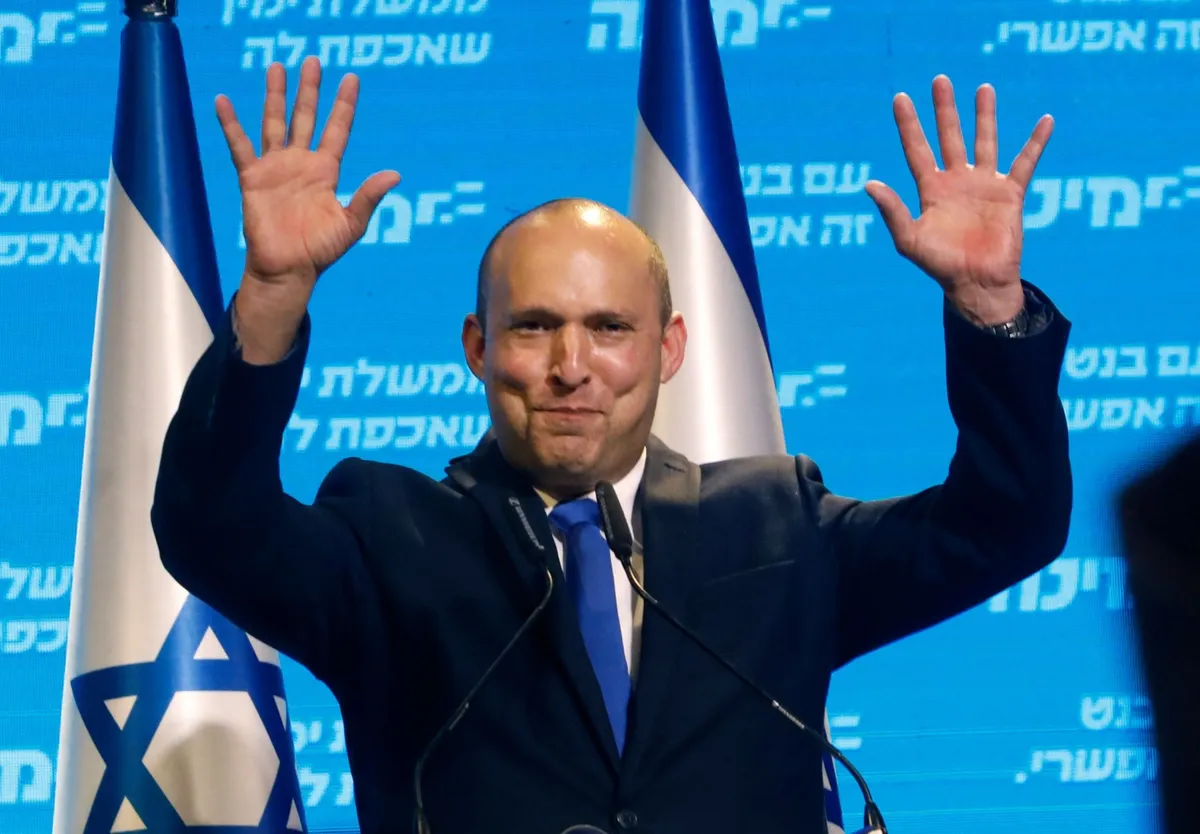
Naftali Bennett, leader of the right-wing Yamina party, speaks to supporters at his campaign headquarters in Tel Aviv on March 24, 2021. (Credit: Gil Cohen-Magen/AFP Archives)






The election campaign has been underway for some time in Israel, with candidates staking out their positions. As the country's most right-wing government has launched a large-scale military operation in the West Bank just months before parliamentary elections, Benjamin Netanyahu's rivals have seized the opportunity to speak out.
His main challenger, former army chief Gadi Eisenkot — whose party is running neck and neck with the prime minister's Likud in the polls — criticized what he called "a total loss of control, difficulties fighting terrorism, and a lack of maintenance of public order in Judea and Samaria," using Israel's term for the occupied West Bank. He also called for "administrative measures to eliminate elements of Jewish terrorism and violence."
Former Prime Minister Naftali Bennett, whose faction has joined forces with that of centrist Yair Lapid under the name "Together," said the army's primary role was to protect Israeli settlers in the West Bank. "There are about 550,000 Israelis living in Judea and Samaria, and they deserve security, period."
Bennett, who once headed a settlement council, instead focused his criticism on the government's refusal to end the mandatory military service exemption for the ultra-Orthodox.
Firmly positioning himself on the right — a strategy that has so far cost his joint slate with the more moderate Lapid some of the latter's support — Bennett has also targeted Qatar, saying he would designate it an "enemy state" if elected. A key mediator in the Gaza war, the gas-rich emirate is viewed by many in Israel as a supporter of Hamas, to which it has long provided funding for Gaza with Netanyahu's approval while he was in office.
"Qatar is a violent, antisemitic cancer that spreads its metastases throughout the West — even into the Israeli prime minister's cabinet — to destroy Israel," Bennett said. Netanyahu has faced allegations of maintaining ambiguous ties with Qatar, particularly in the so-called Qatargate affair, which has fueled political debate in Israel and provided ammunition to his critics.
Doha "has invested for about 25 years in a powerful global influence system that may have caused Israel its greatest harm," Bennett continued, referring to Qatari investments in the U.S. education system and the expansion of the Al Jazeera network. He also said that, while in office, he received intelligence indicating that "Qatar was also funding the Islamic Revolutionary Guard Corps," adding that Netanyahu, who succeeded him, must therefore also have been aware of it.
Qatar responded by accusing Bennett of spreading misinformation for domestic political gain. Ali al-Ansari, press attaché at the Qatari Embassy in Washington, said it was not the first time Bennett had criticized Qatar without providing evidence, and urged Israeli officials to "rather focus on resolving their own national challenges."
"Qatar's role in efforts to support security and stability in the region has been widely recognized by regional and international partners," Ansari said, noting that the Gaza cease-fires and hostage-release agreements brokered by Doha had been carried out in full coordination with many of the same Israeli authorities now criticizing Qatar.

 Evening recap: Netanyahu announces West Bank offensive; 7 killed in Jordan church shooting; tents burned in south Lebanon
 US strike on Iran this weekend? ‘Absolutely,’ says Barrack; ‘I have no idea,’ says Trump