






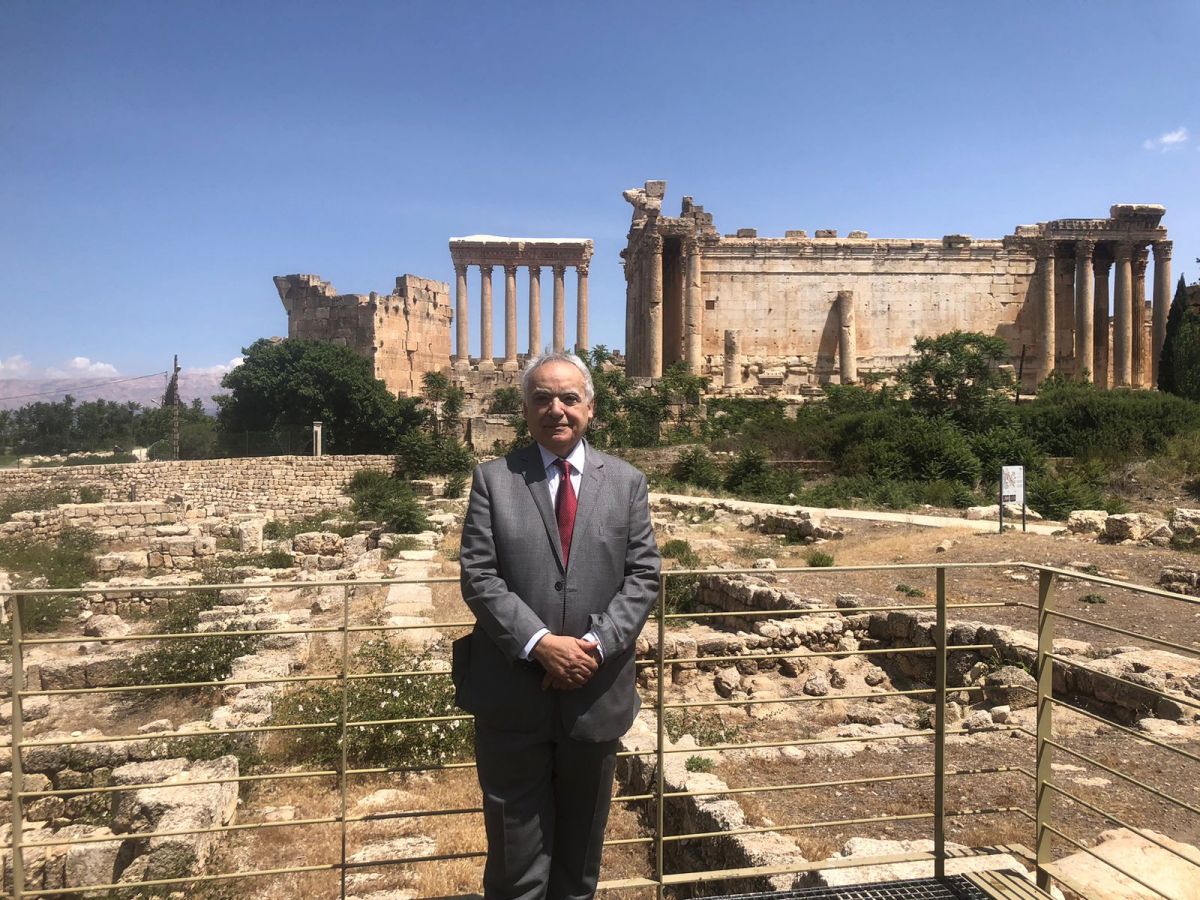
Culture Minister Ghassan Salameh during a visit to Baalbeck on June 3, 2025. (Courtesy of Sarah Abdallah)






BEIRUT — Culture Minister Ghassan Salameh toured the archaeological and cultural sites in the city of Baalbek on Tuesday, including the site of the historic Manshia building that was destroyed in an Israeli airstrike during the recent war between Hezbollah and Israel, according to L'Orient Today's correspondent in the region.
Baalbeck was subjected to Israeli airstrikes during the war, which escalated in September 2024 and ended with a cease-fire two months later. In an extraordinary meeting in November, UNESCO placed 34 cultural sites in Lebanon under "provisional reinforced protection" due to the threat of Israeli bombardments.
Salameh visited three places in his visit so far: the Hajar al-Habla site, the Bustan Nassif site where the minister was briefed on the German excavation mission’s findings and the newly established entrance route to the Baalbek citadel and, finally, the new center of the Directorate of Antiquities, which is still under renovation with a donation from the "Alef" organization and implemented by the Lebanese Organization for Studies and Training.
"The first objective of my visit is to check on the state of the monuments and their surroundings after the Israeli aggression on them and to inspect the damage caused in this city that is dear to the hearts of all Lebanese," Salameh said.
Regarding the historic Manshia building, which was destroyed by Israeli bombings, Salameh said, "The first part of the restoration is currently being done by the owners of the land and, for the second phase, we will try to find the necessary money to rebuild it as it was in the past."
"The second objective is related to a project that I undertook when I first took over this ministry [between 2000 and 2003], which is the large national loan project that we obtained from the World Bank. It is a cultural heritage project in which Baalbek had an excellent share. I also came to see what was implemented from the project set by the World Bank at the time, what was not implemented, and what was not completed," he added.
He explained that the "whole concept of the cultural loan was based on benefiting the residents of five cities – Baalbek, Tripoli, Jbeil, Saida and Sour – economically from the presence of important antiquities in the heart of their cities."
"We must adhere to this concept today more than ever before, given the economic hardship that the country is going through," he stated.
"The third objective of the visit is to get acquainted with and begin coordination with the new municipal council in Baalbek, which I congratulate on its election. We will work with the municipality on what we have completed from the cultural project, and many things, including the restoration of the Manshiya building ... and ensuring this summer is vibrant in Baalbek and other archaeological cities in Lebanon."
Lebanon held municipal elections in May for the first time since 2016 after three postponements since 2022. In Baalbeck, voting took place on May 18, in parallel with the Beirut elections.
In response to a question about the classification of Baalbeck as a tourist city, Salameh said that there are no tourist or non-tourist cities, adding that Baalbeck had an “important” share of the cultural heritage loan, and that it will also have a weighty share if new funding is obtained.
