






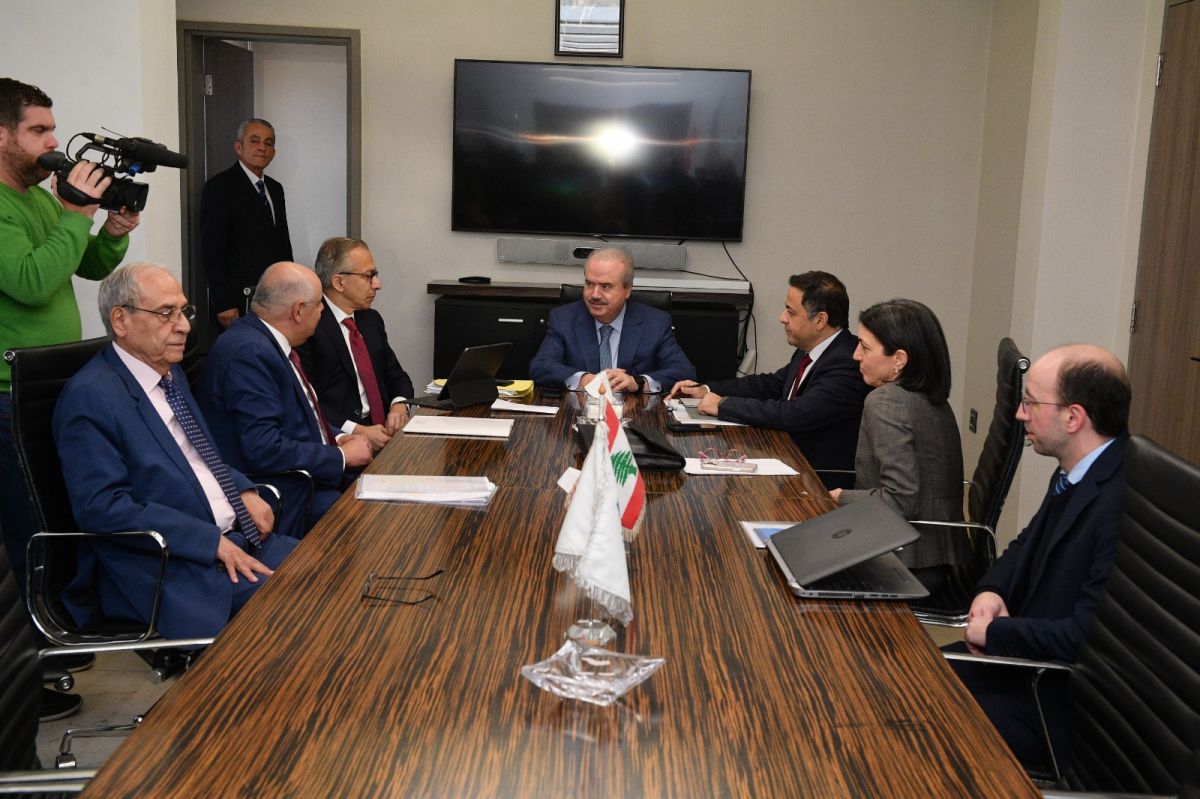
The Minister of Finance, Yassine Jaber (center), during a meeting in March with the committee responsible for negotiations with the International Monetary Fund. (Credit: Finance Ministry.)






BEIRUT — Discussions with the International Monetary Fund (IMF) continued on Monday at the Finance Ministry, following meetings that began last week on the budget framework that should define, in the medium term, future financial policies in the country.
"We have reviewed the preliminary data compiled by the IMF delegation during its meetings with administrations and institutions involved in financial and economic affairs. This data shows that solutions are possible, especially since the Lebanese state is continuing its reform measures," the statement said.
"These negotiations aim to establish a realistic and flexible medium-term financial framework that takes current economic challenges into account, improves transparency and financial discipline, strengthens commitment to structural reforms, and implements more effective spending tools, in line with development and social priorities," the statement continued.
More than three years after signing a framework agreement with the IMF, which has since become obsolete, Lebanon officially resumed its negotiations with the institution last Friday to try to obtain a new financial assistance program. The negotiations between the Lebanese government and the IMF team will conclude on June 5. The Lebanese delegation is led by Finance Minister Yassine Jaber and includes Economy and Trade Minister Amer Bisat, Central Bank Governor Karim Souhaid, and several senior officials and advisers. The IMF mission is headed by Ernesto Riga, mission chief, accompanied by Federico Lima, IMF resident representative in Lebanon, and a technical team.
Minister Jaber met Monday morning with Riga, reviewing the last meeting with the IMF and preparing for the one held the same day.
Jaber also met with a European Union delegation composed of representatives from the European Commission, the European Investment Bank, and the European Investment Fund, in the presence of the director of public finance at the ministry, Georges Maarawi, and advisor Claudine Karaki.
The discussions focused on the progress of joint cooperation in economic reform, infrastructure modernization, and digital transformation. Support for the private sector, stimulating investment, and monitoring reforms related to Lebanon's agreement with the IMF were also discussed.
The head of the parliamentary Finance and Budget Committee, Ibrahim Kanaan, also met with the IMF delegation on Monday, discussing finance and reform laws in preparation as well as the remarks of the IMF and the Central Bank of Lebanon on banking sector reform.
The Lebanese authorities are working to implement measures to pull the country out of an economic crisis it has been plunged into since 2019. Lebanese MPs also approved a draft law in April making amendments to banking secrecy legislation, a measure demanded for years by the IMF.
Between the end of March and mid-April, the Salam government also approved a draft law amending banking secrecy, as well as another law aimed at restructuring the banking sector, which are key reforms on which the financial aid from the monetary institution that Lebanon has requested depends.
