






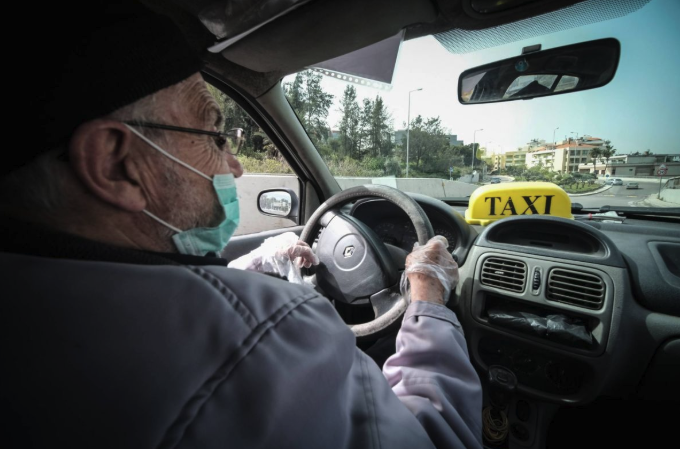
A taxi driver in Lebanon. (Credit: João Sousa/L'Orient Today.)






Civil servants in several regions of Lebanon observed, irregularly, a "warning" strike on Monday, at the call of the General Confederation of Lebanese Workers (CGTL) – the most powerful trade union in the country – and the League of Civil Servants, to protest against the sudden increase in fuel prices decided last week by the government.
In Saida, the call to strike by the League of Public Administration Employees was not widely followed, according to our correspondent in the South. He indicates that work continued normally in several departments, but on the other hand, employees of the Civil State, Finance, Environment, Land Registry, Land, and Public Works services adhered to the union's call by going to their offices while refusing to process citizens' requests.
In Tripoli, civil servants also went on strike. Those who went to their offices refused to receive users. Engineer Ibrahim Nahal, representative of the League of Public Administration Employees, stated that today’s strike is a one-day warning in the offices. All employees respected it seriously by staying at their posts without providing any service to the public or processing any administrative procedures.
The rare exceptions concern only urgent administrative procedures, such as hospital admission or the purchase of chronic medications directly affecting citizens' health and life Nahal further called for an adjustment of the employees' salary scale and a review of retirement pensions and end-of-service indemnities based on the real value of the dollar.
In Hermel, work was also interrupted in all the official administrations of the Serail.
Criticism from Fadlallah
The capping of fuel prices (gasoline, diesel, and fuel for private generators) at rates in effect during the formation of the cabinet in February, aims to finance monthly subsidies granted to active and retired military personnel.
During a sit-in with several unions at Riad al-Solh Square, in front of the Serail, CGTL President Beshara Asmar stated that this protest movement is "symbolic" and aims to "highlight the suffering of workers and civil servants." According to him, this gathering in front of the Grand Serail represents "a first step towards broader mobilization, aiming to annul the government's decision to increase fuel prices," while reaffirming "the right of military personnel and retirees to obtain their legitimate rights."
For his part, Nahal, also a member of the administrative committee of the League of Civil Servants, emphasized from Riad al-Solh Square that the employees "are not asking for the impossible," but for a decent life, a fair salary, and a respectful work environment. "A state that increases taxes and fuel prices to fill its coffers at the expense of the citizen, before giving him crumbs [...] This is not a protective state, but a power that leads to humiliation," added Nahal.
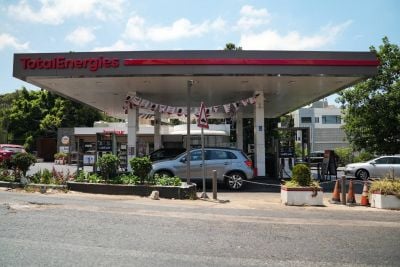
The government's decision regarding fuels has been criticized from all sides since Friday. MP Hassan Fadlallah (Hezbollah) denounced from Parliament on Monday that instead of "solving citizens' problems, the government has imposed a new tax."
Unions have also called for better living conditions for civil servants, after Labor Minister Mohammad Haidar presented a proposal on May 7 to increase the minimum wage by 50% to 28 million Lebanese pounds, the equivalent of $312 at the current exchange rate of 89,500 LL per dollar.
This incomplete proposal was rejected by the CGTL and other unions. CGTL President Asmar had denounced this proposal which, in his view, only sets the minimum wage without change for other levels. He also denounced a minimum wage far too low and had already waved the recourse to the street as a means of pressure. Lebanese workers' wages have collapsed with the sharp depreciation of the Lebanese pound since October 2019. Before the economic crisis, the minimum wage was set at 675,000 LL or $450 at the then-official rate of 1,507.5 LL.
Public transport sit-in
In addition, the public transport drivers' union organized several sit-ins in Beirut on Monday, notably in front of the Interiror Ministry, reports the state-run National News Agency (NNA) to protest against illegal public transport means such as VTCs and tuk-tuks, which take passengers without having obtained the "red license plates," acquired at a high price, to exercise their profession.
The protesters also asked the Telecoms Ministry to interrupt all transport applications that do not comply with the law. They also protested in front of the Tourism Ministry, located near the Interior Ministry, to whom they ask to "sanction agencies and individuals illegally operating in the transport sector, using private cars, foreign drivers, and promoting their services via social networks."
After the sit-in in front of the Interior Ministry, motorized protesters headed towards Martyrs' Square, against a backdrop of patriotic songs and music, partially blocking the road.
From the port heading to Beirut, motorists found themselves stuck in traffic jams due to the sit-in organized by the public transport union, according to local media.