






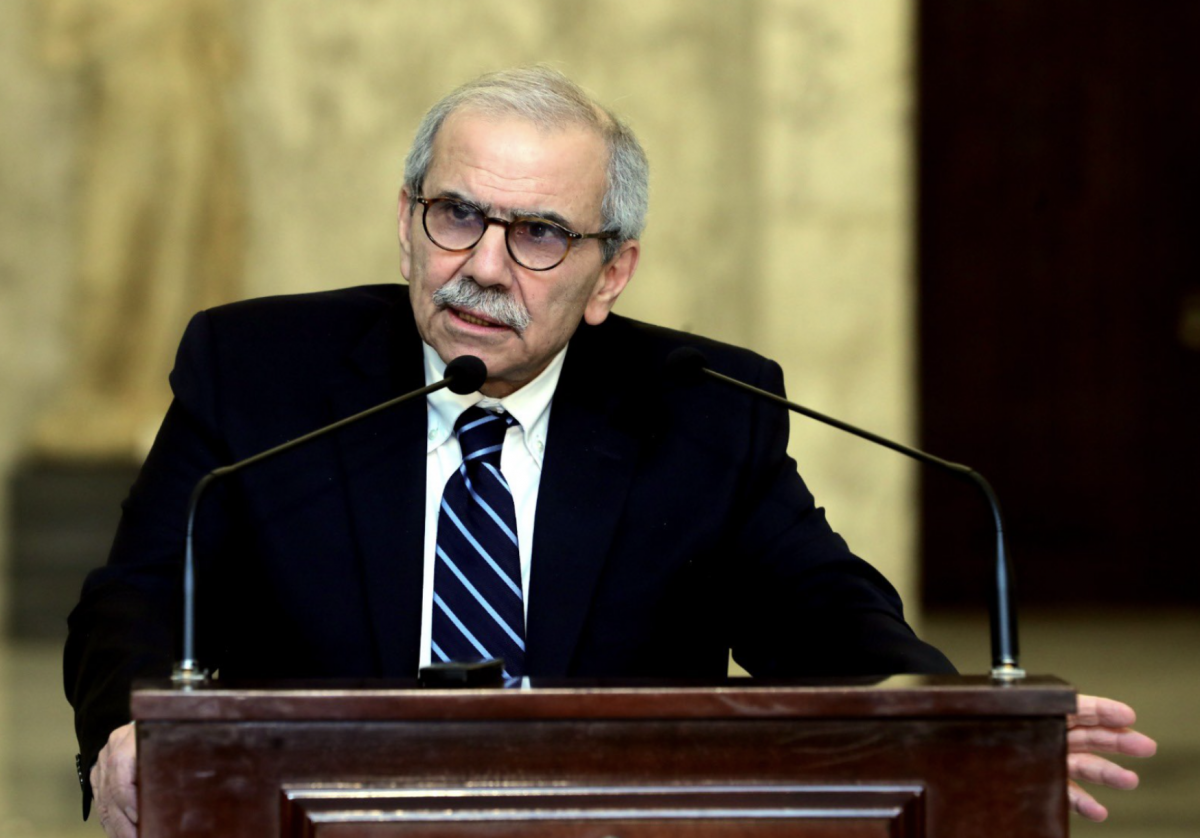
Lebanese Prime Minister Nawaf Salam in Baabda, January 29, 2025. (Credit: X account of the Presidency of the Republic.)






BEIRUT — Lebanese Prime Minister Nawaf Salam once again expressed hope that Arab tourists and investors would return to Lebanon after years of absence, stating that the country was making efforts to give them good reasons to do so.
“Our Arab brothers and our friends in the world had lost confidence in Lebanon. We are working day and night to regain the trust of the Arab world, hoping they will return to us as Lebanon has returned to them,” he said in an interview with Sky News Arabia.
“With the support of our Arab brothers and our international friends, we will be better equipped to succeed,” added the head of the government, emphasizing that “the region has suffered enough from Iranian-U.S. polarization.”
Alongside this interview, Salam stated after a meeting held at the Grand Serail with representatives of the Abu Dhabi Fund for Development that his government was focusing its efforts on “mobilizing the necessary support for reconstruction,” while reaffirming the “clear decision of Lebanon to return to the Arab fold.” He specified that this meeting allowed for a “detailed presentation of his cabinet’s plan in this regard.”
Priority to reforms
The arrival of the Aoun-Salam government in power ended more than two years of presidential vacancy and the continuation of the resigning government of Najib Mikati, amid political tensions and war between Israel, an ally of the United States, and Hezbollah, supported by Iran.
While the fighting ceased after the implementation of an imperfect truce at the end of November, the new power also set as a priority the launch of the anticipated reforms to address the crisis, as well as the restoration of the state’s monopoly on arms, involving the disarmament of militias, starting with Hezbollah and the Palestinian camps.
“We will not remain silent in the face of the presence of any weapon held outside the authority of the state,” assured the head of the government, expressing confidence that “the majority of the Lebanese people support this position.” Hezbollah emerged considerably weakened from the last conflict with Israel triggered on Oct. 8, 2023, following the Gaza war. The truce is based on resolution 1701, which demands its disarmament, although it still resists.
Regarding the Palestinian camps, a mechanism was implemented last Friday to organize their disarmament, which will be done progressively from mid-June. The whole process is based on an agreement between the Lebanese authorities and the Palestinian factions. For Salam, “the danger posed by the weapons in the camps lies in the risk of fueling an inter-Palestinian discord.” He asserted that “Palestine’s strength no longer lies in weapons, but in its international recognition and diplomatic action.”
The head of government also discussed the approach favored by his cabinet, which recently passed the 100-day mark. “My strength lies in restoring the people’s trust in the state. My project is to rebuild the state. What matters to us is the trust of the people, not the satisfaction of close circles. I am aware that there are deeply rooted interests, and we are confronting them,” he declared.
“We are trying to put the country on a new trajectory. I cannot predict where we will arrive, but we are certainly on a new path,” he continued. He stated that “the current government has achieved what no other in ten years has accomplished.”
Referring to the taunts and pro-Hezbollah chants that labeled him a “Zionist” last Friday at Camille Chamoun Sports City, Salam assured that these slogans did not affect him, although he expressed his “sadness over the [Israeli] occupation of parts of Lebanon.” The Israeli army still occupies several positions in southern Lebanon and regularly bombs this region as well as the Bekaa, despite the truce.
