






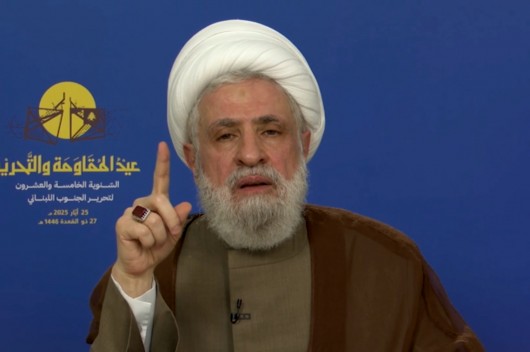
Secretary-General of Hezbollah Naim Qassem during a speech on May 25, 2025. (Screenshot from al-Manar)






Hezbollah Secretary-General Naim Qassem said in a televised speech on Sunday evening that "even the candidates" who opposed the Hezbollah-Amal lists in South Lebanon during the municipal elections "contributed to the success" of the elections, emphasizing the "indestructible strategic alliance" of Hezbollah and the Amal Movement, led by Parliamentary Speaker Nabih Berri.
"We are an integral part of everything positive in Lebanon," Qassem said, stressing that his party was "keen to organize the municipal elections on time to strengthen the state" despite ongoing Israeli strikes on southern Lebanon.
"I salute the people of the South for their pride and determination to be on the front line to liberate the country," he added, stating that "even those who proposed competing lists contributed to the success of these elections."
If Hezbollah and the Amal movement managed to secure uncontested elections for lists they supported in the South, more than 100 out of 272 councils up for election, in some areas, a few independent candidates refused to reach a consensus to organize a vote. In these villages, the alliance maintained its dominance, but with some breakthroughs by competitors. Saturday's voting was mainly marked by low turnout.
However, for Qassem, the ballot "proved that Hezbollah and the Amal Movement are a social bulwark, and their alliance is an indestructible strategic alliance."
'There was no civil war in the liberated areas in 2000'
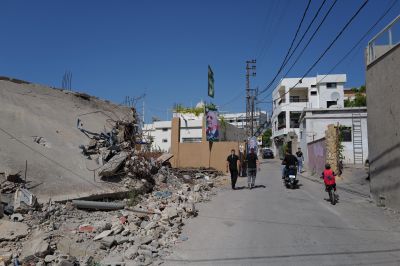
Qassem delivered his address on the occasion of the 25th anniversary of Liberation and Resistance Day, marking the withdrawal of the Israeli army from southern Lebanon in 2000, after 18 years of occupation. An anniversary that takes place this year almost six months after the start of the cease-fire agreement that ended more than a year of deadly warfare between Hezbollah and the Israeli army. Before this truce, Israel launched a violent offensive in late September 2024 on Lebanon and ground operations in the country's south. The cease-fire agreement called for the total withdrawal of Israeli troops from the south, but they continue to occupy five positions on Lebanese territory.
For Qassem, May 25, 2000, marked "a huge triumph" for the Resistance and the Lebanese people. After this date, "no retaliation or revenge took place after the withdrawal," and "there was no civil war or unrest in the liberated areas." He stated that the presence of the U.N. peacekeeping forces in Lebanon (UNIFIL) "could not impose anything" to prevent Israeli violations.
Hezbollah remains committed to the 'people, army, resistance'
The Hezbollah leader praised the statement by the army's commander, Rodolphe Haykal, who in his agenda for the army on the occasion of May 25 commemorations, stated on Friday that "continuous Israeli violations" of the cease-fire hindered the mission of redeploying the army south of the Litani, another condition of the cease-fire agreement. The Lebanese Army must deploy in this area and dismantle Hezbollah's infrastructure there, a mission almost complete, according to authorities, UNIFIL and the army. Haykal's statement "reflects his patriotism and that of the army," said Qassem, who stated that the party remains committed to the "people, army, resistance."
He affirmed that his party has "fully respected the indirect cease-fire agreement between the Lebanese state and the enemy," which stipulated that there should be no presence of its fighters south of the Litani, but that, on the other hand, Israel committed "3,300 violations" of the truce. He blamed these violations on the United States, while the Israeli army continues to strike almost daily in southern Lebanon and has killed more than 160 people since late November.
"If the United States thinks that by applying pressure, they can impose Israeli conditions, I say these conditions will never materialize, whatever the price," he stressed, while U.S. envoy Morgan Ortagus recently stated that Lebanon should follow the example of the Syrian authorities in their willingness to de-escalate tensions with Israel.
Security Council and Cabinet
Faced with the situation in the south, "the voice must be raised at the Security Council, the Cabinet must make itself heard, and every official must do what needs to be done," he said. However, according to him, if the state failed, "other options exist."
He called on the Lebanese government to "act quickly" for reconstruction, which is "the foundation of stability."
"Nobody will blackmail us in the name of stability or reconstruction," he stated, while the U.S. links reconstruction funding to the disarmament of the party. "Let it be clear to all: Don't ask us for anything. Let Israel withdraw [from Lebanese territory], stop its attacks, release the prisoners, and respect its commitments, and then we can talk."
Stating that the war "is not over," he argued that "no one can uproot Lebanon, nor remove the Resistance from Lebanese territory because the blood of its martyrs is entwined with the country's identity."
This article was originally published in French in L'Orient-Le Jour.
