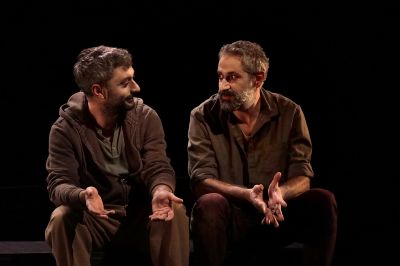
Roy Dib and Rodrigue Sleiman in "Ghasaq" by Chrystele Khodr. (Credit: Marie Clauzade)






With "Ghasaq" ("Ordeal"), a play she wrote and directed, Chrystele Khodr delves into the depths of a generation indelibly scarred by the 1980s: one that was born, grew up and attempted to build a life in the shadow of the Lebanese Civil War. A war officially ended, a peace signed on paper, militia leaders turned into politicians with ties, but an umbilical cord—that which should have been cut at birth—remained suspended, distilling its poison into bodies and minds: divisions, mourning, violence, virility... so many sequels this generation thought it had left behind.
Khodr, however, traces this tense wire. Not to indulge in adolescent nostalgia or act as a historian, but to understand a fragmented, anxious, crushed present that nevertheless attempts to resist corruption, occupation and patriarchy. “Everything pushes us to give up, to die,” said actor Tarek Yaacoub on stage. But they survived. Did they truly survive? “Can we say we are alive?” asked Elie Najem in a suspended moment: A question that resurfaces with each explosion, each miniature war, each rumble.
On stage, four actors—Rodrigue Sleiman, Elie Najem, Roy Dib and Tarek Yaacoub—play their own roles, in the dimness of a minimalist set designed by Nadim Deaibes. It is not the darkness of the tomb, but that of twilight: a truth struggling to be spoken, an undigested past. The war is over, but it still seeps into gestures, silences and bodies.
In the beginning, the acting seems slowed, almost emptied. Then, in a dramatic rise drawn from Henrik Ibsen’s "The Pretenders"—a play about the Norwegian civil war—the actors don the garb of kings and traitors, dominant and dissident. The theater becomes a symbolic battlefield where obsessions with power, virility and conquest are replayed. Just like Lebanon, forced into austerity under the guise of reconstruction, the stage is sober, stripped bare, tense.

“I needed a moment of silence to think, to grieve, to confront without clash or uproar,” confided Khodr. Here, silence is not hollow: It is resistance. And Ibsen’s words, reread in light of Lebanese history, resonate powerfully. King Håkon, mandated by God to rule on behalf of the people, faces Skule, a manipulative warlord who invokes religion to divide. A troubling transposition for a country like Lebanon, fractured by sectarian ambitions.
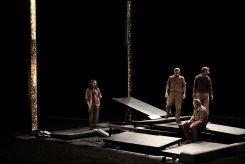
But "Ghasaq" does not only recount the war: The play questions its aftermath. What remains of a man shaped by violence? How does he redefine himself in a country without justice, facing the ruins of his illusions? Through these four male figures, Khodr outlines a counter-model: fragile, lucid, open men, capable of love, of crying, of questioning the masculine doctrines instilled in their homes or schools.
It is these men that "Ghasaq" shows: artists haunted by the legacy of arms, but standing, eager to break free from repetitive patterns. They do not dominate, do not speak louder than others. They listen. They doubt. They sometimes collapse. And it is in this naked humanity that the theater becomes a space for healing.
Khodr, winner of the 2019 Ibsen scholarship—which rewards critical projects inspired by the work of the Norwegian playwright—has not made her first dive into the traumas of the 1980s. Since "Laalla wa aasa," "A Provisional Title" or "Bayt Byout," she has been weaving a theater of memory, nourished by stories, investigations, popular songs, Mexican soap operas or cartoons that form the emotional subtext of a generation.
In "Ghasaq," the audience sings with the actors the themes of "Belle and Sebastian" or "You Are My Destiny." A simple, almost childish gesture, but one that weaves a collective emotional web.
The action begins on Sept. 1, 2020, the centenary of Greater Lebanon, as Emmanuel Macron lands in Beirut, a month after the port explosion. It ends with the words of General Gouraud, who came 100 years earlier to seal the sectarian foundations of the Lebanese state. A loop that, a century later, remains unbroken.
Khodr continues to take it on. Barehanded, with theater as her only weapon.
This article was translated from L'Orient-Le Jour.