






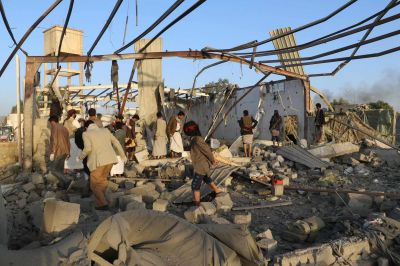
Firefighters are responding to a massive fire that broke out in a cement factory in Yemen on May 5, 2025, after the Israeli army announced that it had carried out airstrikes against the port of Hodeidah and its surroundings. (Credit: Reuters/al-Massira TV.)






Israel conducted airstrikes in Yemen for the second consecutive day on Tuesday, targeting Sanaa and its Houthi-controlled airport, two days after a missile strike by these rebels on Israel's main international airport.
The rebel channel Al-Massirah reported Israeli strikes on Yemen's capital city's international airport, amid a war the country has faced since 2014. According to them, three power stations in the capital and its surroundings, as well as a cement factory in Amran (north), were also targeted.
AFP correspondents in Sanaa heard several strikes and saw smoke rising from various parts of the city. It was not immediately known if there were any casualties. Israel claimed to have targeted the airport and power stations in the Sanaa region.
The rebel channel accused, as on the prior day, the United States of participating in the strikes, but Washington denied any involvement on Monday.
Just before the new raids, the Arabic-speaking Israeli army spokesperson, Avichay Adraee, in a message on X, called for an “immediate evacuation of the surroundings of the airport” in Sanaa. “Anyone nearby must move away from the area. Failure to evacuate could endanger you,” he stated.
On Monday, Israeli strikes on Houthi-controlled regions in the west of the country resulted in four deaths, according to the Houthi Health Ministry.
Israel announced it had targeted Houthi infrastructure for the fifth time since July 2024, “in response to repeated attacks by the Houthi terrorist regime against the State of Israel.”
The infrastructure targeted at the port of Hodeida (west), using missiles and drones, was used for the “transfer of Iranian arms and military equipment,” according to Israeli authorities.
‘Many booms’
Iran, Israel's sworn enemy, supports the Houthis who control a large part of Yemen but denies providing them with military assistance. Claiming to act in solidarity with the Palestinians, the Houthis have claimed dozens of missile and drone attacks against Israel, located more than 1,800 kilometers from Yemen, since the beginning of the war between Israel and Hamas in Gaza. Nearly all of the strikes have been intercepted.
But on Sunday, a missile fired by the Houthis struck directly for the first time, according to the Israeli army, within the perimeter of Ben Gurion airport, near Tel Aviv. Israeli Prime Minister Benjamin Netanyahu promised a strong response with “many booms.”
The Yemeni rebels claimed a “hypersonic ballistic missile strike on Ben Gurion,” which caused a brief interruption of air traffic and a temporary suspension of international flights.
Since the beginning of the war in Gaza, initiated by an unprecedented Hamas attack, the Houthis have also multiplied attacks against ships they consider linked to Israel off the coast of Yemen.
In recent months, Israel has conducted several strikes against strategic Houthi targets in Yemen, while the United States, Israel's principal ally, has intensified its attacks against the rebels since Donald Trump's return to the White House in January.
‘Catastrophe’ Netanyahu blamed Iran for the Houthi attacks and also threatened that country with retaliation.
Iran condemned the Israeli strikes in Yemen and denied aiding the Houthis in the attack on the Israeli airport.
The Iranian foreign minister, Abbas Araghchi, accused Israel of wanting to draw the United States into a “catastrophe” in the Middle East. “The deadly support for Netanyahu’s genocide in Gaza and the war waged on Netanyahu’s behalf in Yemen have brought nothing to the American people,” Araghchi stated on X, warning against “ANY mistake against Iran.”

