


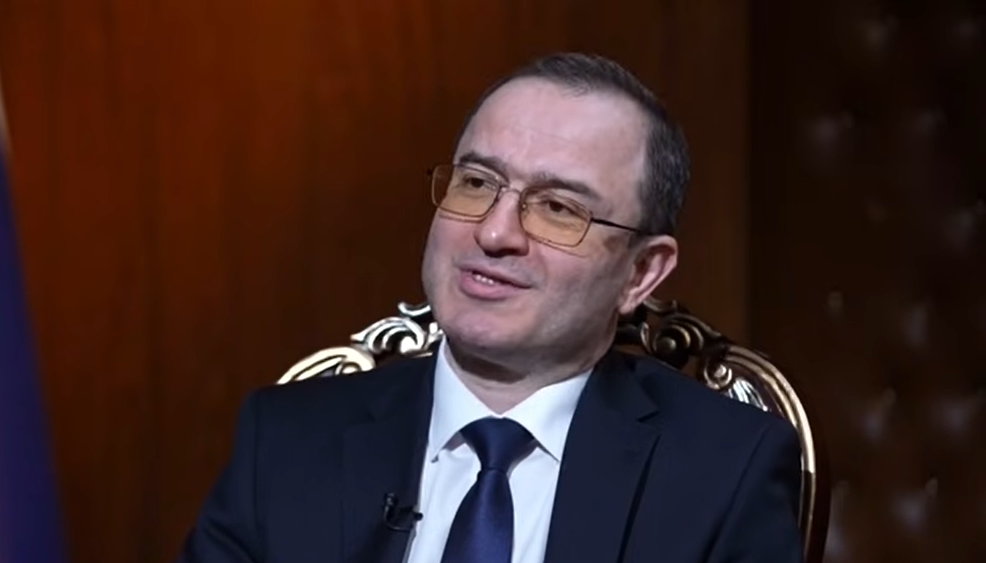
The Russian ambassador to Iraq, Elbrus Kutrashev, during his interview with the Iraqi media outlet al-Sharqiya, broadcast on April 5, 2025. (Credit: Screenshot from Youtube)






Russia will not hand over Bashar al-Assad, who has been in exile since Dec. 8, after being ousted by the rebel coalition that took power in Syria, despite the demands of Syrian interim president Ahmad al-Sharaa since late January for Moscow to hand over the ousted president to Syrian authorities. This assurance was given by Russia's ambassador to Iraq, Elbrus Kutrashev, in an interview with the Iraqi media outlet al-Sharqiya, broadcast over the weekend and available online.
While the interview was primarily focused on topics related to relations between Baghdad and Moscow, the journalist present quickly tried to steer the discussion towards the issue of the former Syrian president. Reluctant to discuss matters outside his area of expertise, Elbrus Kutrashev nonetheless stated that "it is inconceivable for Russia to hand over Bashar al-Assad" as part of any "agreement." "Russia does not participate in such agreements, which are immoral," he added.
The Russian diplomat further explained that the extradition of al-Assad was even more out of the question from Moscow's perspective, as the former Syrian president had not "violated the conditions of his asylum." He clarified that one of these conditions is that the former head of state refrains from any political or media activity, something he has indeed abstained from.

Rumors of Poisoning
Elbrus Kutrashev also rejected claims, attributed by his interlocutor to observers, accusing Russia of "abandoning its allies." He assured that Russian troops in Syria had stopped their airstrikes against the Islamist rebel coalition led by Hay’at Tahrir al-Sham. "The Russians were the last to conduct airstrikes against the rebels. The fall of Bashar al-Assad is not related to a Russian or Iranian decision, but to an internal situation in Syria and the position of the Syrian regime," the diplomat said, stressing that the Syrian army had offered very little resistance in Aleppo, Idlib and the road linking the latter to Damascus.
Responding to the journalist, who had mentioned rumors of a potential poisoning of Bashar al-Assad a month earlier, the ambassador stated that he had no information on the matter and that he would have been "99% sure" to be informed if something like that had occurred. He also dismissed reports that Russia was assisting Maher al-Assad in escaping from Iraq, where he took refuge after the rebel offensive, to Russia.
Bashar al-Assad was overthrown on Dec. 8, 2024, and fled to Russia after a swift offensive launched by the HTS, which captured numerous cities and eventually reached Damascus. The group has since been dissolved, but its fighters form the backbone of the current power structure in Syria. Regarding the situation in the country, the diplomat stated that the personality of Syrian leaders mattered less to Russia than the preservation of the country's unity and the return of its citizens to normal life. He regretted that international discussions, held notably in Aqaba and Riyadh, about Syria's future, excluded Russia, Iran and China, suggesting that this might be due to Western pressures.
Although they have retreated in the face of the rebels' advance to fall back to their bases in Syrian territory, Russian troops are still present in the country. They did not intervene during the massacres of civilians that occurred last March in western Syria, amid clashes between fighters loyal to Assad and the new Syrian security forces.
 2 p.m. recap: Iran says, 'No military solution' to conflict; 2 Israeli soldiers wounded in south Lebanon; Houthis claim attack on Aramco