


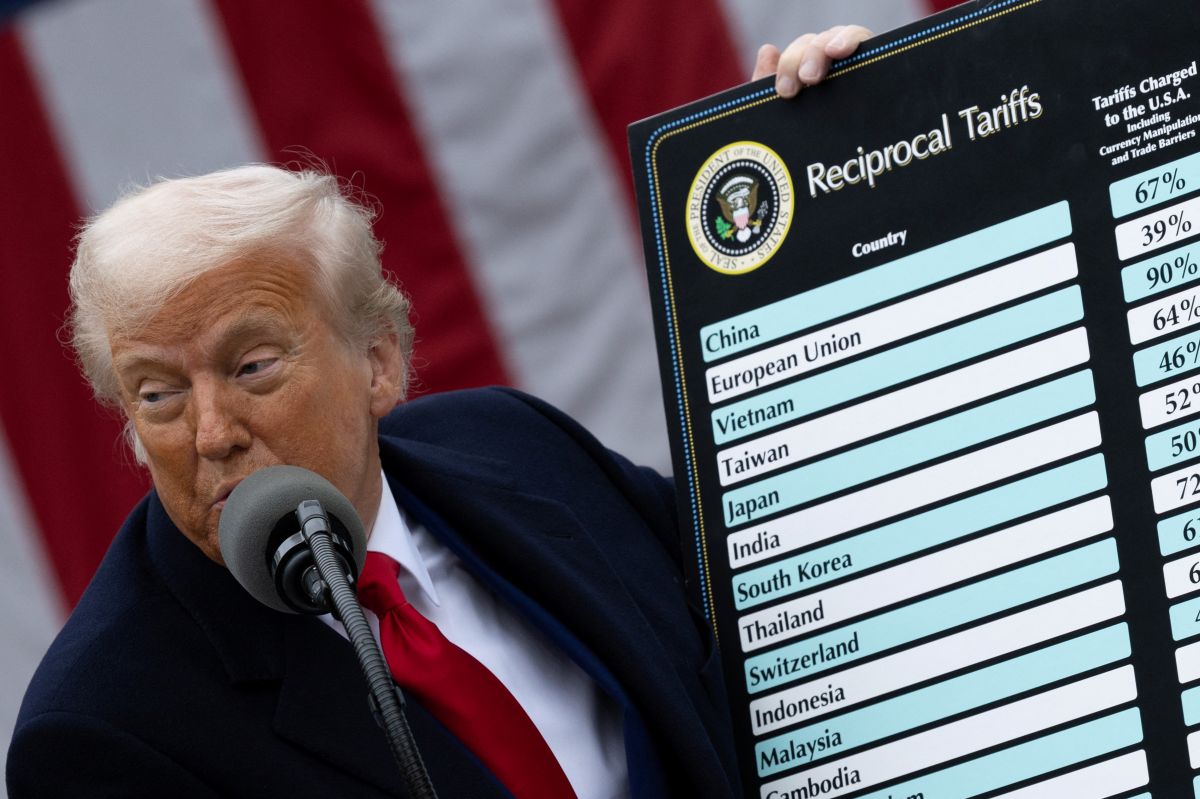
The American president Donald Trump delivers a speech on tariffs in the Rose Garden of the White House in Washington, D.C., United States, on April 2, 2025. (Credit: Carlos Barria/ Reuters.)






Global markets plunged into turmoil on Friday as investors expressed fears about the state of the U.S. economy due to the widespread trade offensive launched by U.S. President Donald Trump, met by China's response. After a chaotic session on Thursday, global markets continued to plummet on Friday following Beijing's announcement of imposing 34% tariffs on all imports of American goods starting April 10 in response to U.S. measures.
On Wall Street, the Dow Jones lost 5.50%, the Nasdaq fell 5.82%, marking a 22% drop since its record in December, and the broader S&P 500 shed 5.97%, its worst trading session since the COVID-19 crisis in 2020. Over two days, more than $6 trillion in market capitalization was wiped out, according to the Dow Jones U.S. Total Stock Market index.
In Europe, the Paris Stock Exchange dropped 4.26%, erasing all its gains for the year shortly after losing more than 5%. Frankfurt and London's markets both fell 4.95%, while Milan dropped 6.53%, marking their steepest declines since the onset of the COVID-19 pandemic in March 2020. The Swiss exchange fell 5.14% and Madrid 5.83%.
"Markets might not be reacting enough, especially if these tariffs prove to be permanent, given the potential impact on global consumption and trade," said Matt Burdett of Thornburg Investment Management. According to Steve Sosnick of Interactive Brokers, "The last times market sentiment changed so dramatically, it was due to exogenous events like COVID-19 and 9/11." "This time, it's strictly the Trump administration's policy," the analyst told AFP.
And "China's retaliatory measures foreshadow the start of an escalation" between the planet's two economic giants, notes Alexandre Baradez, head of market analysis at IG France. It's everything "the market fears."
The return of the recession specter
During a speech on Friday, Jerome Powell, Chairman of the U.S. Federal Reserve, said the "economic consequences" of the tariffs would "probably" be more extensive than anticipated.
Powell cited "higher inflation and slowed growth," as well as an "increased risk to employment." "It is too early to tell what the appropriate monetary policy is," added the Fed chief, implying he did not intend to adjust interest rates in this context, despite calls from Donald Trump, who advocates for a rate cut.
The shockwave triggered by the U.S. tariff announcements has resurrected fears of a possible "recession in the U.S. and on a larger scale," notes Guillaume Chaloin, head of equity management at Delubac AM.
Oil prices, highly sensitive to global consumption changes, were hit hard, reaching their lowest level in four years. The price of Brent crude from the North Sea fell 6.50% to $65.58, while its US equivalent, West Texas Intermediate (WTI), dropped 7.41% to $61.99 a barrel.
In London, Shell fell 7.47% and BP 7.43%. In Paris, TotalEnergies gave up 6.24%. In Milan, Eni lost 4.53%. Across the Atlantic, Exxon Mobil (-7.20%), Chevron (-8.22%), and ConocoPhillips (-9.41%) plummeted.
The sought-after bond market
Amid the trade chaos, investors are flocking to any safe haven that would allow them to create a store of value, primarily the bond market, which offers a yield to investors and is also one of the big winners of the trade war. Sovereign bond yields eased significantly, indicating strong investor appetite.
The yield on 10-year US Treasury notes was 3.99% around 21:10 GMT, down from 4.03% at Thursday's close. The German equivalent moved from 2.65% to 2.57%, while the French yield decreased from 3.37% to 3.33%.

 7 p.m. recap: 1 person killed near border with Lebanon; 200 kilos of explosives carried by mules; Riyadh shuts its airspace