






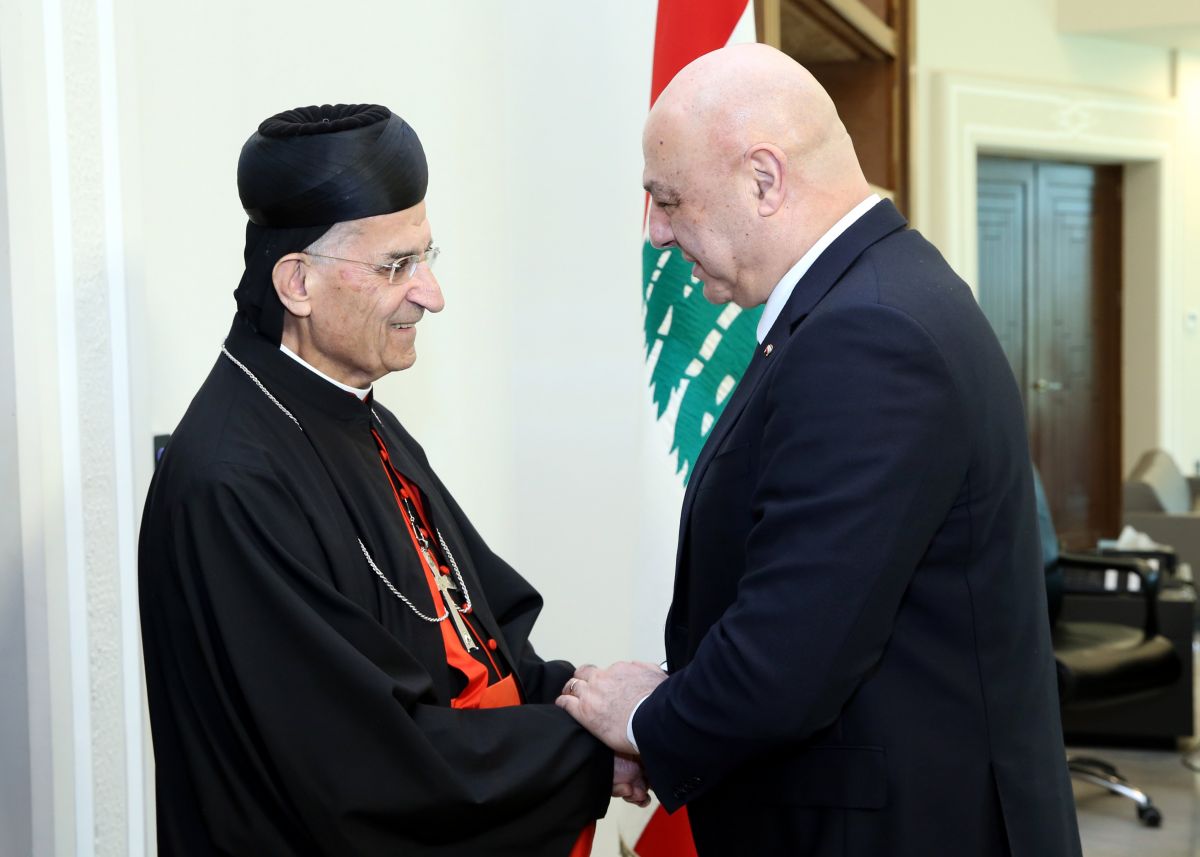
The Maronite Patriarch Bechara Rai met by President Joseph Aoun in Baabda, on April 2, 2025. (Credit: X/@LBpresidency)






For the first time since Joseph Aoun's election to the presidency on Jan. 9, Maronite Patriarch Bechara Rai visited Baabda Palace on Wednesday to meet with the head of state and express his "support." After the meeting, he stated that Lebanon "remains determined to pursue the diplomatic path" in the face of almost daily Israeli attacks. He also stated that it was "inconceivable to continue with two armies and two arsenals" in Lebanon, referencing Hezbollah's weapons.
"We congratulated President Aoun on the appointments, expressed our friendship, and offered our prayers and support," said Monsignor Rai after the meeting. "We also invited him to the Easter mass in Bkirki and discussed public affairs."
When asked about the Lebanese government's position on Israeli strikes, he replied: "We did not address this subject, but in my opinion, what is happening is regrettable and constitutes a violation of the agreement, putting Lebanon and the international community in a delicate situation."
"I am opposed to this unilateral escalation, which constitutes a breach of the cease-fire and hinders diplomatic efforts," he stated. "The Lebanese state, through the president and the prime minister, favors diplomacy because the solution cannot be military."
"Armed confrontations only lead to death and destruction, and that's exactly what Israel is doing. Lebanon endures this situation but remains determined to pursue the diplomatic path," Rai added.
The assembly of Maronite bishops also reaffirmed on Wednesday its support for "the Lebanese state in its efforts to implement United Nations Security Council Resolution 1701," encouraging it to "extend its sovereignty over the entire Lebanese territory and maintain the monopoly of arms, so that Lebanon becomes an area of security, calm, and peace." The Maronite bishops also expressed satisfaction with the recent government appointments. These appointments included key Maronite positions such as the army chief and the governor of the central bank.
Rai also said that "reforms are at the forefront of the president's concerns and responsibilities, as well as international demands." "However, Israeli attacks divert attention and prevent the development of a reform plan," he stated.
Diplomatic work
When asked about Hezbollah's disarmament, Rai said that "Resolution 1701 stipulates that weapons should be exclusively in the hands of the Lebanese state." However, this issue requires diplomatic work and action by the president and the government to resolve internally because it is inconceivable to continue with two armies and two arsenals," he said.
Since the formation of Prime Minister Nawaf Salam's government in February, Hezbollah has linked discussions on its arsenal to dialogue and a national defense strategy. During a Cabinet meeting on March 13, a debate on the party's arsenal was initiated by the Lebanese Forces and Kataeb, who demanded the implementation of a timetable for its disarmament. Shortly afterward, ministers Tamara al-Zein (Environment) and Yassine Jaber (Finance) expressed their opposition to any disarmament of Hezbollah as long as Israel occupies five positions in southern Lebanon.
Hezbollah was considerably weakened by its war against Israel, which it initiated by opening a support front with Gaza in October 2023 and concluded with a ceasefire agreement in November 2024, stipulating the party's disarmament and withdrawal from the area south of the Litani, where the Lebanese army is already deployed. However, the Israeli army still holds five points on Lebanese territory and continues its daily operations against members of this pro-Iranian group, especially in southern Lebanon. According to Lebanese authorities, it has committed "more than 1,500 violations" of the truce since its inception, killing 127 people, more than half of whom are civilians.