






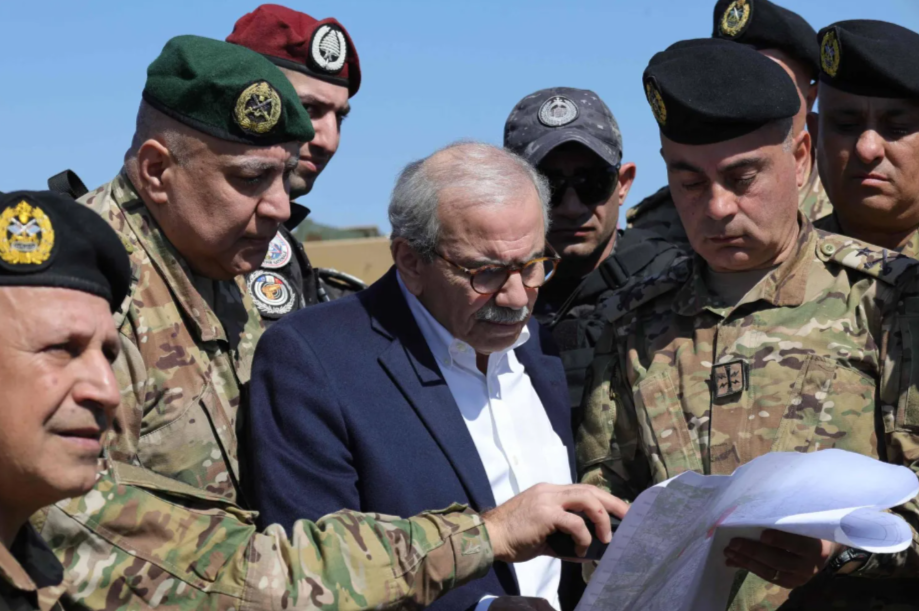
Lebanon's Prime Minister Nawaf Salam checks a map surrounded by Lebanese Army soldiers as he visits the southern village of Khiam near the border with Israel, on February 28, 2025. (Credit: Rabih Daher/AFP)






BEIRUT — Prime Minister Nawaf Salam urged the army Friday to quickly identify and arrest those behind rocket fire towards Israel, which responded by striking south Beirut for the first time since November.
Israel had announced Friday morning that around 7 a.m., its army detected two rockets launched from southern Lebanon, one of which fell short, landing in Lebanese territory, and another which was intercepted in the air by the Israeli air defense systems.
Salam contacted the army chief and "asked him to act quickly to undertake the necessary investigations to uncover those behind the irresponsible rocket fire that threatens Lebanon's stability and security," according to a statement from his office, urging "intensified efforts" to arrest the perpetrators.
Friday was the second time — the first was last Saturday — that rockets were fired from Lebanon towards Israeli territory since a Nov. 27 cease-fire between Israel and Hezbollah.
In both cases of rocket fire toward Israel, Hezbollah firmly denied any involvement in the attacks and reaffirmed its commitment to the cease-fire deal, which Israel has violated hundreds of times, according to French and Lebanese authorities. The Israeli army has razed entire villages to the ground since the truce, and killed more than 115 people.
In response to the Friday attack, Israel struck Beirut's southern suburbs, where Hezbollah has a significant presence, for the first time since the truce.
The statement also said Salam had also been in contact with unspecified foreign officials to press for Israel to "stop its repeated attacks."
Israel has continued to carry out air raids in south and east Lebanon since the ceasefire, striking what it says are Hezbollah military targets that violated the agreement.
Under the terms of the cease-fire, Israel was due to complete its withdrawal from Lebanon by Feb. 18 after missing a January deadline, but it has kept troops at five locations it deems "strategic."
The agreement also required Hezbollah to pull its forces north of the Litani River, about 30 kilometres (20 miles) from the Israeli border at the farthest points and dismantle any remaining military infrastructure in the south.
The Lebanese Army deployed as the Israeli army pulled out.
Salam also emphasised "the need to complete the measures taken by the Lebanese army to limit weapons to state hands," according to the statement.
He reiterated "Lebanon's full commitment to the implementation of Resolution 1701 and the cease-fire arrangements," emphasising that "only the Lebanese Army is in charge of protecting the borders."
United Nations Security Council Resolution 1701 ended a 2006 war between Israel and Hezbollah and served as the foundation for the November truce.
"The Lebanese state decides between war and peace," Salam added, according to the statement.
