






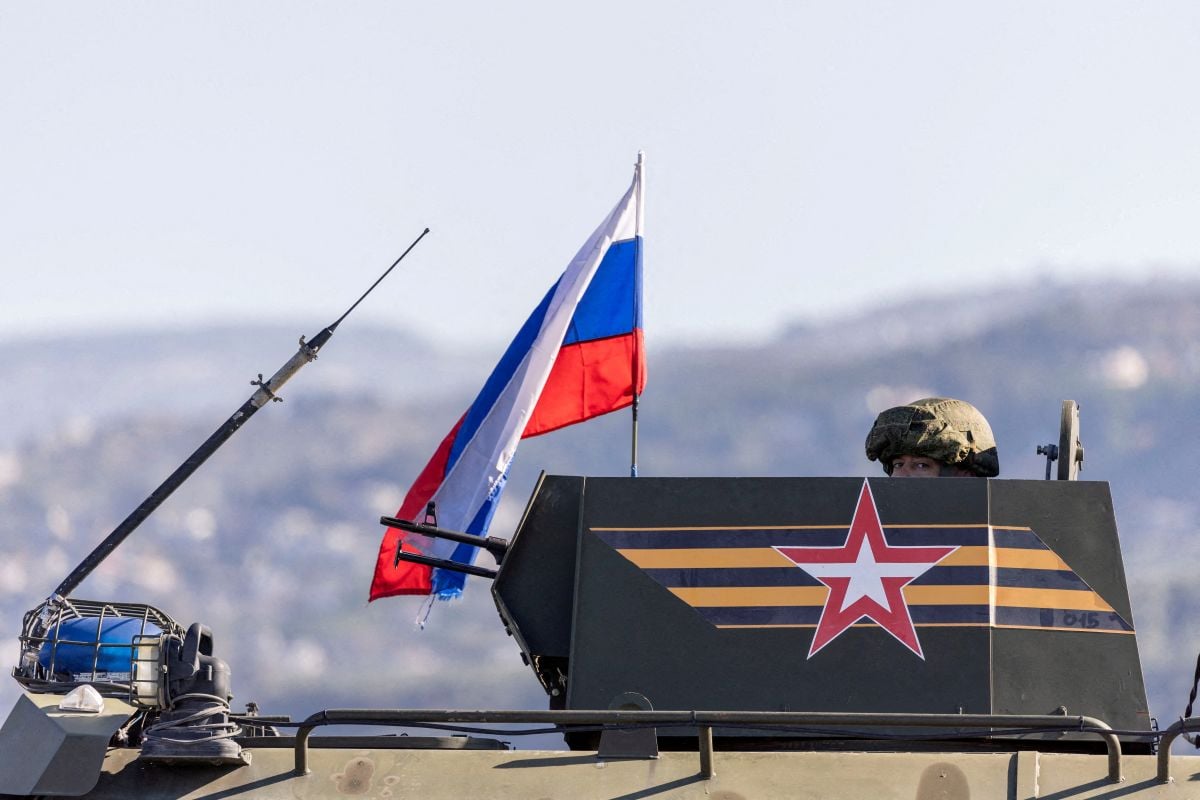
An infantry fighting vehicle that is part of a Russian military convoy heading towards the Hmeimim airbase, near Latakia, on the Syrian coast, on Dec. 14, 2024. (Credit: Umit Bektas/Reuters)






For years, soldiers from the Russian airbase Hmeimim, south of Latakia, moved freely in Syrian coastal cities, from which their combat aircraft took off to bomb rebels fighting the regime of Bashar al-Assad. But since the fall of the regime, small groups of former rebels have guarded the entrance to both Hmeimim and the Soviet-era naval base in Tartus, located 60 km south. "They (the Russians) must inform us before leaving," says one of the guards, who requested anonymity.
The future of the bases, essential to Russia's military presence in the Middle East and Africa, has for nearly three months been in the hands of interim Syrian President Ahmad el-Chareh, who seeks to renegotiate the 49-year lease granted under the Assad regime for the Tartus base and the unlimited lease for Hmeimim. He wants better conditions without expelling the Russians from his territory.
In fact, these bases could become a bargaining chip in exchange for diplomatic support and financial compensation from Russia, which has been deeply involved in the Syrian economy and defense for seven decades, well before its 2015 intervention in the civil war that helped keep Assad in power. Since his fall, the former Syrian president has been in Russia with his family after fleeing through the Hmeimim base on Dec. 8.
A mutually beneficial rapprochement
Eight Syrian, Russian, and diplomatic sources, who requested anonymity, were interviewed and revealed new details about the first high-level meeting between Ahmad el-Chareh and an envoy sent by President Vladimir Putin. Among the topics discussed were billions of dollars in Syrian debt to Russia, the future of Bashar al-Assad, and the repatriation of Syrian funds allegedly deposited in Russia.
Ending the hostility between the two powers has advantages for both sides. Despite some easing of European and American sanctions against Syria, the remaining restrictions complicate affairs for the new regime in a war-torn and impoverished country, where restoring Russian supplies of weapons, fuel, and wheat could be vital for its 23 million people.
"The Syrian leaders are ready to make peace, even with their former enemies," said a diplomat based in Damascus. "Moscow still has things to offer Syria and remains too influential to be ignored," confirmed Anna Borshchevskaya from the Washington Institute. "Russia simply needs a government in Damascus that guarantees its interests, and it is ready to strike a deal with it," she added.
A United Nations official also stated that Russia has not yet exported grains to Syria under the new administration led by Ahmad el-Chareh, but this may change amid ongoing negotiations.
Meanwhile, U.S. President Donald Trump has remained silent on Syria since taking office, as he seeks to warm relations with Moscow, notably after suspending U.S. military aid to Ukraine. A State Department spokesman argued that with Bashar al-Assad gone, Syria had "the opportunity to no longer be dominated and destabilized by Iranian or Russian influence." However, Israel wants Russia to maintain its presence in Syria to counter Turkish influence, which is active in several Syrian rebel circles, including Hay'at Tahrir al-Sham (HTS), which was recently disbanded.
Common strategic interests
In a December interview with the Saudi channel al-Arabiya, Ahmad el-Chareh acknowledged that Syria and Russia share "strategic interests." Under Assad, Moscow heavily equipped and supplied ammunition to the now-dismantled Syrian army. It also financed key infrastructures, including power plants and dams.
During a round of talks in Damascus on Jan. 29, Ahmad el-Chareh requested the cancellation of loans contracted from Russia under the previous regime, according to two corroborating sources. Before the war, Syria was largely free of foreign debt, but now owes between $20 billion and $23 billion, according to Syrian Finance Minister Mohammad Abazid, who did not specify the share owed to Moscow.
During the three-hour meeting, which included Russian Deputy Foreign Minister Mikhail Bogdanov, Syrian officials also discussed the return of Bashar al-Assad to Syria. This topic, however, was only briefly mentioned, according to a source close to the talks, suggesting it was not a major obstacle to normalizing relations. So far, Moscow has ruled out any extradition of the former president and says it has not received any request in that regard, according to a high-ranking Russian source.
The Syrian leader also demanded the repatriation of Syrian funds his government suspects were deposited in Russia by the previous regime. However, the Russian delegation led by Bogdanov denied the existence of such funds, according to a Russian diplomat in Syria.
Correcting past mistakes
Asked Tuesday about the progress of discussions regarding Russian military bases, Kremlin spokesman Dmitry Peskov asserted that Moscow "continues its contacts with the Syrian authorities" and that work between the two governments "is ongoing." Former Kremlin adviser Sergei Markov assessed this month that the situation seemed favorable to Moscow: "The new Syrian authorities do not see Russia as a hostile country. But the Kremlin will have to make concessions in exchange for these bases," he wrote on Telegram.
In a statement released after the Jan. 29 meeting, the Syrian government emphasized the need to "correct past mistakes" and demanded "compensation" for the destruction caused by Russia during the war. The cost of reconstruction is estimated at $400 billion, according to the United Nations Economic and Social Commission for Western Asia (ESCWA).
According to a source close to the matter, Russia refuses to assume this responsibility but might propose humanitarian aid, possibly using the Tartus and Hmeimim bases as distribution centers. However, a U.N. official indicated no such initiatives have been implemented since December.
Despite these points of contention, the Syrian-Russian meeting reportedly went "smoothly," according to all sources interviewed. The first direct phone call between Ahmad el-Chareh and Vladimir Putin two weeks ago was deemed "constructive" by the Kremlin. The Russian president even extended "an official invitation to Syrian Foreign Minister Assaad al-Chaibani for a visit to Russia," according to the Syrian presidency.
