






Thank you for joining our live coverage of the confidence vote for Prime Minister Nawaf Salam's government
We will resume reporting tomorrow.
MPs Nabil Badr, Imad Hout, Haidar Nasser and Jamil al-Sayyed abstained from voting.
MPs from the Strong Lebanon bloc and Cynthia Zarazir did not give Salam's government confidence.
95 MPs expressed confidence in Nawaf Salam's government, 12 did not and four abstained.
To gain confidence, the Salam government must obtain the votes of an absolute majority of the MPs present.
After Salam's speech, the vote of confidence process began.
Before Salam's speech, Parliament Speaker Nabih Berri addressed MP Firas Hamdan’s remarks on the cease-fire agreement between Lebanon and Israel. "There are no signatures. What has been agreed upon is a plan to implement U.N. Resolution 1701, adopted in 2006. There are no signatures, nothing at all," Berri said.
On reconstruction, Salam said:
"We will set up a special, independent reconstruction fund to mobilize Arab and international support, and we will not accept any political conditions in exchange for this support."
Some MPs criticized the ministerial declaration's use of the term "we want" instead of a clear commitment.
Salam responded: "When we say we want, it's not just a wish, it's a commitment."
"The ministerial declaration defines the objectives and outlines the broad guidelines, but there is no doubt that we will put in place concrete action plans, and members of parliament will be able to hold us accountable for their implementation," he added.
"We thank those who have placed their trust in us, and we pledge to listen to the comments of those who have not," he continued.
Prime Minister Nawaf Salam addresses MPs.
"I have listened to the MPs' remarks and our government will take them seriously. We will work to strengthen their confidence as well as that of the citizens. We stand together, even if we are diverse."
MP Firas Hamdan said it was necessary to "abandon the language of betrayal."
"The Lebanese proved their patriotism during the last war," he added. The MP also called for "a judicial audit to be carried out, as depositors' money is sacred." He announced that he had "confidence in the government, hoping that promises will be transformed into action."
He also called for residents of the southern border districts of Sour, Marjayoun, Bint Jbeil and Hasbaya be exempt from paying utility bills, arguing that these areas were heavily impacted by Israeli strikes, leaving services largely disrupted.
MP Georges Bouchikian pleads the government "to save Lebanon."
"As members of parliament, we will fully commit ourselves alongside the government to achieve its objectives. Saving Lebanon and preserving the unity of the Lebanese people are our priorities," he added. Lebanon is going through a major national and humanitarian crisis. It is imperative to respect the sacrifices of Lebanese citizens, whose homes have been destroyed and burned as a result of Israeli aggression."
"Can I reserve my place to speak next year?" one MP quipped, addressing Parliament Speaker Nabih Berri, referring to the lengthy MP speeches.
MP Faisal Karami took the floor next and expressed confidence in the government.
"Convinced that the new mandate requires national solidarity, we place our full confidence in the government," he said, while asking Salam's government to pay extra attention to the development of Tripoli and surrounding impoverished areas.
Karami also emphasized his support to "the State's monopoly on arms," and referenced the demand to release Islamist prisoners.
To find out more about the case of the Islamist prisoners in Lebanon, read Jeanine Jalkh's analysis: Islamist prisoners: A ticking time bomb for Lebanon?👈
Kataeb leader Samy Gemayel says he has "full confidence" in Nawaf Salam's government and considers this ministerial statement to be the "best Lebanon has had in a long time."
"Let's all get ready to open a new Lebanese chapter that brings everyone together," said Gemayel, calling for a "truth and reconciliation" conference between the Lebanese parties. "It is impossible to open a new page in Lebanon without equality between the Lebanese, which starts with the fact that no one should hold weapons," he added.
Taking the floor next, MP Jihad al-Samad said he was "obliged to facilitate the government's task."
"The government has obtained popular confidence before parliamentary confidence, and that's why I will also give it my confidence," he said.
He took advantage of his speech to assert that it is the duty of deputies to concentrate "on passing reform laws."
MP Nabil Badr has announced that he will not be placing his trust in Nawaf Salam's government. "We will follow the actions of this government and criticize it where shortcomings appear, but we will not place our trust in it," he declared.
He also addressed Salam: "Anyone who wants to reduce the Sunni community to his own person must possess impressive political weight and a parliamentary group, and you have neither."
"We would have been among the first to support the government if a different method had been adopted for its formation," he added, pointing out that the Cabinet had been formed "according to partisan interests and without fair representation."
He also criticized the ministerial statement, saying it contained "vague expressions used to avoid clear commitments to the people." "It is necessary to make commitments, not wishes," he said.
Worthy to note that multiple Sunni MPs have previously criticized Salam for lack of representation in the Cabinet. Press here to find out more. 👈
MP Mohammad Yahya was the first to speak. "The government must deploy all necessary means to liberate every inch of our territory. We demand compliance with Resolution 1701, as well as the activation of the Taif Agreement, in particular the implementation of those articles that have not yet been applied," he asserted.
He placed his trust in the government
The session for the MPs' vote of confidence in the government has resumed.
Before the session was suspended, Maronite MP for Baabda Camille Chamoun announced his confidence in the government.
“We are entering a promising new era, and we hope for security and peace [for Lebanon]”, he said. Recalling that the country has experienced conflict since independence, he felt that “the main reason is linked to the centralization” of the state and its institutions.
🔴 The session was adjourned and will resume at 6 p.m. Twenty deputies spoke this morning.
Armenian-Orthodox Tachnag MP Hagop Terzian, elected from Beirut, focused his speech on young people and the brain drain from Lebanon to abroad. “Only three sentences about young people in the ministerial statement? It's a disgrace,” he said, nevertheless expressing confidence in the government.
The Vice-President of the Parliament, Elias Bou Saab, retook the floor and reiterated his previous statement. He announced that two more MPs would speak before adjourning the session. “We will vote in the evening and conclude at around 8:30 p.m., with a speech by Nabih Berri,” he added.
Jezzine MP Charbel Maroun Massaad said that Lebanon was “living through a historic and delicate moment when time is running out.”
He indicated that he would give his vote of confidence to the government but that “this confidence represents a condition,” that the necessary reforms be carried out. “We grant confidence but remain extremely vigilant, and we will withdraw it if the government fails in its mission.”
Beirut MP Cynthia Zarazir, a member of the popular protest movement, denounced the promises to improve electricity supply, education, women's rights, and individual freedoms. “But how? What is the plan? What are the mechanisms?” she asked.
”Justice in the explosion of the port of Beirut and in the money confiscated from the Lebanese, the productivity of the public administration, the full application of the 1701 and the liberation of the territory from all occupation (...) The Lebanese have had enough of promises, they expect action. In the meantime, there is no trust,” she asserted.
Parliamentary Vice-President Elias Bou Saab, who has been presiding over the session in place of Nabih Berri, announced a suspension of the session after two speeches by MPs Cynthia Zararir and Charbel Massaad.
“If the speeches are short, we can get it over with today,” said Bou Saab.
Sunni Zahleh MP Bilal Houchaimi, close to the Future Movement, said that Lebanon was "in serious need at a pivotal historical moment.” He called for no force to occupy a "single centimeter" of Lebanese territory.
“We call on the State to strengthen measures to protect its sovereignty and its people,” he said.
The MP also called for “concrete action and not just slogans” regarding the depositors' money issue. “The government must adopt a comprehensive plan to recover this money and hold the banks fully accountable.”
Finally, he announced his vote of confidence for the Salam government.
North Lebanon Maronite MP William Tawk, close to Marada and the SSNP, gave his vote of confidence to the government after a short speech.
“Neutrality is the solution. The prime minister's mission is difficult, time is running out and we need to get back on track,” he declared.
Koura MP Adib Abdel Massih, close to the Kataeb and Michel Moawad, said that the government had his vote because he “trusts those who chose them."
"We want to rescue and then reform, not the other way around,” he stressed.
The MP also called on the Cabinet to “establish a culture of national security. The Lebanese Army alone guarantees the nation's security,” he insisted, announcing his intention to present a bill to reintroduce military service.
“We also hope to develop a strategy to reduce the number of brigadier generals in the army and raise the retirement age,” he added.
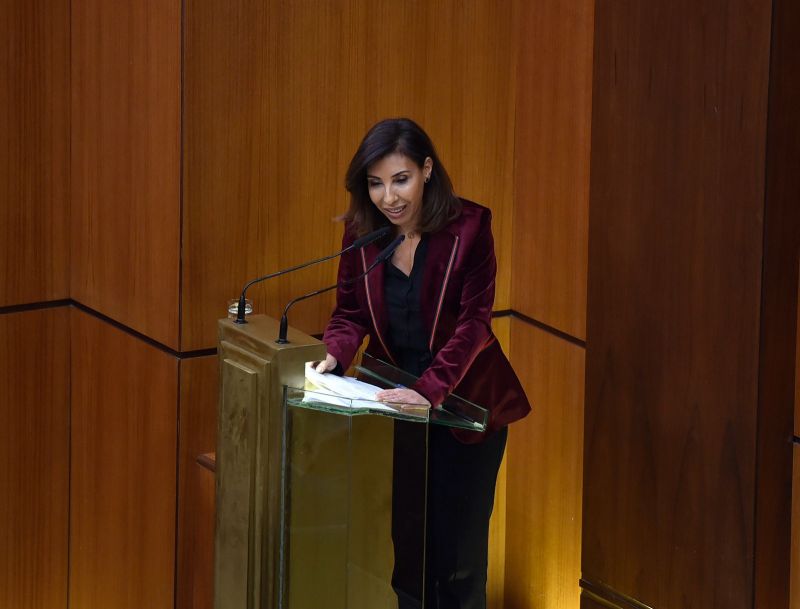
Mount Lebanon Sunni MP Halima Kaakour stated that the ministerial statement “should have included a more frank confrontation of the banking and 'mafia circles.'”
“We sacrificed efficiency in Lebanon for the sake of sectarian quotas. Sectarianism is a lie, invented to protect the zaims [leaders],” Kaakour denounced. “I'll give you my 'vote of confidence,' but only if you're braver than that statement,” she concluded.
The Sunni MP for Saida, Oussama Saad, of the Nasserite Popular Organization, felt that granting confidence to the government “must not prevent the vitality of the people from holding the government and Parliament to account in the event of failure.”
He called on the State to confront Israeli aggression and occupation with its own forces. “If it fails to do so, popular resistance will regain its legitimacy,” he stressed. “Contrary to my usual practice, this time I am giving the government my vote of confidence,” he concluded.
In a lengthy speech, Maronite MP Michel Doueihy of North Lebanon called on the Salam government to “make Lebanon neutral with regard to foreign axes,” before announcing his confidence in the government. “In the ministerial statement, 'Lebanon's right to defend itself' should have been replaced by 'the State's right to defend itself,' to make it clear that this is the State's role.” He also called on the government to “stay away from all banking and financial powers.”
Doueihy was interrupted by other MPs and Nabih Berri before finishing his speech. “Some have spoken for half an hour,” he protested before leaving the rostrum.
Sunni Akkar MP Walid Baarrini, who belongs to the Future Movement, called on the government to focus on development in Akkar. “We suffer from isolation,” he denounced, calling on Prime Minister Nawaf Salam to address the rights of the people of Akkar.
“We demand the creation of a ministerial committee specialized in monitoring the resumption of activities at Qleyaat airport,” an issue included in the ministerial declaration, the MP added.
Lastly, Baarrini called for federalism while respecting national unity and the Taif Accords. “We don't want partition, but rather political, social and economic justice,” said the MP, who expressed his confidence in the government.
“There are still 18, 19 people who need to speak. So if we can shorten it,” said parliamentary vice-president Elias Bou Saab, speaking before MP Michel Douaihy and after Walid Baarini.
A moment of confusion surrounded the speaking time of the various parliamentary blocs. “Are you counting the speaking time and the number of MPs speaking?” interrupted Free Patriotic Movement MP Ghassan Atallah, questioning Nabih Berri.
“Gebran spoke for over half an hour!” retorted Berri, referring to the speech by Gebran Bassil, president of the Free Patriotic Movement, the previous day.
Druze MP Wael Bou Faour of Walid Joumblatt's Progressive Socialist Party (PSP) took the floor, calling on the government to “lift all immunities” enjoyed by political and judicial officials. “Everyone has immunities, except the citizen,” he asserted.
“The priority is to liberate the lands occupied [by Israel], bring back the prisoners, rebuild and restore the sovereignty of the State,” added Bou Faour, who called for wider decentralization and hoped that the government would "respect the National Pact [of 1943], which makes no provision for federalism" in institutions.
The independent MP for Rashaya-Bekaa West, Ghassan Skaff, called on the government to be “a founding cabinet” in the transition period the country is going through. He also called on the government to declare an environmental emergency to save the Litani River. The MP expressed confidence in the government, “on condition” that it carries out the necessary reforms.
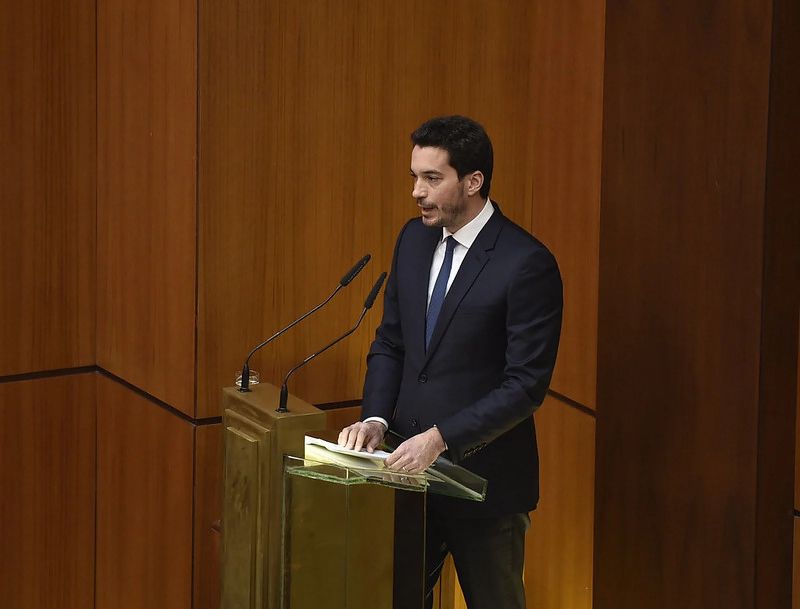
(Credit: Ali Fawaz/Flickr account of the Lebanese Parliament)
Tripoli's Sunni MP Abdelkarim Kabbara, who belongs to the Future Movement, questioned the government about the fate of the city of Tripoli, which is suffering from a lack of development and great poverty. "Is there a rescue plan for the city, which is threatened by a cruel lack of livelihoods?” he asked.
The MP nevertheless announced that he had confidence in the government, “while keeping his eyes open” to its actions.
Ibrahim Mneimneh, another protesting MP, took the floor after Melhem Khalaf. He hailed the “hope” represented by the Salam government and expressed his confidence in it, calling on it to “reform the electoral law and hold the municipal elections on time,” which are due to be held this year after four successive postponements.
“The country will not be organized without justice and accountability for all the crimes committed against the Lebanese people”, asserted Mneimnrh, who called for "a neutral investigation" into the Aug. 4, 2020 explosion in the port of Beirut.
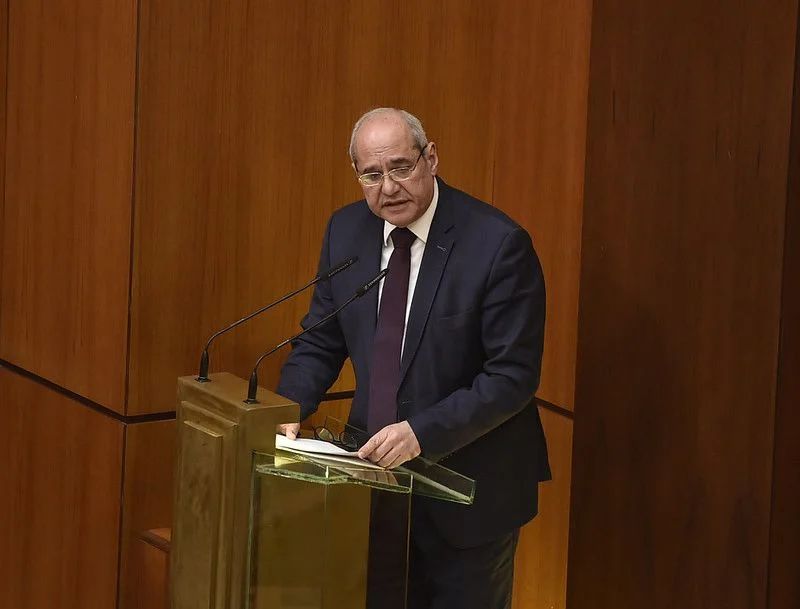
(Credit: Ali Fawaz/Flickr account of the Lebanese Parliament)
After Ibrahim Kanaan, Beirut's anti-establishment MP Melhem Khalaf took the floor. He called on the government to “turn the page on deadly conflicts” in Lebanon and said it was the duty of the state and Lebanon to acquire new international legitimacy.
Commenting on the ministerial statement, Khalaf said he had expected a ministerial declaration that would put an end to the past era and carry a clear plan. “The declaration merely listed a set of general promises,” he lamented.
“In keeping with the generally positive mood, I will give the government a chance, I will put my trust in it, I will follow it, and if it fails, I will be in the front row demanding its immediate resignation,” he concluded.
“There is a historic opportunity today, and we must seize it and not let it slip away,” said Ibrahim Kanaan, a Maronite deputy from Mount Lebanon.
He spoke of “Israeli violations” in Lebanon and said, “We want to know what the status is of agreements with Arab countries for aid to the Lebanese army.” As for the restitution of depositors' savings and the restructuring of the banking sector, he asserted, “There's no shortage of laws. We just need to apply them and judge those who need to be judged.”
The floor is now given to Ibrahim Kanaan, a former Free Patriotic Movement MP who left the Aounist party in August 2024.
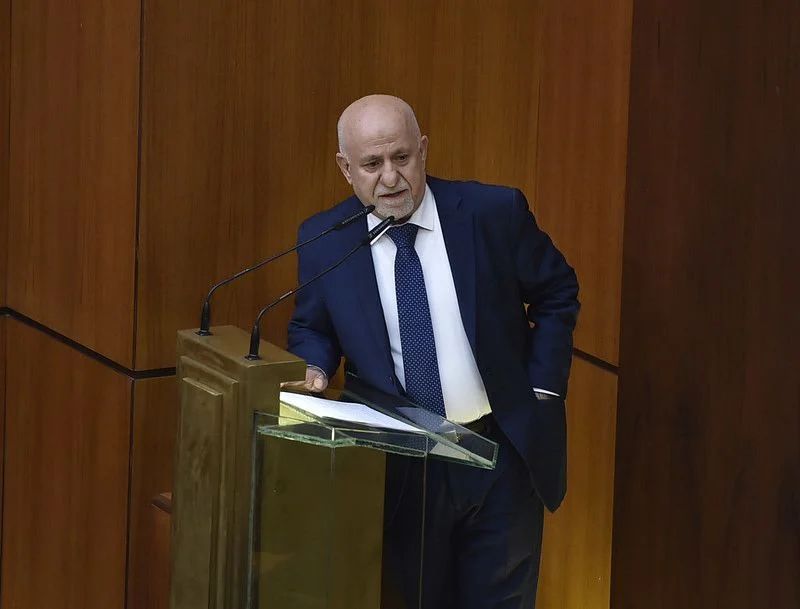
(Credit: Ali Fawaz/Flickr account of the Lebanese Parliament)
Kabalan Kabalan, a Shiite MP from the Amal movement, called on the government to be “diplomatically active with the relevant embassies” in raising the issue of Israeli violations in Lebanon. He also called on it “to rebuild what the Israeli enemy has destroyed in the southern suburbs, south Lebanon and the Bekaa.”
He affirmed that the parliamentary bloc of the Amal movement would give its confidence to the government, wishing it “full success” but tempering this by saying that “confidence does not mean taking the country to destructive phases.” He also insisted on the priority to be given to the money of Lebanese depositors blocked in the banks. “We need to determine responsibilities, which are shared between the banks, the central bank and the government or the state.”
Parliament Speaker Nabih Berri opened the session at 11 a.m. sharp, giving the floor to Kabalan Kabalan, MP for the Amal movement.
More than 30 MPs are due to speak today, after yesterday's 17. The MPs will then vote.
The meeting began at 11 a.m. sharp for the second consecutive day of debates, at the end of which a vote is expected to be taken on whether or not to grant confidence to Nawaf Salam's government.
Two sessions will mark the day, which will necessarily end with a vote, “even if the deputies had to stay up until midnight,” as Parliament Speaker Nabih Berri announced on Tuesday.
Some 60 MPs have asked to speak during the debates, which will be broadcast live on television. Yesterday, 17 spoke, and many more will do so today.
The first day of debates, on Tuesday, was marked by a speech from Hezbollah, whose leader of the parliamentary bloc, Mohammad Raad, announced his confidence in the cabinet. Its former ally, Gebran Bassil, leader of the Free Patriotic Movement, consolidated his position in the “positive opposition,” refusing to give his bloc's confidence in the government.
The overwhelming majority of MPs indicated their intention to give their confidence to the government, even Future Movement MPs, unhappy at having been left out of the cabinet, but whose request to include the reactivation of Qleyaat airport (Akkar) in the ministerial declaration was met.
Hello and welcome to our live coverage of the second parliamentary session devoted to the vote of confidence in Nawaf Salam's government.
This second day will include more speeches by MPs, nearly 20 of whom spoke yesterday. The MPs will then proceed to the vote.
Already have an account? Login here
You have reached your article limit
Stay informed about a Middle East in crisis.
Subscribe now and save 30%: just $8.9/month instead of $12.9.
This article is only available to L’Orient Today subscribers.
Already have an account? Login here