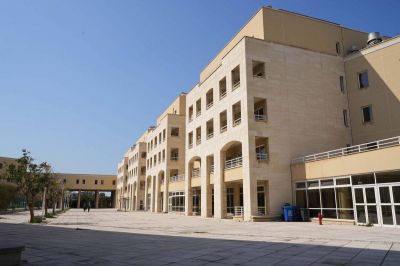
The Lebanese University campus in Hadath. (Credit: Mohammad Yassin/L'Orient-Le Jour)






The controversy surrounding the alleged discovery of weapons in a warehouse at the Lebanese University’s (LU) campus in Jnah, in Beirut's southern suburbs, has reignited, two days after the university issued a statement denying the allegations.
LU acknowledged, however, that “a few military uniforms, suitcases and locked boxes with unknown contents” were found in the warehouse.
A judicial source confirmed to L’Orient Today that military equipment was found at the scene.
This controversy has taken a political turn, as Hezbollah faces accusations from its opponents, which the party denies.
The warehouse, located opposite the Chinese embassy and near a Lebanese Army roadblock, is protected by an iron curtain, locked by two padlocks sealed with red wax.
Contrary to some reports, the building is not located on the LU campus in Hadath. The underground warehouse, rented by the university, is isolated and located close to the building housing the League of LU Full-Time Professors and its mutual fund.
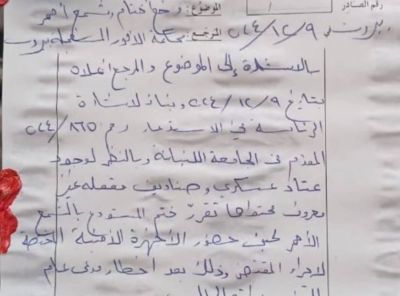
In its Dec. 9 press release, the only public university in Lebanon indicated that the sealed location was a rented warehouse but that, during an inspection to assess the damage caused by recent Israeli airstrikes, “it was noticed that the locks on the warehouse, which was used to store materials and perishable equipment, had been replaced.”
Electronic devices for military purposes
A judicial source who wished to remain anonymous said that military equipment and uniforms had been found.
“The electronic equipment in the warehouse is used for military purposes and for flying drones,” said the source, who added that the inscription “Radwan” — the name of Hezbollah's elite unit — was found on steel boxes that could not be opened.
According to the same source, university officials tried to obstruct the investigation on several occasions. LU President Bassam Badran did not respond to a request for comment.
“There are no weapons in this warehouse. There are clothes, empty military vests, suitcases... But there are no weapons, as has been reported in the media,” said caretaker Education Minister, Abbas Halabi, to L’Orient Today.
As for the computers found, Halabi said that they “belong to the university and are obsolete.”
He also mentioned the presence of “several suitcases with unknown contents, all of which are in the possession of the public prosecutor [Jamal Hajjar], who is now in charge of the ongoing investigation.” When contacted, Hajjar did not immediately respond.
Judge Carla Shawah, in charge of supervising the investigation, ordered the premises to be sealed. The case was then transferred to the Public Prosecutor's Office of the Court of Cassation, and State Security was tasked with emptying the warehouse, before the keys were handed over to LU, according to the judicial source.
When contacted, a source within State Security was unable to provide any further information on the case. Both the army and Internal Security Forces also failed to respond to inquiries.
“No weapons were found. We discovered electronic devices, among other things, but nothing is clear at the moment. The investigation is still ongoing,” said another security source.
‘A lot of secrets’
At the headquarters of the League of LU Full-Time Professors and its mutual fund, several individuals, speaking on condition of anonymity, confirmed that an LU official, who had visited the premises during the inspection tour several weeks ago, had discovered that the locks had been replaced.
“There are a lot of secrets surrounding this story,” said one employee.
The controversy quickly took on a political dimension. The media outlet ThisisLebanonnews, whose contributors are reputedly opposed to Hezbollah, accused the party on Instagram, citing an anonymous “informed political source,” of using civilians as “human shields.”
“We have nothing to do with this... This matter is in the hands of the security services,” Hezbollah’s spokesperson told L’Orient Today.
“In general, Hezbollah tends to meddle in the Lebanese University’s internal affairs... This is even more blatant in places where the [Amal-Hezbollah] tandem has a presence, such as Jnah or Hadath,” explained Joseph Manih, a law student and Lebanese Forces representative at the university.
“The State must assume its responsibilities and continue its investigation,” he added.
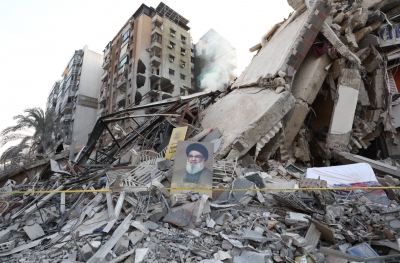
Before the cease-fire between Israel and Hezbollah came into effect on Nov. 27, after more than a year of war, the Israeli army heavily bombed the southern suburbs of the capital, claiming that the strikes were aimed at Hezbollah’s infrastructure and arms depots.
The Jnah and Hadath districts, where LU's main campus is located, were heavily targeted by these strikes, often preceded by evacuation orders.
The war killed more than 4,000 people in Lebanon and caused billions of dollars worth of damage in several parts of the country.