





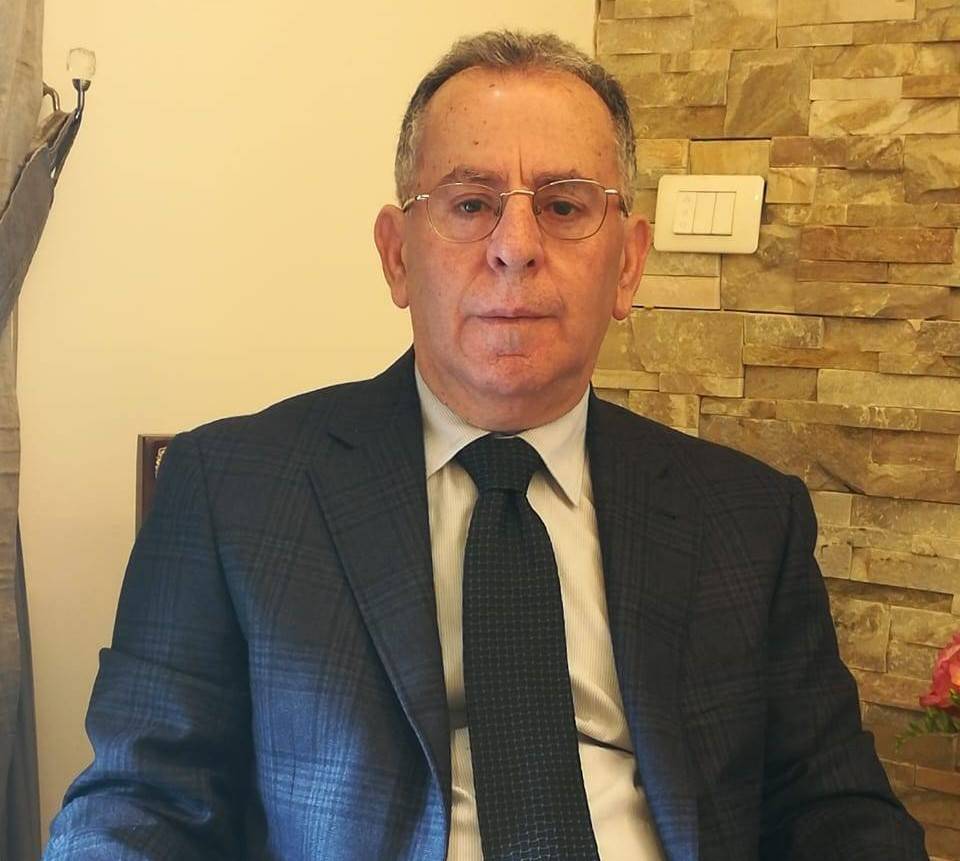
Jamal Hajjjar, acting attorney general at the Cassation Prosecutor's Office. (Photo courtesy of the attorney general)






BEIRUT — Lebanon's parliament passed a law Thursday indefinitely extending the terms of five Supreme Judicial Council (SJC) members whose mandates expired Oct. 14. The law also contains a provision stating that a public prosecutor at the Court of Cassation automatically becomes a member and ex-officio vice president of the SJC, regardless of their position's permanence. This applies to Judge Jamal Hajjar, recently appointed chief prosecutor by SJC president and Court of Cassation chief justice, Souheil Abboud.
Ordinarily, a public prosecutor at the Court of Cassation is appointed by decree, requiring a two-thirds majority of the Cabinet members and the president's signature. However, due to the ongoing political crisis, when Judge Hajjar's predecessor retired in February 2023, this process was impossible due to the presidential vacancy and the caretaker government's limited authority.
Abboud then used his administrative prerogatives to appoint Hajjar as prosecutor general on an interim basis. Unlike his predecessor, the acting prosecutor was initially unable to sit on the Supreme Judicial Council. However, the new law grants him full membership and the vice-presidency, effectively equating his status with that of a permanent prosecutor.
Hajjar now joins the SJC’s five existing members: Afif Hakim, Dany Chebli, Mireille Haddad, Habib Mezher and Elias Richa. Their terms expired on Oct. 14, but Parliament controversially "extended" them Thursday, a month and a half later. This move has drawn criticism from legal experts who argue the extension constitutes a "renewal" or "new appointment," especially since the SJC has been paralyzed by political differences and hasn't met since June.
With the addition of Hajjar, the SJC now comprises seven judges, including Abboud, who presides over the council. However, legally, the SJC should consist of 10 members. Two vacancies stem from the retirement of Court of Cassation judges who haven't been replaced due to the ongoing judicial stalemate. The third vacancy arises from the retirement of former Judicial Inspectorate head, Bourkan Saad, who was an ex-officio SJC member. His replacement, Samar Sawah, was notably excluded from the new law.
An individual measure?
A judge, speaking to L’Orient Today on condition of anonymity, criticized the exclusion of Sawah from the council as a "double standard." Previously, the exclusion of replacements for the prosecutor and the head of the Judicial Inspectorate was justified because they hadn't been sworn in before a President of the Republic. "Now that this condition has been set aside for the new prosecutor," the judge questioned, "why hasn't it been set aside for Burkan Saad's replacement?"
They argued that "by enacting an individual measure, the new law does not take on the general character that should be specific to it."
Another judge, also speaking anonymously, suggested the legislative amendment aimed to ensure Sunni representation within the SJC. Hajjar is Sunni, while the Druze community already has representation through Judge Afif Hakim.
The new law also extends the terms of magistrates who hold positions requiring a Cabinet decree and who will reach retirement age between March 15, 2025 and March 15, 2026. This specifically affects Ali Ibrahim, head of the financial prosecutor's office, who was set to retire in April 2025.
MP Kassem Hashem, a member of the Amal Movement, like his colleague MP Ali Hassan Khalil who authored the legislation, told L'OLJ that the extensions will come to an end following the election of a president in Lebanon and the subsequent formation of a new government empowered to make judicial appointments.

 Evening recap: Netanyahu announces West Bank offensive; 7 killed in Jordan church shooting; tents burned in south Lebanon
 US strike on Iran this weekend? ‘Absolutely,’ says Barrack; ‘I have no idea,’ says Trump