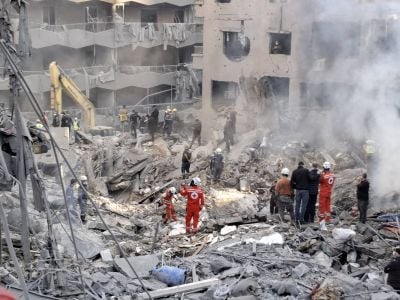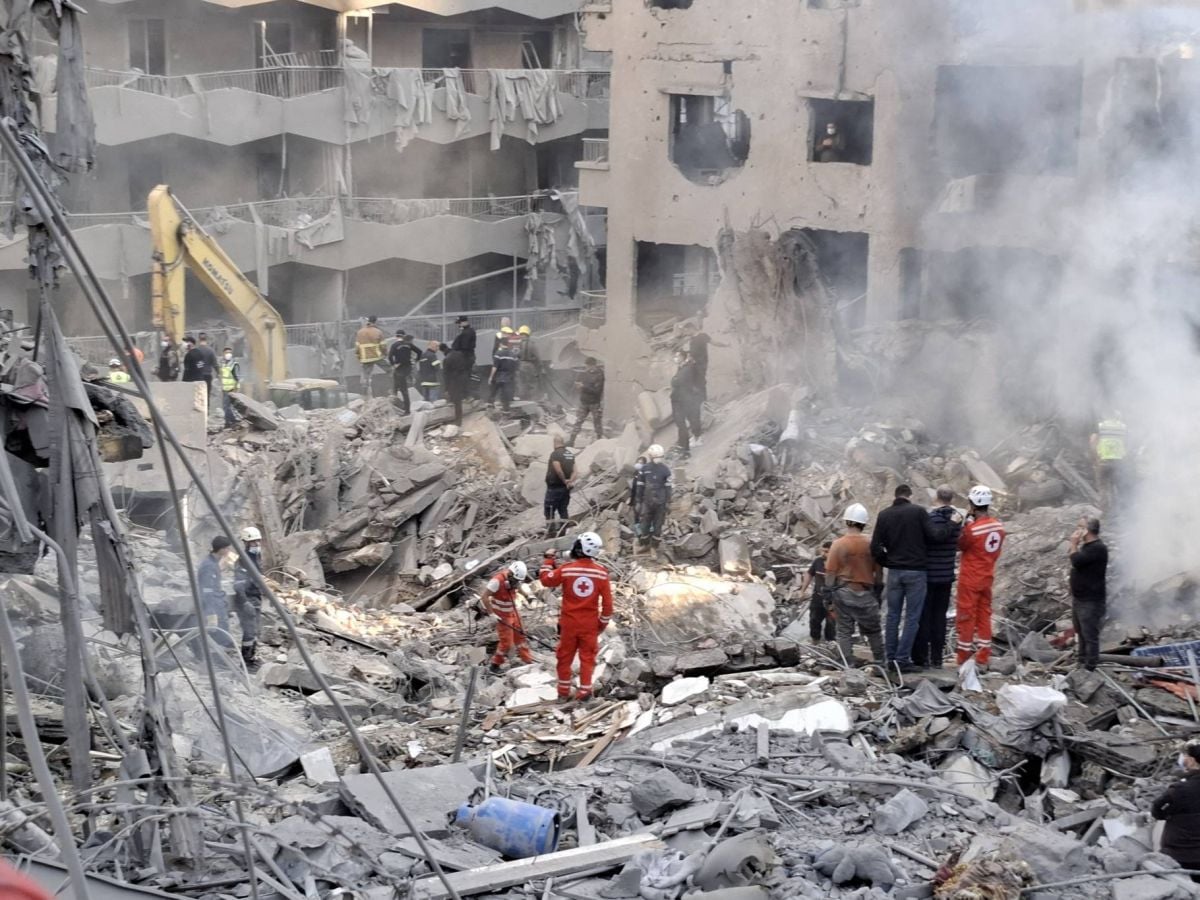
Rescue workers and people at the site of the Israeli strike at Basta al-Fawqa, Beirut, Nov. 23, 2024. (Credit: Mohammad Yassine/L'OLJ)






For two days following the Israeli strike on Basta al-Fawqa in Beirut, the death toll has remained provisional as rescue teams worked to uncover the victims of a strike that reduced an eight-story building to rubble, jolting the city awake at 4 a.m.
Efforts to find the missing and identify the dead remain difficult. “Their bodies are in pieces. DNA tests must be conducted,” said Joseph Abou Chaaya, head of Civil Defense Operations, during an interview on Monday with L’Orient Today.
He referred to the latest figures from the Health Ministry: 29 killed and 67 injured, though no further details were provided. Meanwhile, the identities of some victims have started to emerge.
A ‘crowded and popular’ Beirut neighborhood
“Ninety percent of the victims are locals, from old Beirut families,” said Mosbah Eido, the mukhtar (a local official responsible for civil records) of Bashoura, a neighborhood adjacent to Basta al-Fawqa.
“The destroyed building is located on a crowded and popular street, typical of traditional Beirut,” he added, listing family names of victims: Sahaf, Bchennat, Naamani, Hanbale...
“But the search is not over; more clarity will come,” Eido expressed with hope.
What about the victims’ identities? “Unfortunately, we never disclose names,” a spokesperson for the Health Ministry told L’Orient Today.
The day of the airstrike, some organizations shared victims’ identities on social media. The municipality of Merwanieh, a village in Saida district, announced on Facebook Saturday evening that Kassem Mohammad Ibrahim had been killed in Basta.
The following day, Egna Legna, a collective of Ethiopian domestic workers, posted on Instagram that one of the victims was “of Sudanese nationality.” This was confirmed by the Sudanese embassy to L’Orient Today, which identified the victim as a 25-year-old man who had lived in Lebanon for five years but did not disclose his name.
“Many Sudanese, Ethiopian and other migrant workers lived in that building,” Egna Legna noted. The collective and the Ethiopian embassy in Lebanon did not respond to our inquiries.
‘He watched me grow up’
Some relatives of the victims have shared their grief on social media, identifying those lost in the strike.
“This man, Ibrahim, died in the airstrike on Basta last night. He was 86 years old and had run this bookstore across from my apartment for 50 years,” wrote one Instagram user on Sunday.
“He watched me grow up; he used to deliver newspapers to my grandmother,” the young woman added in her tribute to the bookseller. Ibrahim was killed on his balcony in a building directly facing the targeted one.
Eido confirmed the information, noting that many surrounding buildings were severely damaged. “This is only a few buildings away from the first attack on Basta over a month ago,” Eido recalled, referencing a previous Israeli strike on Oct. 10. That earlier bombing targeted Wafic Safa, a senior Hezbollah security official.
Among the recent victims was the building’s caretaker, a Syrian who had lived there with his wife and two children for nine years. The children were six and nine years old.
“We knew them well; they were originally from Rasm al-Khabbaz, a village east of Aleppo,” a Basta resident told L’Orient Today. “The mother was in her 30s, and the father was likely in his 50s, I believe. Their relatives are still holding onto hope that they are alive,” the man sighed, his voice exhausted.
Initially, rumors suggested the Israeli strike on Basta targeted Mohammad Haidar, a senior Hezbollah official, or possibly another figure, Talal Hamieh. However, according to Haaretz, Israeli security sources eventually acknowledged that “the assassination attempt on the Hezbollah operations chief failed.”
On Monday, the Israeli army told AFP that the strike in Basta hit a “Hezbollah command center.” “What is certain is that this is a massacre,” Eido remarked. “The death toll will only rise,” he feared.