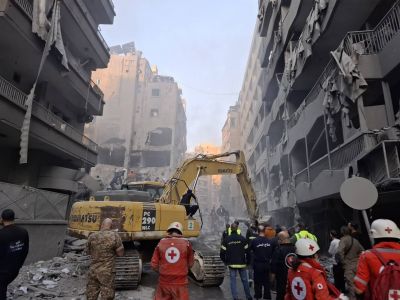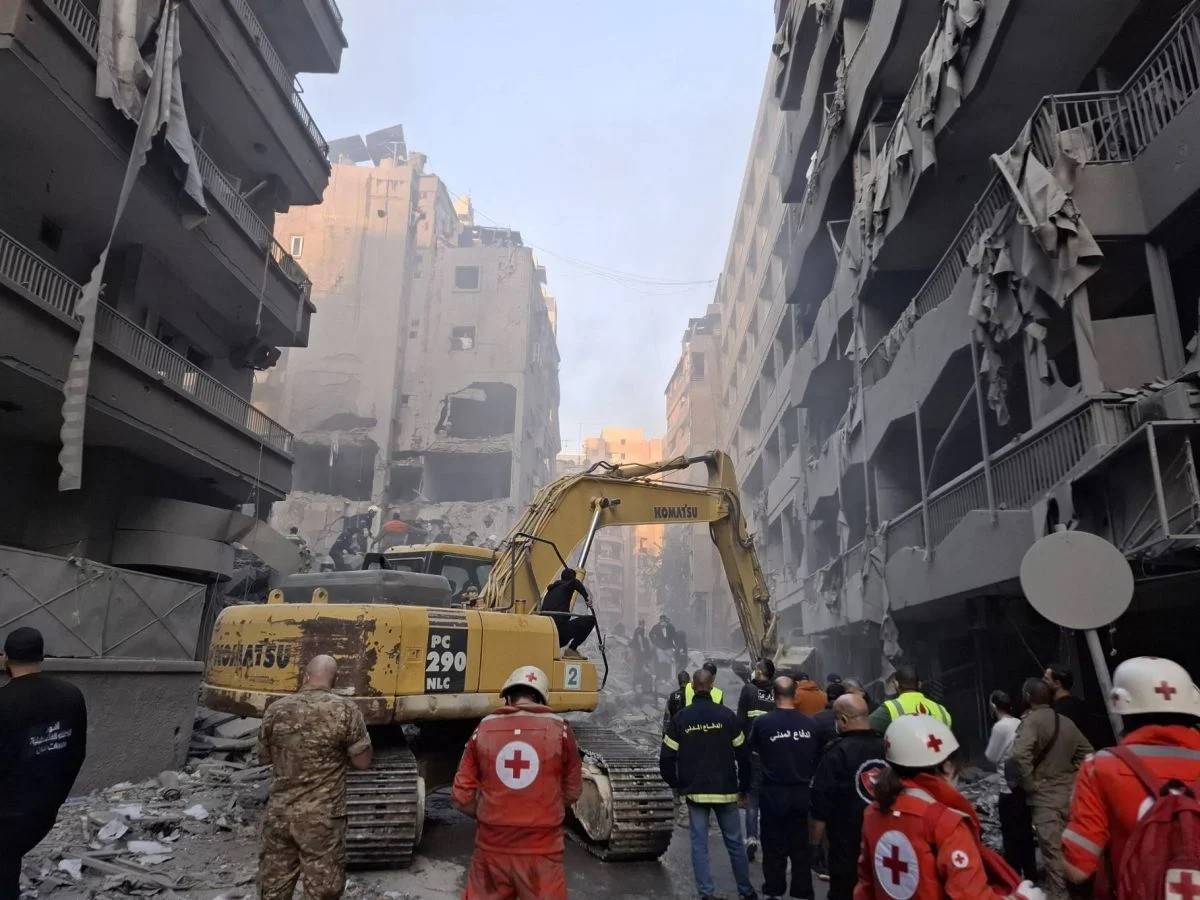
Rescue workers in a street in Basta al-Fawqa, Beirut, after deadly Israeli strikes, Nov. 23, 2024. (Credit: Mohammad Yassine / L'Orient Today)






Beirut was abruptly awakened at 4 a.m. by a series of powerful bombings targeting the Basta al-Fawqa neighborhood, in the heart of the capital.
Here is what we know so far about this attack:
The strike
- At 4 a.m., Israeli jets fired several missiles, at least four or five, on an eight-story residential building on Maamoun Street in the Basta al-Fawqa neighborhood. Geolocation experts have identified the building, which was completely leveled, on maps of the area:
- Multiple local media outlets speculate that the aircraft conducting the strikes dropped ''bunker busters,'' munitions capable of penetrating underground before detonating. Israel used these to assassinate Hezbollah leader Hassan Nasrallah and his presumed successor Hashem Saffiedine.
These 2,000-pound bombs were withheld from U.S. shipments of arms to Israel starting in May out of concern from the Biden administration that they would be used in civilian areas.
- The Israeli army's intended target in this bombing remains unclear. Neither the Israel nor Hezbollah has issued a statement so far.
The aftermath
- At least 20 people were killed and 66 injured, according to the Lebanese Health Ministry's provisional toll.
- In the late afternoon, clearing operations were still ongoing, suggesting that the death toll could rise. Dozens of rescue workers, as well as agents from various security agencies, were present at the scene.
- The targeted building was completely destroyed, along with parts of the surrounding area, and a deep crater left in the ground.
The context
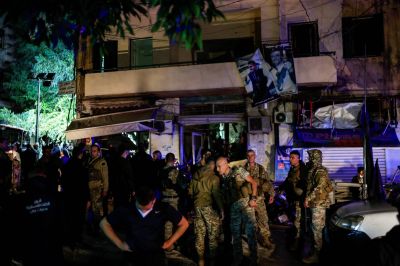
- This marks the fourth Israeli airstrike this week targeting a central area of Beirut, while the majority of attacks have focused on the southern suburbs.
- On Sunday, a strike hit the Syrian Baath Party headquarters in Ras al-Nabaa, where several members of Hezbollah's media relations office were present. The head of the press office, Mohammad Afif, was killed in the airstrike, along with several colleagues. On the same day, the Mar Elias neighborhood was targeted in a strike on an electronics store, resulting in multiple deaths. On Monday, a bombing struck Zoqaq al-Blat, a neighborhood just a few hundred meters from downtown Beirut.
- On Oct. 10, around 8 p.m., the Israeli army fired on Basta al-Fawqa and the neighboring Noueiri district. These two attacks were deadly, killing 22 people and injuring at least 117.
- On Wednesday, Hezbollah leader Naim Qassem declared that his party would target the ''center of Tel Aviv'' in response to Israeli strikes on Beirut. ''Israel attacked the heart of Beirut, so it should expect the response to happen in the center of Tel Aviv. It must pay the price,'' he said.
The target
The Israeli channel Kann News, citing an Israeli security source, reported that “the target of the Beirut bombing is senior Hezbollah official Mohammad Haidar.” Earlier on Saturday morning, media outlets had indicated that the target was Talal Hamiyeh, a senior Hezbollah figure presented as the head of the party’s clandestine operations unit, Unit 910.
According to the U.S. State Department, Mohammad Haidar is the head of Hezbollah’s "Bureau 113" and oversees the party’s networks outside Lebanon. No specific details about the nature or location of his activities have been documented. He is said to have appointed leaders in various unspecified Hezbollah units and was reportedly close to Imad Mughniyeh, Hezbollah’s former military commander, who was assassinated in Damascus in 2008. In 2004, Haidar was elected to the Lebanese Parliament. On Sept. 10, 2019, the State Department added him to its list of global terrorists.
Local media describe Haidar as a jihadist aide to former Hezbollah Secretary-General Hassan Nasrallah, alongside other figures such as Fouad Shokr, a Hezbollah military leader, Ibrahim Akil, head of the elite unit, and Ali Karaki, a party commander — all of whom were assassinated by Israel in Beirut. Haidar is considered a frontline leader in Hezbollah’s security and strategy operations.
Mohammad Haidar is also related to Mohammad Afif, Hezbollah’s media official assassinated by Israel, and Wafic Safa, the head of the party’s security apparatus.
Hezbollah MP Amine Cherri, speaking from the site of the Israeli airstrike that targeted Basta el-Faouqa at dawn, stated that no Hezbollah figure was present in the building targeted.
Sources also told Al-Hadath and Al-Mayadeen media that no senior Hezbollah members were targeted in the bombing.
In the morning, Israeli news channel Kann, citing an Israeli security source, claimed that "the target of the Beirut attack is senior Hezbollah official Mohammad Haidar." Earlier, media outlets had reported that Talal Hamieh, a senior Hezbollah official and the head of the party's clandestine operations unit, Unit 910, was the target of the strike. Later, Haaretz reported that the strike was a "failed" assassination attempt.
This article was originally published in French in L'Orient-Le Jour.