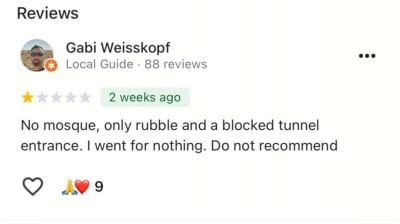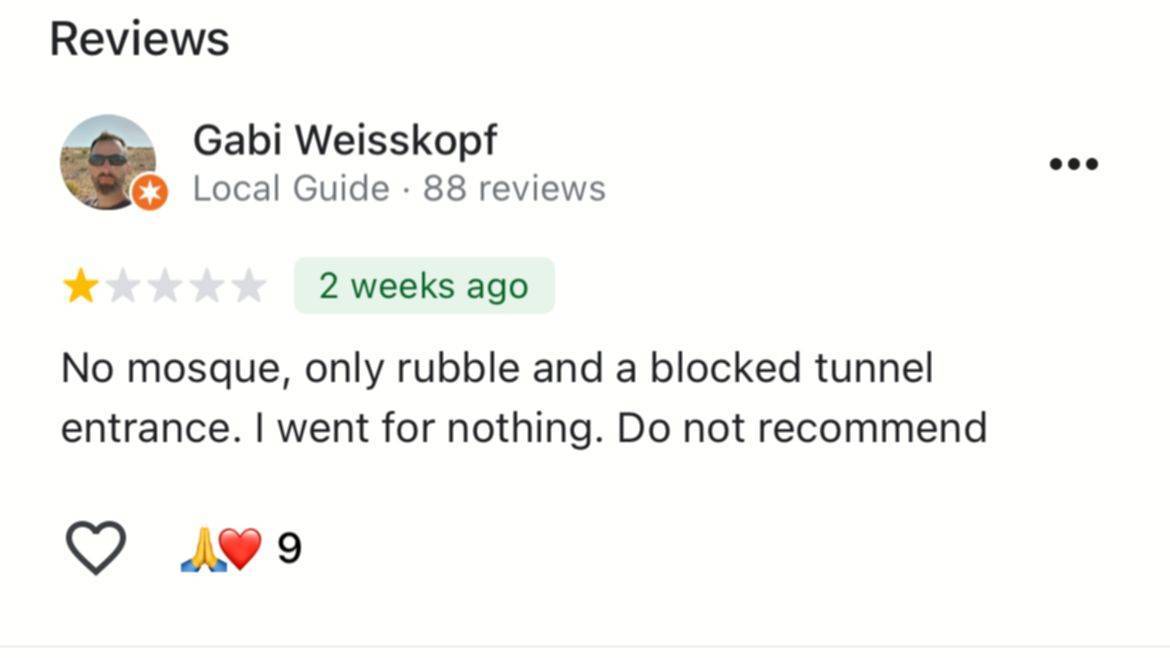
"No mosque, only debris and a blocked tunnel entrance. I went for nothing. I do not recommend." Under the Google listing of a mosque in southern Lebanon, a man mocks the destruction caused by Israeli bombings. Screenshot from Google Maps.






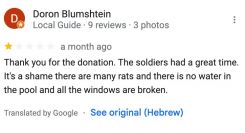
"Thank you for the donation! The soldiers had a great time. It's a shame there are many rats and there is no water in the pool and all the windows are broken." A Google Maps user, Doron Blumshtein identified as an Israeli "local guide," posted a one-star review in Hebrew mocking the war-damaged Khalet Farah chalet in Aita al-Shaab, southern Lebanon.
The Israeli ground offensive in southern Lebanon, launched on Sept. 30, has been met with a wave of disturbingly ironic comments on Google Maps, where Israelis mock the very destruction caused by their military.
Another Israeli "local guide" named Gabi Weisskopf on Google Maps mocked the destruction of the Ahl al-Quran Mosque near Yarine (Sour district), writing, "No mosque, just debris... I don't recommend it," with a laughing emoji.
The mockery extends beyond tourist attractions and religious sites; even the country's dilapidated hospitals are not spared. "A little too full," an Israeli user on Google Maps callously described the bombed-out Salah Ghandour hospital in Bint Jbeil just weeks after it was heavily damaged in airstrikes.
Google policy violations
Applauded by Israel's supporters on X, who see it as a "psychological defense mechanism" by Israeli soldiers, these comments nonetheless violate Google’s user contribution policy, which prohibits "offensive" and "deliberately provocative" content. However, since Google is the sole moderator of these reviews, they can only be removed by the company itself.
Contacted by L’Orient-Le Jour, the American company emphasized that "contributions to Google Maps are open to everyone. If a review violates our rules, we remove it, and we encourage users to report such content so that we can review it and take action."

That said, and despite suspicions of war crimes committed by the Israeli army in Lebanon, regardless of the circumstances, "Google will not be legally liable for content generated by its users," notes Ralph Beydoun, director of the research and strategic communication firm InflueAnswers. "These platforms generally benefit from a certain degree of legal protection against the actions of their users. However, Google could face lawsuits or public pressure to remove harmful or violence-inciting content, depending on the laws in effect in various countries and the specifics of the situation."
Will Google Provide Updated Satellite Imagery?
Google could also face public pressure regarding the updating of its maps, as was already the case for the Gaza Strip, especially as entire neighborhoods have been completely destroyed in at least 37 villages in southern Lebanon since the war between Israel and Hezbollah began on Oct. 8, 2023. While some bombed sites are already marked online as "temporarily closed," it is still impossible to view the extent of the damage on online maps, as updates are not automatic, and the delays for reflecting such changes can sometimes take several years.
“Updating satellite imagery is a complex process with variable timelines,” explained Jihad Bourassi, a data science and image processing engineer at BRGM (Bureau de recherches géologiques et minières - France's public reference institution in Earth Science). “Satellite imagery updates depend on the frequency of satellite passes over the area; the more frequent passes mean faster updates. Moreover, analyzing and interpreting satellite imagery is a time-consuming and resource-intensive process, further delaying map updates. Furthermore, access to satellite imagery can be restricted by legal or commercial constraints, particularly in conflict zones, further delaying map updates.” For its part, Google says it is exploring "the possibilities of updating satellite images as soon as they become available" but states that it does not "have any new plans to share at this time."