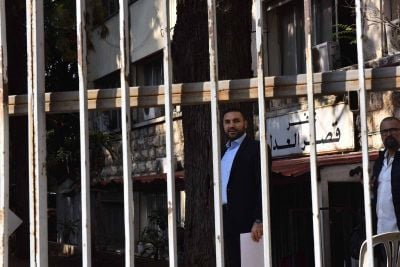
Journalist Mohammad Barakat, Thursday November 7, 2024, at the Palace of Justice in Beirut. (Credit: Provided to L'Orient Today)






Mohammad Barakat, editor-in-chief of the Asas Media website, appeared before Acting Public Prosecutor at the Court of Cassation, Jamal Hajjar, on Thursday, following a complaint recently filed by sheikh Ali Khatib, vice president of the Supreme Islamic Shiite Council. In an interview on the al-Jadeed channel aired on Oct. 28, the journalist accused sheikh Khatib of failing to assist those displaced by the ongoing war in Lebanon and questioned the financial transparency of the Supreme Islamic Shiite Council over the past 20 years.
After the questioning by Judge Hajjar, the journalist was released on bail. Before the hearing, he posted on his X account, questioning "why a million displaced Shiites have not been helped, why Supreme Islamic Shiite Council funds have been spent outside the budget, why there has been no oversight of khoms (religious taxes) and zakat (alms) funds, and why the restoration of buildings in Hazmieh owned by the Council was carried out without a tender process.”
“My words (during the TV interview) have been distorted,” Mr. Barakat told L'Orient-Le Jour, pointing out that the complaint overlooked the “financial accusations” he had made and was thus “presented as a defamation case.” In a statement released late Thursday afternoon, the journalist claimed that the distortion of his words was a part of accusations of “stirring up sectarian strife,” a charge punishable by up to three years in prison.
“My comments do not undermine the dignity of sheikh Khatib, nor that of the Supreme Islamic Shiite Council,” he assured. According to his statement, Mohammad Barakat intends to submit documents proving "the offenses committed" to the Cassation Prosecutor's Office by next week.
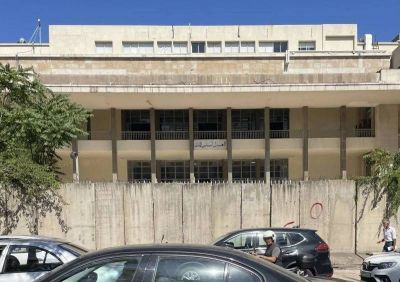
Restoration for personal use?
On the program in question, Mr. Barakat alleged that the sheikh had four buildings restored in Hazmieh, accusing him of “keeping them for personal use” despite their potential to house “200 families.” He noted that during the July 2006 war, sheikh Abdel Amir Kabalan opened “to the displaced the same buildings that Imam Moussa Sadr (the Shiite leader who disappeared in 1978) had dedicated to the service of the Shiite community.”
When contacted, a source from the Supreme Islamic Shiite Council confirmed that only one building had been restored, with just one apartment being livable, while the rest of the premises are used as offices and reception rooms. According to the same source, sheikh Khatib, whose home is located in a bombed-out area of Beirut's southern suburbs, was asked by Council officials to move into the apartment, where he has been living for the past month. The source added that the restoration of the building was financed by the state budget.
The editor-in-chief also accused sheikh Khatib of spending “a billion Lebanese pounds a month,” roughly equivalent to $11,000, on his personal expenses. The interviewed source disputed this figure, assuring that, as part of the government budget, sheikh Khatib receives a salary of no more than the equivalent of $2,000 from the Lebanese state. Mr. Barakat also accused the Council's Executive Committee of neglecting its duty to investigate and approve the accounts of religious charities.
“Hundreds of millions have been raised over the past 20 years, yet none of this money has made its way into the Council's coffers,” he said. This was also refuted by the interviewed source, who stated that it was “regional Shiite authorities,” not the Council that collected those funds. Finally, in response to criticism over the lack of aid for the displaced, the said source stated that the Council “has opened the doors of the Islamic University (Khaldeh) and Waradiya University in Iklim el-Kharroub to nearly 400 families.”
Last August, the Lebanese Order of Editors called on journalists “to refuse to appear before any court other than the press court,” which has jurisdiction over press offenses. In his press release, Mr. Barakat stated that he received the same advice but chose not to follow it, explaining that he has “confidence in the integrity and wisdom of Judge Hajjar.”