





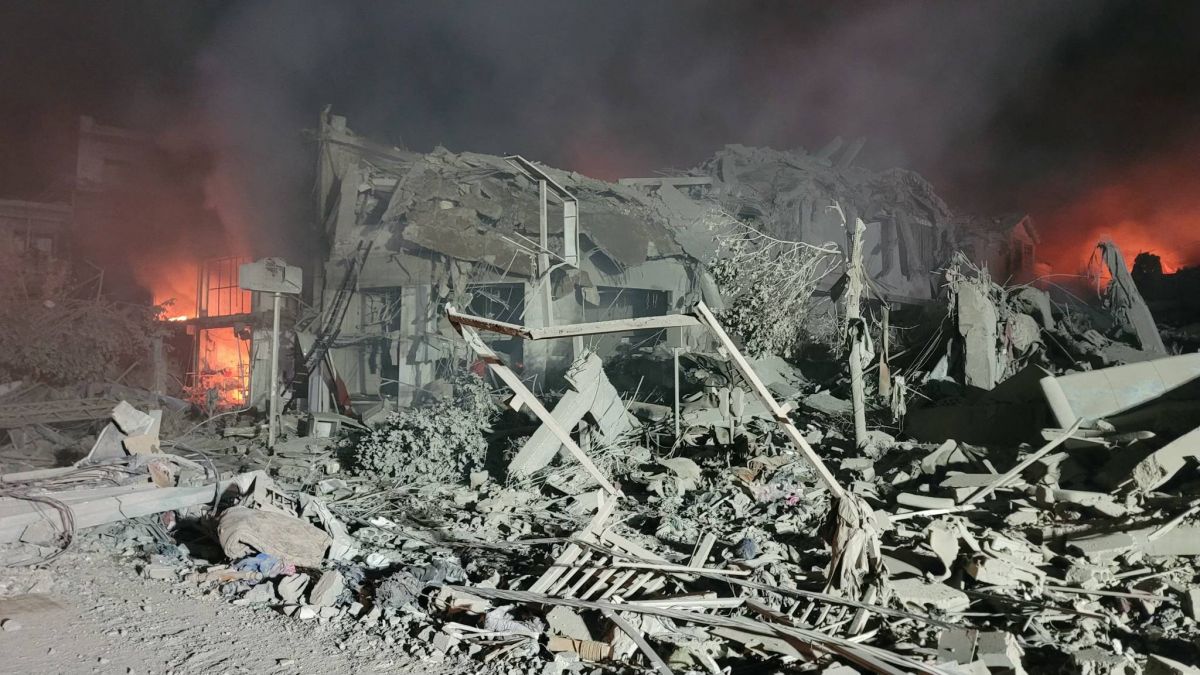
The destruction caused by an Israeli air strike that targeted the city of Nabatieh, in southern Lebanon, on Oct. 12, 2024. (Credit: Abbas Fakih/AFP)






Following Hezbollah's initial statement on Sunday, Oct. 14, 2024, in which it accused the Israeli army of bombing the villages of Hanine and Tiri in the Bint Jbeil district of southern Lebanon with "missiles loaded with cluster bombs," in the ongoing war in Lebanon, the group issued a second statement on Monday reiterating these accusations. The second announcement stated that the bombs targeted several areas in southern Lebanon's Marjayoun district, including Alman, Wadi al-Khanzir (in Wadi Hojeir region), Khallet Raj (between Alman and Deir Siryan).
"We call on international humanitarian and legal organizations to condemn these crimes, particularly as they could have long-term negative repercussions for civilians," the statement added.

After reaching out to the Lebanese Army and the Civil Defense, L'Orient Today was unable to independently verify Israel's use of these bombs. Additionally, Hezbollah did not respond to requests for further information. However, sources cited by our correspondent in southern Lebanon reported that these bombs have been dropped in several locations in recent days, primarily where fighting is intensifying between Hezbollah fighters and the Israeli army. Affected areas include Labbouneh and Hamoul on the outskirts of Naqoura in the Sour district, as well as Jibbayn, Aita al-Shaab, Hanine, and Tiri — all located in the Bint Jbeil district. Our correspondent noted that, at this time, it is unlikely that photos or other evidence documenting the use of these weapons will emerge due to the intensity of the ongoing fighting in these areas.
According to the United Nations, "cluster munitions" refers to any weapon system that fires a cluster of small explosive submunitions at a target. These munitions are prohibited under the Convention on Cluster Munitions, signed in Oslo in May 2008 and came into force in 2010. This prohibition is based on the indiscriminate nature of the injuries such munitions cause, which do not distinguish between military and civilian targets.
The number of countries bound by the provisions of this international treaty stands at 112, with an additional 12 countries joining the original 94 signatories, according to a U.N. report from Sept. 5, 2023. Israel is not a signatory to the treaty. Despite its existence, cluster bombs continue to claim many victims worldwide. The report indicates that 987 people were killed or injured by these munitions in 2022 alone, with the vast majority of casualties occurring in Ukraine (890) following the Russian invasion.

What do cluster bombs have to do with the advance of Israeli troops into Lebanon?
The mention of cluster bombs, or fragmentation bombs, evokes painful memories in Lebanon, as they were used extensively by Israel during the 2006 war in Lebanon. An estimated four million of these munitions were dropped in southern Lebanon and western Bekaa in the last 72 hours of the conflict, as former Lebanese Foreign Minister Adnan Mansour recalled in September 2011 ahead of a meeting of partner countries to the Convention on Cluster Munitions in Beirut.
At the time, Mansour noted that 400 victims had also been reported due to contact with these munitions hidden in the ground, one-third of whom were children, after the cessation of hostilities. The toll of victims did not end there; as recently as 2019, casualties continued to occur in the southern Lebanon, despite several demining operations carried out by the army and the U.N., which continued until 2018.

Stationed in southern Lebanon in 2006, retired General Sami Rammah recalls this period well. "These extremely dangerous munitions can be dropped from aircraft or launched by artillery," he told our publication. These bombs explode before hitting the ground, sending shrapnel in the form of metal balls or nails over a large area, which detonate upon contact with a person or object. However, many remain buried underground and can explode much later when unsuspecting victims, such as farmers or children, come into contact with them.
"I wouldn’t be surprised if Israeli troops used these munitions during the ground incursion stage, as they always seek to advance with as few [Israeli] casualties as possible, preferring to eliminate a large number of opponents in order to facilitate their advance," Rammah analyzed.
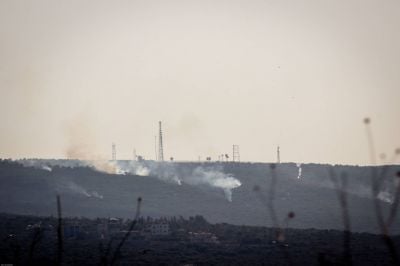
In its statement on Sunday, Hezbollah described the use of such weapons as "a new barbaric crime that adds to the series of atrocities against the Lebanese and Palestinian peoples" committed by the Israeli state. This comes amid Israel's ongoing war with Palestinian Hamas in Gaza, which began in October 2023. In the statement, Hezbollah claims Israel used these weapons in Lebanon "because it has recognized the incapacity of the international community and organizations to confront its crimes." So far, there has been no official reaction from Israeli authorities.
This article was originally published in French in L'Orient-Le Jour