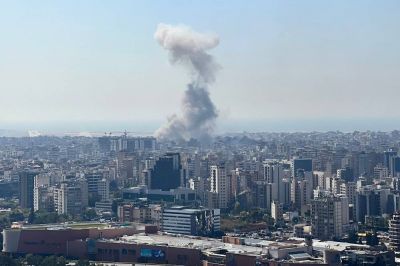
Smoke rises from the site of an Israeli airstrike that targeted a neighborhood in the southern suburbs of Beirut on October 8, 2024. (Credit: Mohamed Abouelenen/AFP.






Once her papers are stamped, Mona takes a deep breath. She will be able to board with the Turkish navy to leave Lebanon, her country now grappling with "a war that kills, destroys, and deprives everyone of sleep."
Surrounded by her four children, ten suitcases in hand, this 42-year-old Turkish-Lebanese woman is about to leave with tears in her eyes with a feeling of "wrenching," but also relief to put her family out of reach of the daily Israeli bombings on the southern suburbs of Beirut, the stronghold of Hezbollah.
"We had the most beautiful country in the world and now we are refugees," she laments, "they destroyed our lives and stole our laughter."
On Wednesday, Ankara organized the most significant evacuation of foreign nationals from Lebanon. In total, it plans to transport 2,000 of its citizens and their relatives on two ships — out of 14,000 registered Turkish citizens in Beirut. They are expected to arrive Thursday morning at the port of Mersin, in southern Turkey.
"Security nowhere"
"We are the first and only ones to carry out an evacuation operation of this scale since the beginning of the conflict in Lebanon," which has been dealing with cross-border shootings between Israel and Hezbollah for a year that recently turned into open war, boasts Ambassador Ali Baris Ulusoy. Salwa al-Agha, who was born and has lived her entire life in Beirut, is of Palestinian origin and a Turkish citizen, is leaving with her two children.
"Even if we weren't under the bombs, we weren't safe anywhere. We heard the explosions and it has a psychological impact on us," she tells AFP, as Turkish diplomats work to check the identity papers of travelers leaving. She admits, all three are leaving "into the unknown." "But I am leaving to keep the children safe," she assures.
After kissing her sister one last time in tears, she walks away saying she is "leaving a part of (her) heart" in Beirut. Ambassador Ulusoy, meanwhile, is already considering "possible additional evacuations" from Lebanon where, in addition to the bombings, the Israeli army launched ground incursions in the south on September 30.
Since October 2023, over 2,000 people have been killed in Lebanon, including nearly 1,200 since September 23, according to an AFP count based on official figures. "It will depend on the number of requests from our citizens and security conditions. If the situation deteriorates further, these requests will surely increase," anticipates the Turkish ambassador.
"The war will last"
So far, many Lebanese have taken flights — the Beirut International Airport, close to the southern suburb, is still operational — at their own expense. Meanwhile, more than 400,000 people, mostly Syrians who came to Lebanon to escape war in their own country over a decade ago, and Lebanese, have crossed the Syrian border on foot. Foreign capitals regularly call on the Israeli army to spare Lebanon's only airport, to allow their nationals to leave if they wish. Lebanon says it has received only "commitments" and no firm "guarantees" that it will be spared.
Ghazi Youssef never thought of leaving before. And yet, in thirty years in Lebanon, he has experienced at least two wars with Israel, the worst economic crisis in Lebanon's modern history, and the shockwaves of the conflict in neighboring Syria. But this time, suitcase on his shoulder, he marches, determined, toward the port. "This time, the bombings are stronger," says this 58-year-old Turk.
Mohammed Diab has also endured everything. This developer has borne the brunt since 2019 and the country's bankruptcy, which severely impacted his real estate promotion contracts. Today he has decided to leave with his two children, one of whom suffers from kidney disease and uses a wheelchair. "We cannot stay in Lebanon," stresses Mr. Diab.
He has no idea what he will do in Turkey, but it doesn't matter, he says. "If the situation improves, we'll return to Lebanon." Before adding: "but it seems like the war will last."