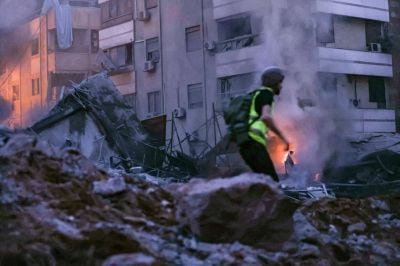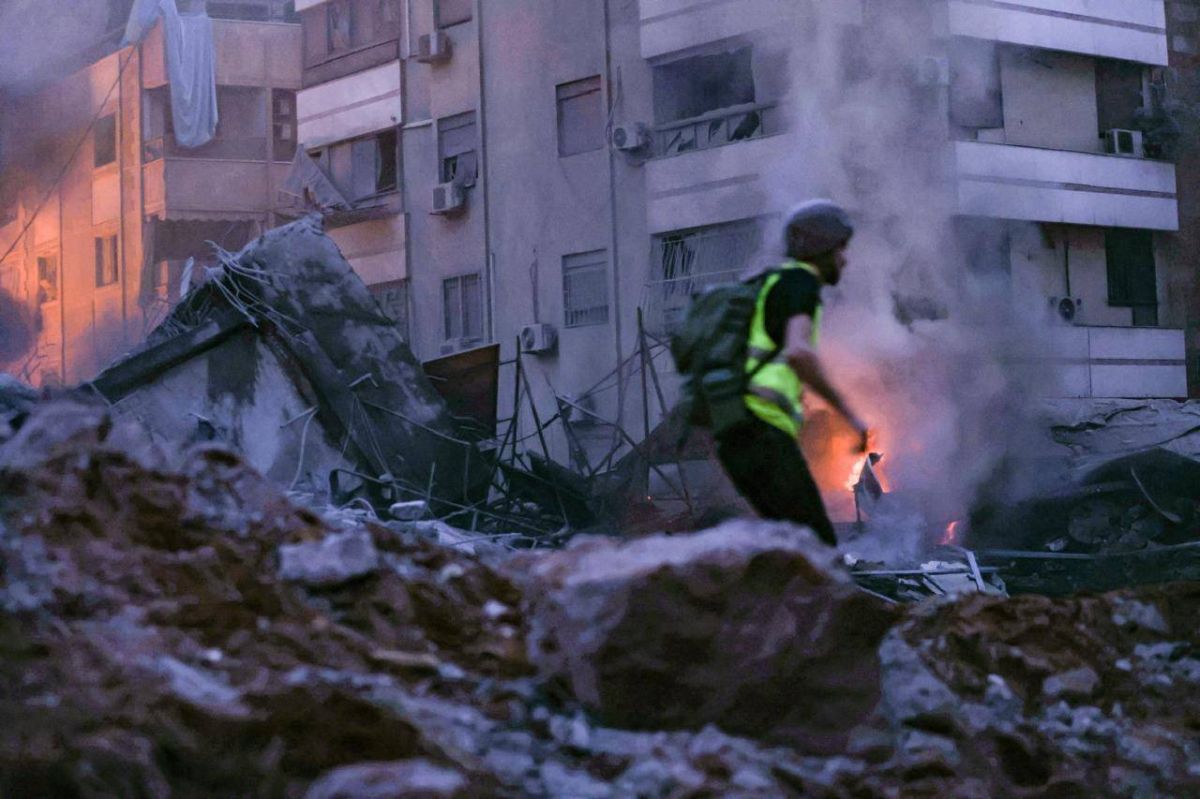
A rescuer in the rubble of Beirut's southern suburbs yesterday, following an Israeli strike. (Credit: AFP)






At dawn, men are busy in still-smoking perimeters, walking on heaps of ashes. Around gaping craters from which iron rebars sprout, rows of disfigured buildings threaten to collapse. The southern suburbs of Beirut, densely populated and a Hezbollah stronghold, had always known they were on the front line. At 6:30 p.m. yesterday, a series of bombings targeted several of the party's command centers. Their blasts shook the capital and the heights, where everyone thought the bomb had fallen next to them.
In Dahiyeh [Beirut’s southern suburb], those who had not yet left, after a week of particularly deadly attacks throughout the country, understood that it was time. Ahmad*, like many others, had gotten used to the sound of bombs. But yesterday, at the moment of the detonation, he did not want to know who, how, or even where. He, his wife and his daughter grabbed the bags they had prepared during the day and drove to their village. During the first hours of the night, everyone initially thought of fleeing. In the capital's streets, there’s a displacement of populations toward squares, far from buildings, like Martyrs’ square in downtown Beirut.
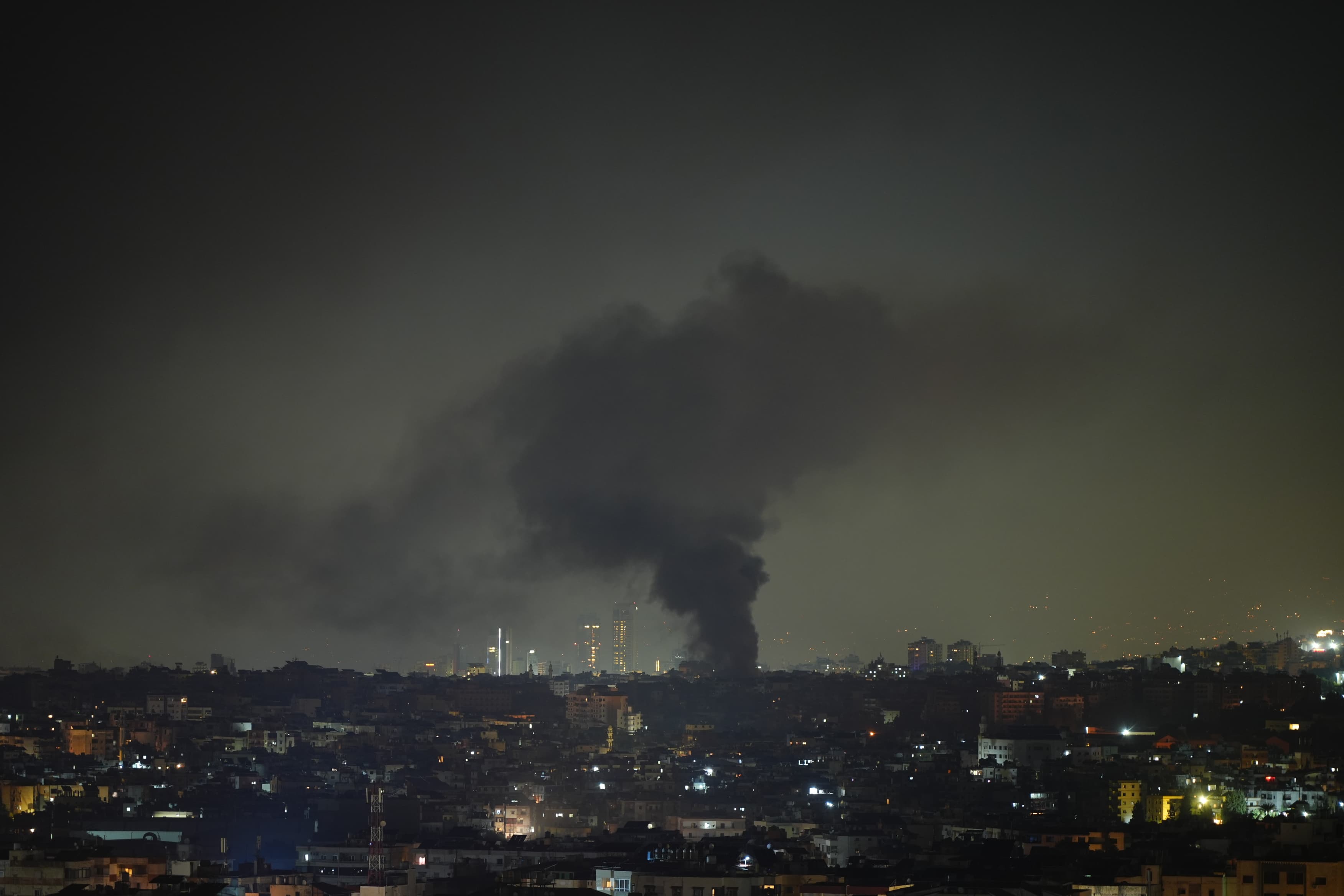 View of Beirut's southern suburbs bombarded by Israel on Sept. 27, 2024. (Credit: Mohammad Yassine/L'Orient-Le Jour.)
With their small ambulance and some supplies, Ihab and his volunteers are helping the displaced sitting in clusters on the sidewalks. “It’s over. It’s war with a capital W. I have never seen such chaos,” said the head of the National Committee for Humanitarian and Social Services, a “non-partisan” NGO as he specified. His rescuers made trips between Hadath and capital schools to shelter families. “None of these youths have slept. I force them to go to bed. It’s 10 a.m., and I’m heading off again. We need to take care of a school because the management refuses to have displaced handled by a party,” said the man. From the Civil Defense headquarters in Furn al-Chebak, which started shaking after the first strike in the late afternoon, Malek* and his colleagues rushed towards the airport road. Arriving 30 minutes later on site, he described buildings erased from the map, “like a parking lot.”
Teams distribute tasks. The area needs securing, and various fires spurting everywhere require extinguishing. Malek crossed haggard faces, lost families asking if he has seen so-and-so, or wondering if their house is still standing.
Where to go and what to do
Marwa* and her loved ones ran, crying, in all directions, from burj al-Barajneh, then drove to Tayyouneh, with children and grandchildren. It’s initially every man for himself. “We thought our building was going to collapse. It was much worse than during the 2006 war,” recounted the elderly lady in her car parked in Saifi village. She and her family don’t know where to go or what to do. Since this morning, she is on the lookout for images or videos indicating their building is still standing.
In Gemmayzeh, Charlie Haber was drinking a glass of wine with two clients when the first explosion rumbled. “It felt like a massive earthquake. We opened the doors, people inside were panicking, they rushed to settle their bill and left,” said the manager at Aaliya’s, a café-bar-restaurant. In the district, all establishments like his ended up closing their doors.
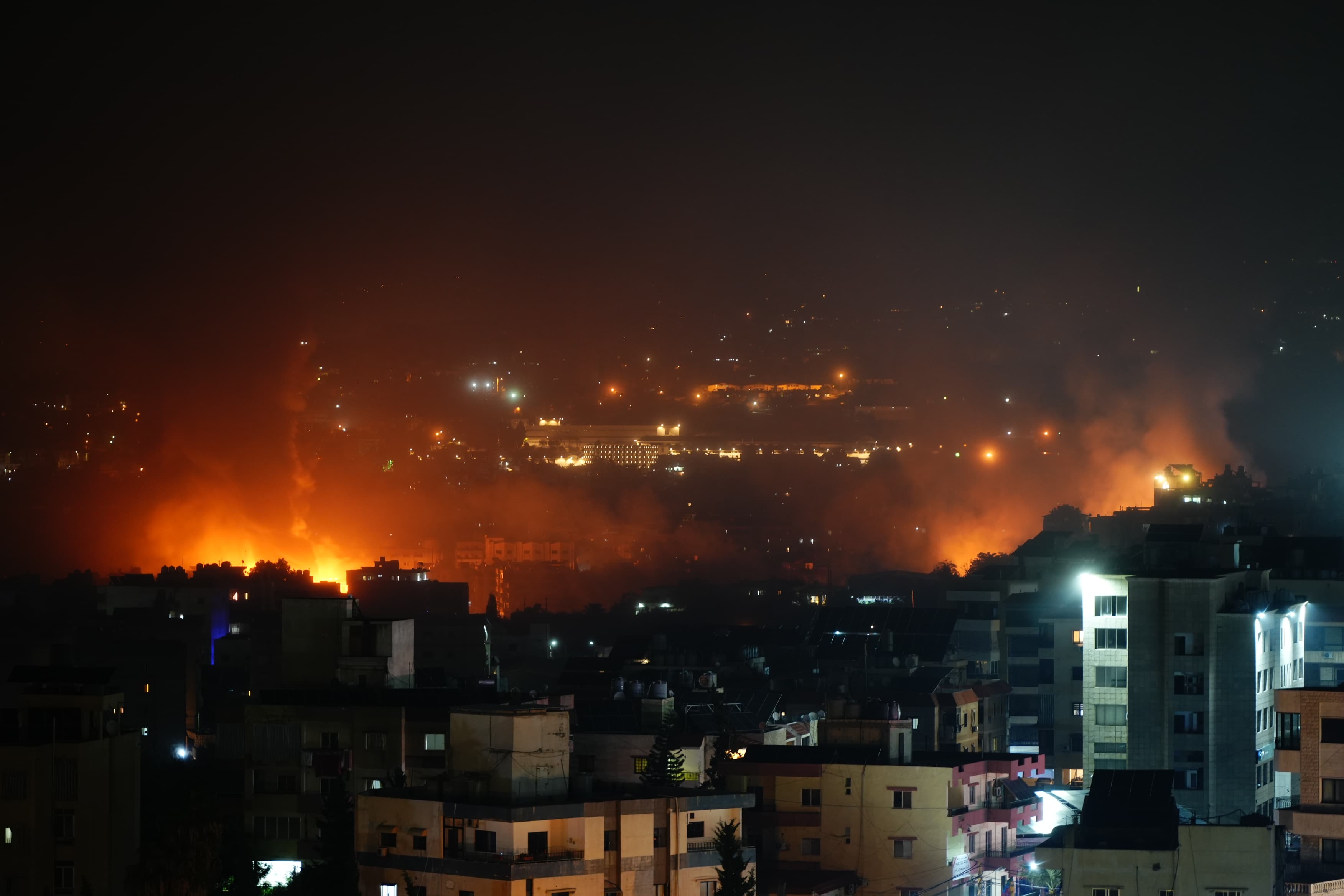 View of Dahiyeh bombarded by Israel on Sept. 28. (Credit: Mohammad Yassine/L'Orient-Le Jour.)
A few kilometers away, panic also took over a high-end hotel in Raouche. Since last Monday’s massacres, the clientele has exclusively consisted of displaced from south Lebanon or Dahiyeh. “We were all in the lobby until dawn, with the noise of airplanes and drones outside. The phone didn’t stop ringing, but we are full. Some of our new clients dashed to the reception, ready to pay 100 or even 200 dollars more per night for fear we’d give their rooms to others,” recounted an employee under anonymity. Ceiling tiles collapsed in the Sainte-Thérèse hospital corridors in Dahiyeh. It’s there, among others, that the first injured from the initial explosion were taken.
First, they had to reassure the already present patients and take care of the newborns in the premature care unit, said the establishment’s director, Elie Hachem. “We’re used to it,” said an employee from a neighboring hospital. “We have seen this before recently. Once you see it the first time, and the second, you get used to such scenes. But of course, it hurts,” he added.
In the early evening, conflicting information circulated. It’s impossible to verify the death or injury toll. Authorities instructed not to communicate any figures until everything is centralized, to avoid fueling panic.
'The Israelis won’t let us go until the last one'
Found safe and sound in an ambulance downtown, Julia and her two children were later transferred to a school in Ras al-Nabaa turned into a shelter since Monday. “We are safe, but what a humiliation! We left with nothing, sleeping on mats. With this atmosphere and these sounds, my little ones didn’t close their eyes until 4 a.m.,” she added.
In the city center, a man recounted having “lost consciousness” after the first strike, which allegedly killed Hassan Nasrallah. Next to him, another feels hunted: "The Israelis won't let us go until the last one." A family sits under a tree, having fled the southern suburbs after the first Israeli warning. “The Lebanese flag has a tree in the middle; we came to hide under the tree. But none of the Lebanese officials are looking at us,” lamented a father. Siham al-Masri, 58, leaned against a pole, worried about her family's fate, from whom she hasn't heard news since yesterday. Her brother-in-law was in one of the buildings targeted during the first operation. Hundreds traveled over 10 kilometers on foot to get closer to downtown or the corniche.
The Israeli army announced more targets in Dahiyeh around 11 p.m. A deadly silence gripped the capital, interrupted only by honking and strikes punctuating the night.
“We were asked to evacuate Dahiyeh like animals,” shouted a woman downtown, under the symbolic fists of the “revolution” of October 2019. She fled around 2:30 a.m., slaloming between bombs. Throughout the night, cars sped from the capital. Omar*, in his 50s, evacuated his family around 11 p.m. As they headed towards the mountains, their town, Choueifat, was targeted. He left his office around 1 a.m. to collect some belongings from home. “I drove like in a video game: A bomb ahead, another behind a while later, a fire next to it,” he said calmly.
Around 2:30 a.m., the bombings intensified. Malek, the rescuer, and his colleagues were ordered to leave the zone immediately. “At that moment, I relived exactly the shelling of Dahiyeh in 2006 when I had just started the job,” he recalled.
'Witnessing the finishing off of an already dead man'
Those who are lucky, are holed up at home watching TV. From the eighth floor of a high-standing building, Mona* and her friends witnessed strike after strike from the balcony, continuous news playing in the background. They compared in fear the lights and sounds of bombs falling on the Sainte-Thérèse, Chiyah, Kafaat, Mrayjeh, Tahwita and other districts.
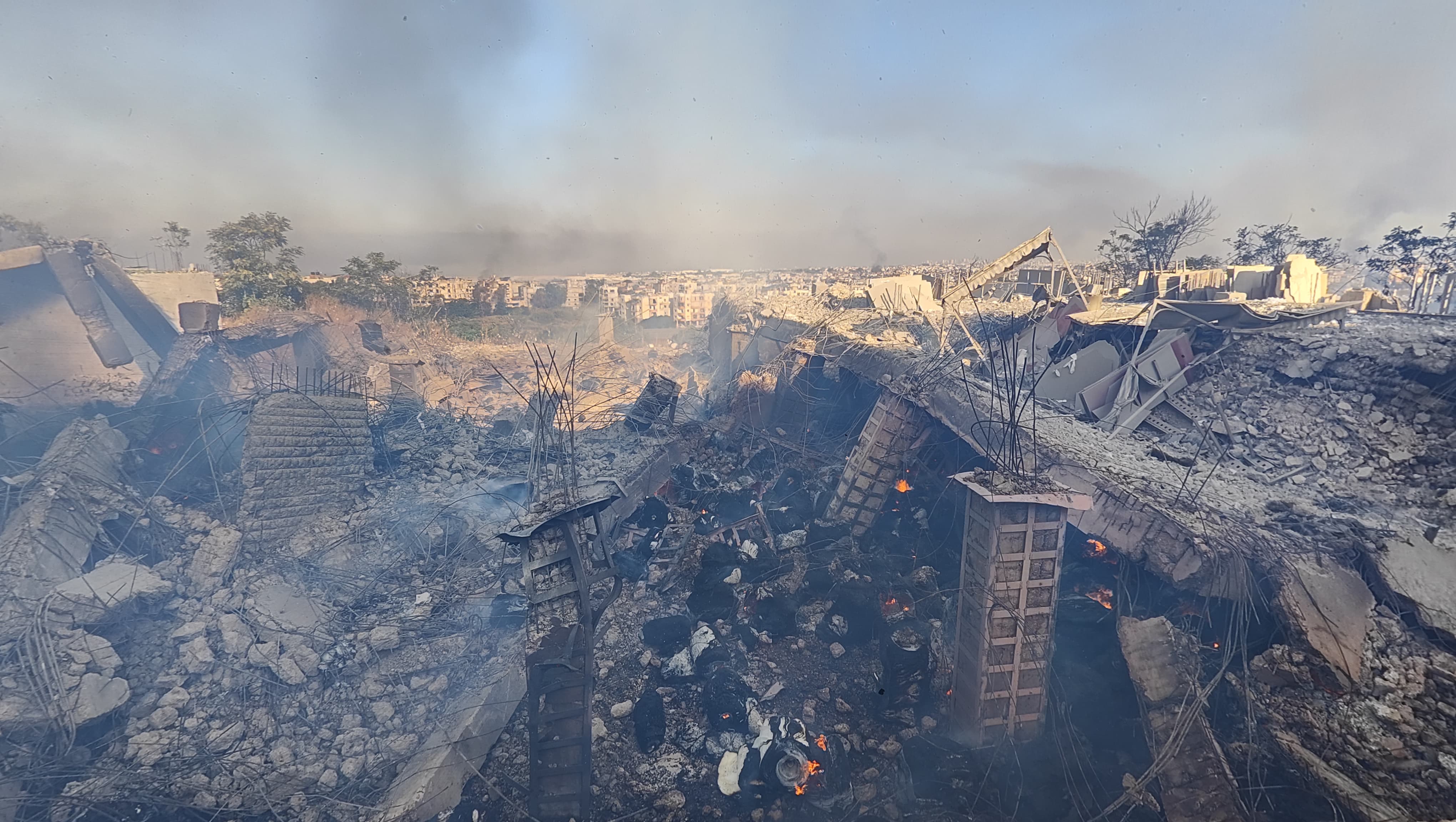 On Sept. 28, in one of the bombed areas in Choueifat, south of Beirut. (Credit: Mohammad Yassine/L'Orient-Le Jour.)
In WhatsApp groups of families, friends, or colleagues, explosions were counted coldly or hysterically. Some ended up sleeping. Others broke down. “I had to calm a woman who couldn’t sit, pacing back and forth in the room. We had to bring her back to the present without analyzing past wounds or thinking about the future,” recounted Eliana Kachaamy, psychotherapist, and co-founder of the Lebanese Association of Terrorism Victims.
In everyone's mind across the country, layers of images, stories, and thus, traumas, resurfacec. The Israeli invasion of 1982, the 2006 war, and even the Beirut port explosion on Aug. 4, 2020.
Rana and her family haven’t moved from the Karantina neighborhood since that fateful date when her husband and little Hussein were injured. Mohammad, her husband, had then sworn to tear up his passport if he managed to leave the country. “Last night, I only thought of that day. And I wondered how to run with the little one,” she recounted in the morning.
There are also those who anxiously follow developments from abroad. Like Lara*, 39, from Khiam, who recounted from a European country feeling like “witnessing the finishing off of an already dead man.” Her family living in the southern suburbs updated her all night on WhatsApp. Their building still stands, but for how long?
In one night, an entire myth collapsed before her eyes. “It’s the end of a story. And it makes one wonder if we haven’t been fed lies about Hezbollah’s power and indestructibility for decades. Even Hamas has resisted more than the party.”
At dawn, the mystery of Hassan Nasrallah’s fate persisted. The casualty toll remained uncertain. Rescuers were still deployed to assist inhabitants from the rubble. Thick columns of smoke still rose in the sky. The day dawned over a city still holding its breath. A few hours later, his death was announced by the party: The beginning of a new era.
*Names have been changed.
This article was originally published in L'Orient-Le Jour.