


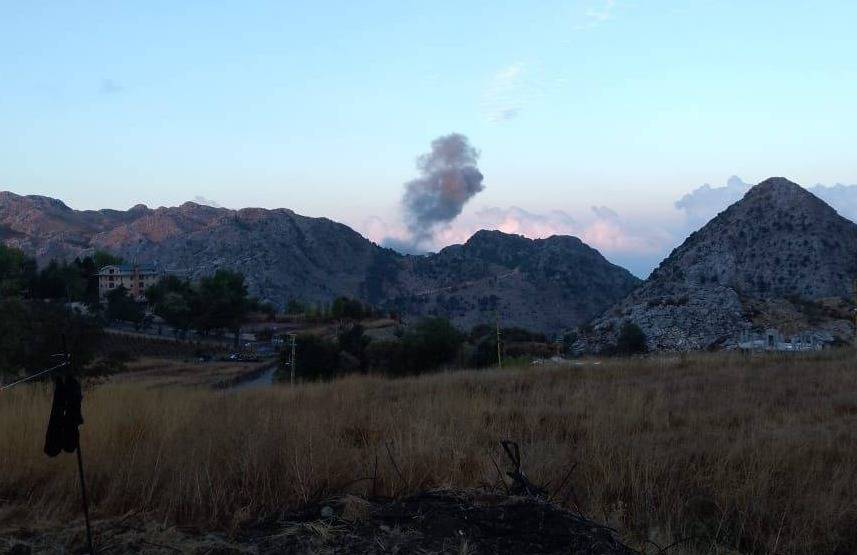
A smoke plume rises from where a missile fell between the two villages of Ehmej and Almat, some 35 kilometers north of Beirut, in the Jbeil district, on Sept. 23, 2024. (Credit: Oussama Abi Younes)






A missile fell around 34 kilometers north of Beirut on Monday morning in the uninhabited mountainous area of Wardiyat, near the villages of Ehmej and Almat, in Jbeil district. No casualties were reported.
Ehmej's mayor, Nazih Abi Semaan, confirmed that the missile was indeed an Israeli weapon, but he believes it fell on the village's outskirts by mistake during one of the many flights over the area made by Israeli jets that morning.
"Our village was not directly targeted," Semaan said. "The area where the missile fell is an agricultural zone and dedicated to ecological tourism. It was probably an Israeli missile, as planes flew over the area this morning."
An MP from Jbeil, who requested anonymity, warned that a miscalculation could lead the country into an accelerated escalation. "We warned against an all-out war with regards to Iran's calculations," he said.

Simon Abi Ramia, also an MP for Jbeil, said that the missile fell in the Ehmej jurd (Arabic for forest).
"But there is no military activity in this area," he said, describing it as a place lived in by some farmers and regularly visited by tourists. A security official told Ramia that the institution is "99 percent sure" that the missile fell by mistake.
The exact location of where the missile fell has been described diversely. Tony Abi Younes, manager of a bakery in Ehmej, told L'Orient Today that the missile fell in an agricultural area where apple trees and tobacco are grown. However, the owner of a ski rental shop in Ehmej said the missile fell in a rocky, deserted area, accessible only on foot.
Mohammad Awad, a journalist from Almat, a predominantly Shiite village, said that around 6 a.m., residents heard the sound of the missile landing between his village and the predominately Christian village of Ehmej. Awad said the missile fell near an empty cave, but emphasized that Hezbollah was "not carrying out any military activity there," a point that Younes also asserted. According to Awad, the prevailing belief among security institutions with which he has contacted is that the missile fell in the area by mistake.
The ski rental shop owner feels the same. "I don't think we were directly targeted, but there were a lot of Israeli jets flying over the area yesterday," he said.
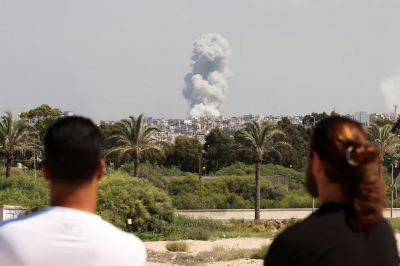
Fighting between Hezbollah and Israel has escalated significantly in the last week, and on Monday morning, the Israeli army struck hundreds of targets in southern Lebanon and the Bekaa, promising "more extensive" raids against Hezbollah and issuing a warning to people in Lebanon to "stay away from Hezbollah targets."
"If it turns out to be an Israeli attack," said Fares Souhaid, a former Jbeil MP, ‘"it would be a message from Tel Aviv to Hezbollah, to make it understand that no region can be considered safe for it."
He urged the Lebanese Army to investigate the incident, saying that the missile had fallen in an area known as Beqaatite Almat.
Employees from both the Ehmaj and the Almat municipalities confirmed that the Lebanese Army was on site, and Ehmej's mayor said that security forces were taking samples from the site of the strike.
Reporting contributed by Michel Hallak, L'Orient Today's correspondent in northern Lebanon.

