






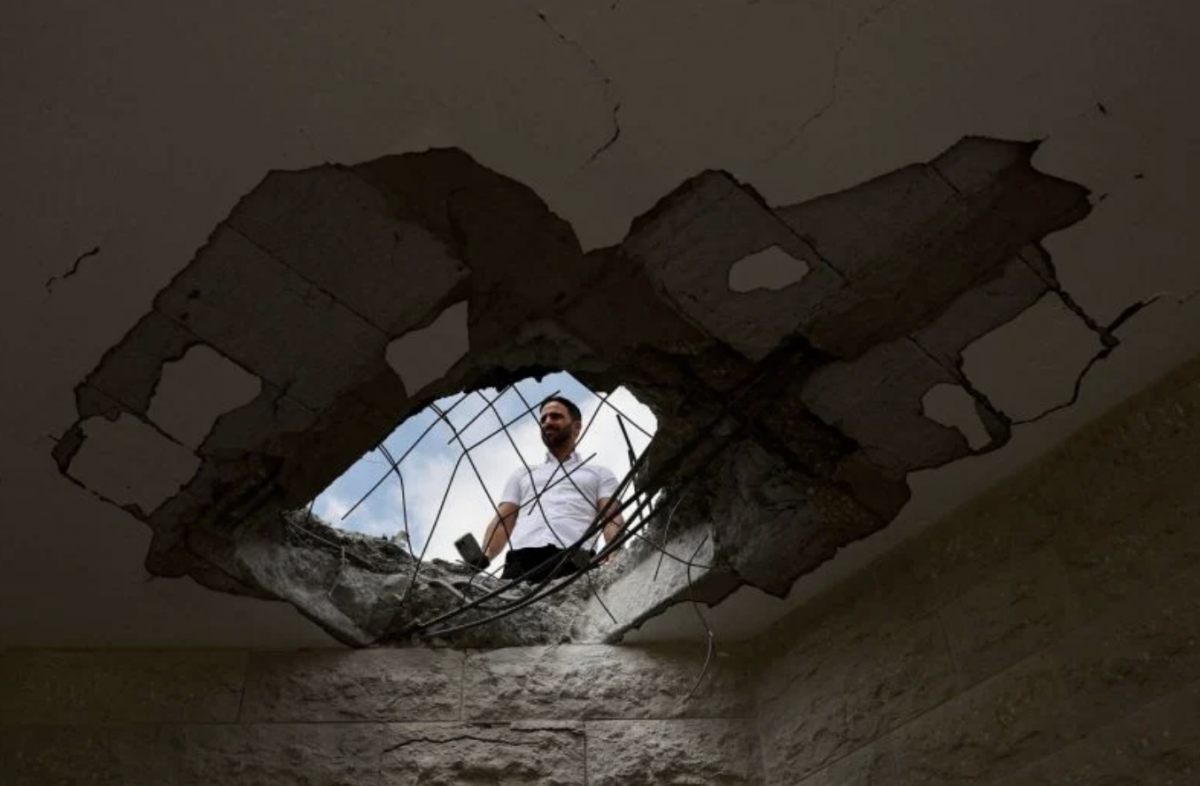
An Israeli assesses the damage to a residential building after being directly hit by a projectile, following Hezbollah's launch of hundreds of rockets and drones towards Israel, in response to the assassination of Fouad Shukur, Aug. 25, 2024. (Credit: Ammar Awad/Reuters)






At dawn on Sunday, Hezbollah finally retaliated to the assassination of its military chief Fouad Shukur, immediately after the “pre-emptive” Israeli strikes that targeted several villages in south Lebanon almost an hour earlier.
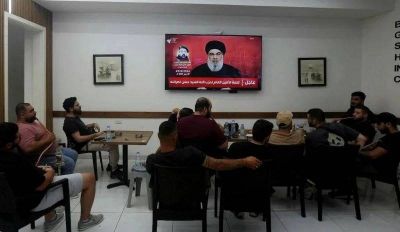
According to Hezbollah Secretary General Hassan Nasrallah, who gave a speech on Sunday evening, the main target of Sunday’s operation was the Israeli Glilot base, home to Israeli army Unit 8200, located “110 kilometers from the Lebanese border and 1,500 meters from Tel Aviv.”
Unit 8200 is the Israeli intelligence corps's largest and most important information-gathering unit, according to the official Israeli army website. It operates in all areas and wartime, the site added, members of the unit join combat field headquarters “to enable a faster flow of information.” The Israeli army denied that the base was hit.
Nasrallah also claimed that the second target was an air base and missile defense site located 75 kilometers from Lebanon and 40 kilometers from Tel Aviv. In his speech, he congratulated himself on an achievement.
However, it has not been confirmed whether Hezbollah actually succeeded in hitting these bases, or whether Israel’s Iron Dome intercepted the projectiles, as Israel claimed. The Israeli army said it “identified Hezbollah’s plan” before it was launched and then carried out “self-defense” strikes to stop it.
The Israeli army’s Arabic-speaking spokesman, Avichay Adraee went on to say that no one was injured and “no military camps were hit in either northern or central Israel.”
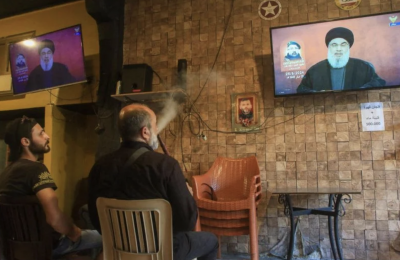
“Nothing but lies,” replied Nasrallah in his speech. It’s hard to tell who is lying and who is not. But what do the military experts think?
No proof
Hezbollah initiated the attack by firing 320 Katyusha rockets at 11 different Israeli positions in northern Israel and the occupied Syrian Golan. These rockets aimed to “flood the interception missile system and open a space for the drones to go through and hit the desired targets, " said military expert and former war correspondent Elijah Magnier.
Before the attack, some analysts said that Hezbollah might use precision-guided missiles to target the Israeli cities of Haifa or Tel Aviv, which the party ultimately decided not to do. According to Magnier, the reason Hezbollah used drones rather than precision-guided missiles is that it still wants to avoid an all-out war. The use of these missiles could lead to heavy retaliation by Israel, which would increase the risk of war.
“The fact that Hezbollah has not used these precision-guided missiles is a smart decision,” said Magnier. “Hezbollah is telling Israel that it doesn’t want to show all the weapons it has unless Israel decides to go to an all-out war. In this case, the party would have no red lines,” Magnier added.
Military expert Riad Kahwaji said, “There is no evidence so far that Hezbollah targeted a base near Tel Aviv,” and added that “the party has stuck to its rules of engagement by keeping targets within the usual depth, no more than 20 kilometers,” deep into Israel.
Israel’s claim of ‘pre-emptive’ strike is ‘inconsistent’
What about the intensive raids on villages in south Lebanon, which Israel described as “pre-emptive”? Magnier questioned the Israeli version. “This so-called pre-emptive Israeli strike on South Lebanon is dubious because Hezbollah’s attack came afterward, which means that the attack was programmed and took place anyway,” said the expert.
Magnier added that the “pre-emptive” strike was also dubious given that it did not “achieve its objective” or prevent Hezbollah’s planned retaliation. “How is it possible to destroy so many bombs, which were ready to be fired, without killing anyone? It’s impossible. Where is the unit in charge of firing these missiles? It’s inconsistent,” added Magnier.
Former Lebanese Army general Wehbeh Qatisha did not share the same reading. “Of course it’s credible. The Israeli intelligence services are very strong and constantly monitor the front. They’ve been maintaining this front for more than 10 months, and one can see how precise their information is: Any Hezbollah fighter on a motorcycle can be tracked down and eliminated,” he said.
For his part, Kahwaji underlined the lack of evidence: “We don’t know what Israel targeted or what damage it caused because there is no visual evidence.” The Israeli army said on Sunday that it had attacked thousands of rocket launchers in Lebanon with more than 100 fighter jets. “This figure is exaggerated, it’s more like dozens of rocket launches, which is still significant if true,” the expert said.
Communication is controlled
Nasrallah also denied Israeli allegations that Hezbollah had planned to fire 6,000 rockets. Does Hezbollah have the capacity to send such a large number of projectiles? “Firing 6,000 rockets would require hours of preparation. Nobody can do it just like that, in two minutes. The Israelis surely knew that Hezbollah was preparing a large-scale attack, but they also exaggerated their account of the attack so that they could say later, ‘You see, it was a huge offensive and we managed to counter it’,” said Qatisha.
“In any case, even if it was 6,000 rockets, if the damage was not significant and they stayed within a strike zone of 10 to 15 km from the border, it’s just much ado about nothing,” he said. According to him, “In any military organization, the discourse produced is never totally true. Reality is always twisted to suit the story the organization wants to tell. This communication is controlled. The Israelis can’t lie too much; there are realities on the ground. But the biggest clue is that no Israeli servicemen have been hit so far, that hasn’t been reported.”
Haaretz reported that the Israeli army said on Sunday that an Israeli Navy soldier was killed in Hezbollah’s attack on northern Israel and said it was investigating the cause of his death. According to Reuters, two other sailors were also wounded in the strike.
This article was originally published in L'Orient-Le Jour and translated by Joelle El Khoury.

