






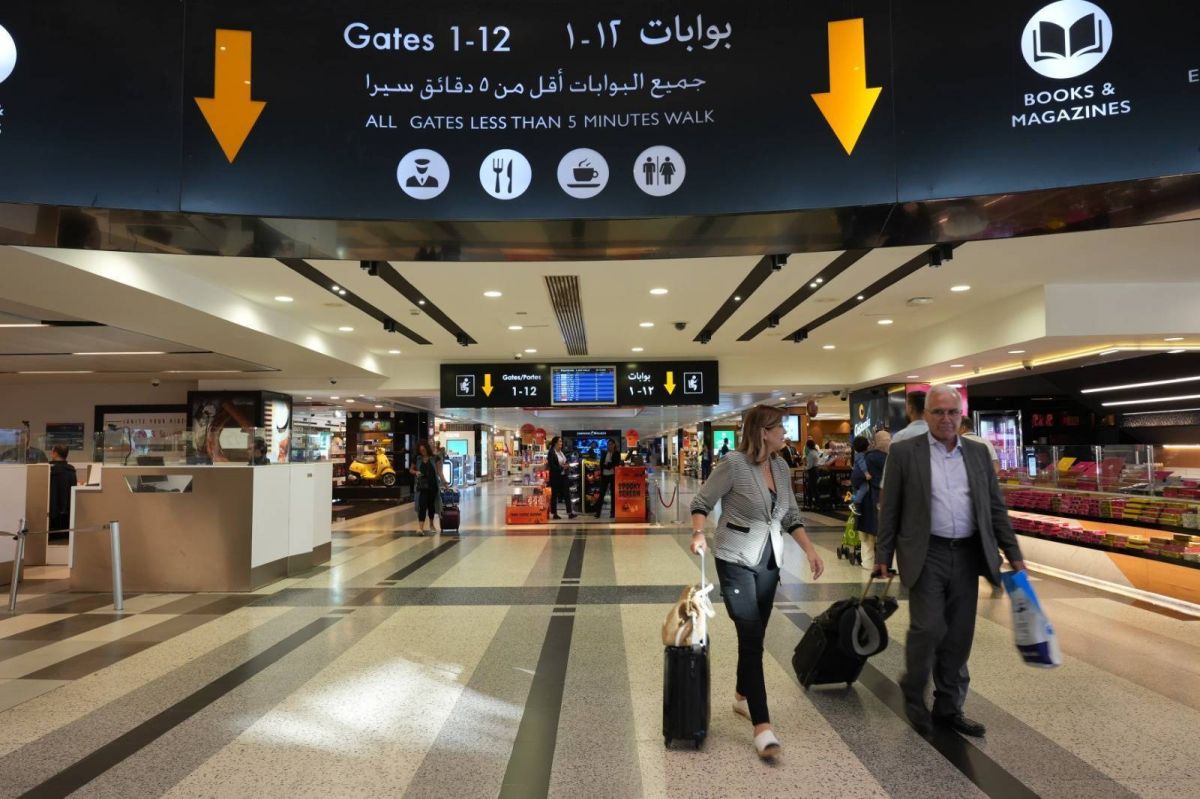
One of the halls at Beirut international airport. (Credit: Mohammad Yassin/L'OLJ)






Fadi El Hassan, Rafic Hariri International Airport's head, revealed on Monday, during an interview on Al-Hurra, the existence of a comprehensive emergency response plan for the airport, ready to be activated in the event of an attack.
"We have a strategic emergency plan in place, similar to what was used during the 2006 Lebanon War, including the use of military airports if necessary," Hassan stated, emphasizing that the plan had been recently updated in collaboration with security agencies.
This revelation was made after recent Israeli threats of a potential strike on Lebanon, which highlighted concerns regarding airport safety, as retaliation after the deadly strike that took place last Saturday in the Druze town of Majdal Shams, in the Israeli-occupied Syrian Golan Heights, which killed 12 children and teenagers.
Since the incident, the Israeli government has issued stern warnings to Hezbollah, accusing the group of responsibility for the strike, and has extended these threats to Lebanon as a whole. In response, Hezbollah, which has been engaged in clashes with Israel since Oct. 8, has firmly denied any involvement.
Hassan reassured that international airlines continue to operate flights from Beirut, regularly conducting safety audits. "The world's leading airlines send teams annually to review our safety measures. If they had any reservations, they wouldn't maintain their operations here," he said, dismissing rumors about security issues.
Lawyer Majd Harb, former parliamentary candidate for North Lebanon and son of former MP Boutros Harb, on Friday proposed an urgent initiative to rehabilitate the military airports in Qlayaat, Hamat and Rayak, transforming them into dual-use airports for both military and civilian purposes.
Middle East Airlines (MEA) CEO Mohammad al-Hout, in a statement to the National News Agency, confirmed that the airline had not received any threats regarding an imminent strike on the airport. "If there was any credible threat, we would not leave a large number of our planes at the airport," Hout asserted, adding, "We would have taken immediate precautionary measures to protect our fleet." He explained that some delays in MEA flights were due to insurance considerations and strategic adjustments. "We are cautious about having a large number of planes on the ground at any given time, in case, God forbid, something happens," Hout elaborated.
Addressing concerns about the airport's readiness, Hout emphasized that MEA is fully prepared for any scenario. "We have a plan in place for every possible situation, including a worst-case scenario where the airport might be targeted," he said. He further noted, "We continue to monitor the situation closely and are in constant communication with local and international authorities."
Hassan also mentioned ongoing collaboration with international partners, including the UK's Ministry of Transport, which conducts annual reviews specifically focused on airport security. He stressed that no airline had raised concerns about security breaches at Beirut's airport, underscoring the high level of trust in the airport's safety protocols.
As the situation in the region remains tense, Hassan concluded with a promise of new facilities and improvements at the airport, aimed at enhancing passenger experience despite the uncertainties that he said passengers will notice in the coming year.
Several airlines have canceled or delayed flights in and out of Rafic Hariri International Airport as Lebanon and the international community expect Israel to retaliate. These flight changes are in addition to delays accrued by several scheduled Middle East Airline (MEA) flights.
