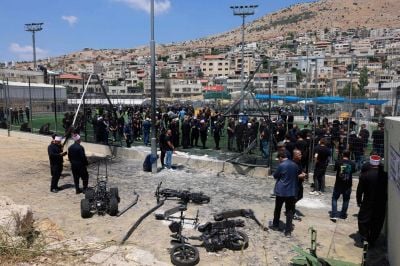
People look at the damage after rockets were launched across Lebanon's border with Israel which, according to Israel's ambulance services killed people, at a soccer pitch in Majdal Shams, a Druze village in the Israeli-occupied Golan Heights, July 27, 2024. (Photo; REUTERS/Ammar Awad)






BEIRUT — We are in a scenario quite similar to the one that followed the Iranian retaliation against Israel on April 13, when the Islamic Republic sent hundreds of drones and missiles into Israeli territory for the first time in its history. That was in response to the attack on an annex of the Iranian consulate in Syria on April 1.
Israel had promised a strong retaliation, the United States did everything to ensure that the response was measured to avoid a regional conflagration, and Iran then calmed the situation to avoid escalating further.
After the strike on Saturday evening, attributed to Hezbollah, against Majdel Shams, a Druze town in the Israeli-occupied Golan Heights, which killed at least 12 people aged 10 to 20, Israeli Prime Minister Benjamin Netanyahu promised that Hassan Nasrallah's party would 'pay a high price.'
The course of the next few hours will depend on three factors. The first is Washington's ability to contain the escalation. The second is the scale of the Israeli response, which will happen in any case. The third is the degree of Hezbollah's response to this Israeli reaction. Two of the three actors involved—the United States and Hezbollah—clearly do not want a total war. The third, Israel, might be tempted to initiate one but is aware that the risk is very high and has not yet made its decision.
Hezbollah's Miscalculation?
The major difference with the escalation in April is its starting point. While Iran proudly claimed its attack on its enemy, Hezbollah quickly denied, even before the toll was known, being behind the strike on Majdal Shams. Why would the Shia party target a football field in a Druze town—considered 'loyal' to its ally, the regime of Bashar al-Assad—in the Golan Heights, annexed by Israel? Was it a mistake? Could the strike be attributed to another actor?
It is very difficult to sort out the truth from falsehood at the moment, with many unverified pieces of information circulating since Saturday evening. Hezbollah has been regularly targeting the occupied Golan for several weeks. It claimed a strike, almost simultaneously, against the Maale Golani base, quite close to Majdal Shams. Could it have made a miscalculation? It's always possible, and it's the scenario that Western diplomats have feared for months. But Hezbollah has carried out over two thousand strikes since October 8, with caution and precision. Furthermore, the Falaq missile used, according to Hezbollah, against Maale Golani is one of the most sophisticated projectiles the militia possesses.
American intelligence services have 'no doubt that Hezbollah carried out the attack on the Golan, but they are not sure whether the group targeted this specific location or if it was a miss,' a source familiar with the matter told AP, on condition of anonymity.
The Scale of the Israeli Response
Two other theories are widely circulating in Lebanon. The first attributes the Majdal Shams tragedy to an interception missile by the Israeli army. The second goes even further, suggesting it is an Israeli trap to trigger a large-scale war in Lebanon.
Hezbollah circles dismiss claims that they are trying to sow discord between Shiites and Druze. In a delicate position, Druze leader Walid Joumblatt seemed to join this view by suggesting that Israel has "long sought to trigger sectarian strife and fragment the region." He urged for any mishaps to be avoided.
In the absence of an independent investigation, demanded by EU foreign policy chief Josep Borrell, each party will continue to defend its version of the facts.

This is far from a minor detail. If the strike was the result of a Hezbollah error, it is very likely that the party will do everything it can to avoid escalation. In this logic, the Israeli response could also be more measured. Conversely, if the Majdal Shams tragedy is linked to an Israeli desire to start a new chapter in this war, escalation will be much harder to control. Israel wants to push back Hezbollah without having to agree to a ceasefire in Gaza. It wants to bend it without necessarily triggering a regional and protracted war.
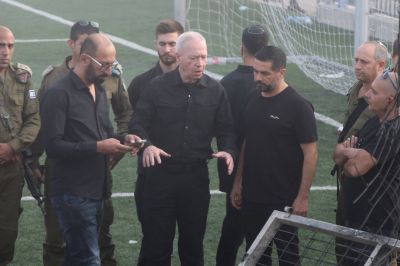
The Israeli cabinet is meeting today to decide on the next steps. If the Israeli response targets key Hezbollah infrastructure, as it did in Iran, escalation can probably be contained. If it targets civilian or highly symbolic sites, the situation will become much more complicated.