






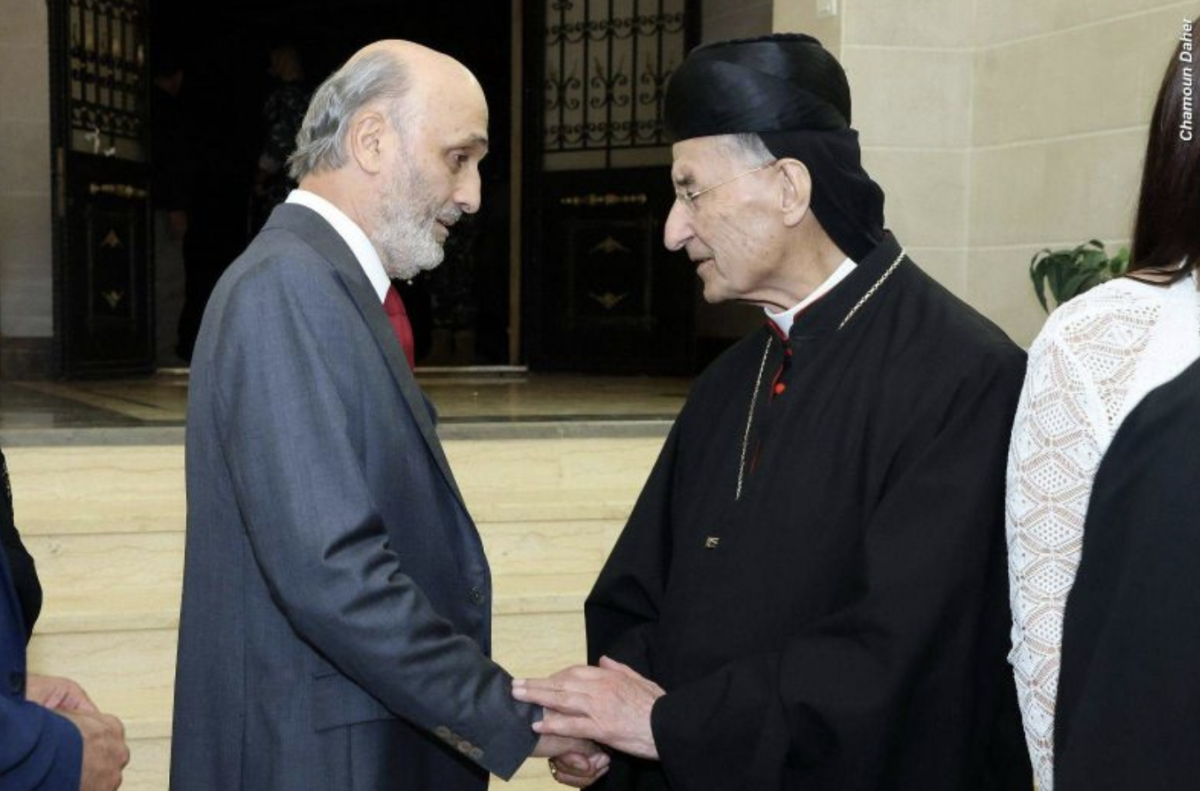
Lebanese Forces (LF) leader Samir Geagea and Maronite Patriarch Bechara al-Rai in Bqaa Kafra, July 20, 2024. (Credit: LF)






Since clashes erupted between Hezbollah and Israel in southern Lebanon on Oct. 8, one day after Hamas’ attack, the head of the Maronite Church, Bechara al-Rai, has consistently criticized the party for its unilateral decision to drag Lebanon into the ongoing war in Gaza.
On Saturday, during a church service in Bqaa Kafra (in the northern district of Bsharri) celebrating Saint Charbel’s Day, the country’s patron saint and a native of the village, Rai reiterated this position.
“Lebanon is a land of holiness, fraternity and unity among citizens,” he said. “It is not a land of conflict, war, murder and destruction.”
The following day, in his Sunday sermon delivered in Annaya (Jbeil district) Rai said, “pray for Lebanon so the ongoing war in the south comes to an end and for a just and total peace in Lebanon and Gaza.”
‘Who asked you to start a war?’
The head of the Maronite Church is not the only one criticizing Hezbollah.
Lebanese Forces (LF) leader Samir Geagea, a significant local adversary of Hezbollah and the Amal Movement, has also voiced his opposition.
On Saturday, during a dinner held in Bqaa Kafra in the presence of Rai, Geagea once again attacked Hezbollah.

“Who asked you to start a war in the name of the Lebanese people? Nobody,” said Geagea, in a message addressed to what he called “the people of the resistance.”
Criticizing “the lethargy of the Lebanese government” in the face of Hezbollah, Geagea lamented that the war had already claimed the lives of “more than 500 martyrs, for no clear reason.”
“Theoretically, the aim of this war was to support Gaza,” he added. “Except that this is not the case.”
In the same context, Geagea supported the Maronite patriarch, who had been the target of defamation campaigns by Hezbollah’s popular base, particularly after he endorsed Security Council Resolution 1559 (2004). This resolution stipulates the “disarmament of militias present on Lebanese territory.”
Rai even made the implementation of this resolution a key issue for the future president.
“We refuse to accept attacks against you, whatever the circumstances,” Geagea declared, addressing Rai.
Both Rai and Geagea are also continuing to press for the presidential election to be held swiftly, which has been paralyzed since the last electoral session on June 14, 2023.
While the prelate urged that MPs elect a president, Geagea continues to pass the blame to the mumana’a (the resistance, i.e., Hezbollah and its allies), whose MPs have torpedoed all the election sessions by forcing a lack of quorum.
“The mumana’a axis is deliberately blocking the presidential election for two reasons: Firstly, its inability to obtain a majority to elect its candidate, leader of the Marada Movement, Sleiman Frangieh,” Geagea said. “Secondly, this camp is waiting to see what happens next in the region.”
“Lebanon comes 17th in their order of priorities,” he added, implicitly accusing Hezbollah of betting on a victory for its Iranian patron in the Gaza war, in order to impose the election of Frangieh, who is rejected by both the opposition and Gebran Bassil’s Free Patriotic Movement.
In the same vein, Geagea reiterated his opposition to dialogue, a condition laid down by Parliament Speaker Nabih Berri in order to convene a new electoral session.
Recalling that the Constitution does not stipulate the holding of an expanded dialogue before the presidential election, Geagea argued that his camp, “which refuses to allow dialogue to become a custom, showed goodwill by proposing an initiative” based on two scenarios: The first providing for informal consultations before an open session, and the second, an open session, which would be suspended (but not closed) to hold informal consultations in the event of non-election.
These proposals were due to be discussed last Friday with Berri’s bloc. However, the meeting was postponed indefinitely without explanation.
This last point was likely on the agenda of the meeting between Berri and Druze leader Walid Joumblatt late yesterday afternoon in Ain al-Tineh, Berri’s residence.
“We are sparing no effort to stop the war and hold the presidential election,” said Joumblatt as he left the meeting.
All eyes are now on the talks scheduled for Monday between an opposition delegation and Hezbollah MPs in a bid to end the presidential impasse.
Meanwhile, Deputy Parliament Speaker Elias Bou Saab remains adamant that the presidential deadlock demonstrates the current parliament’s inability to elect a head of state.
He continues his call for early parliamentary elections. Speaking on Friday to the Greek Orthodox Patriarch Youhanna X, who was visiting Dhour Choueir, Bou Saab’s hometown, Saab said: “If we do not succeed in electing a president, I call on all political leaders and MPs to have the courage to resign collectively, in order to reconstitute power after introducing the necessary amendments to the electoral law.”
This article was originally published in L'Orient-Le Jour and translated by Sahar Ghoussoub.
