






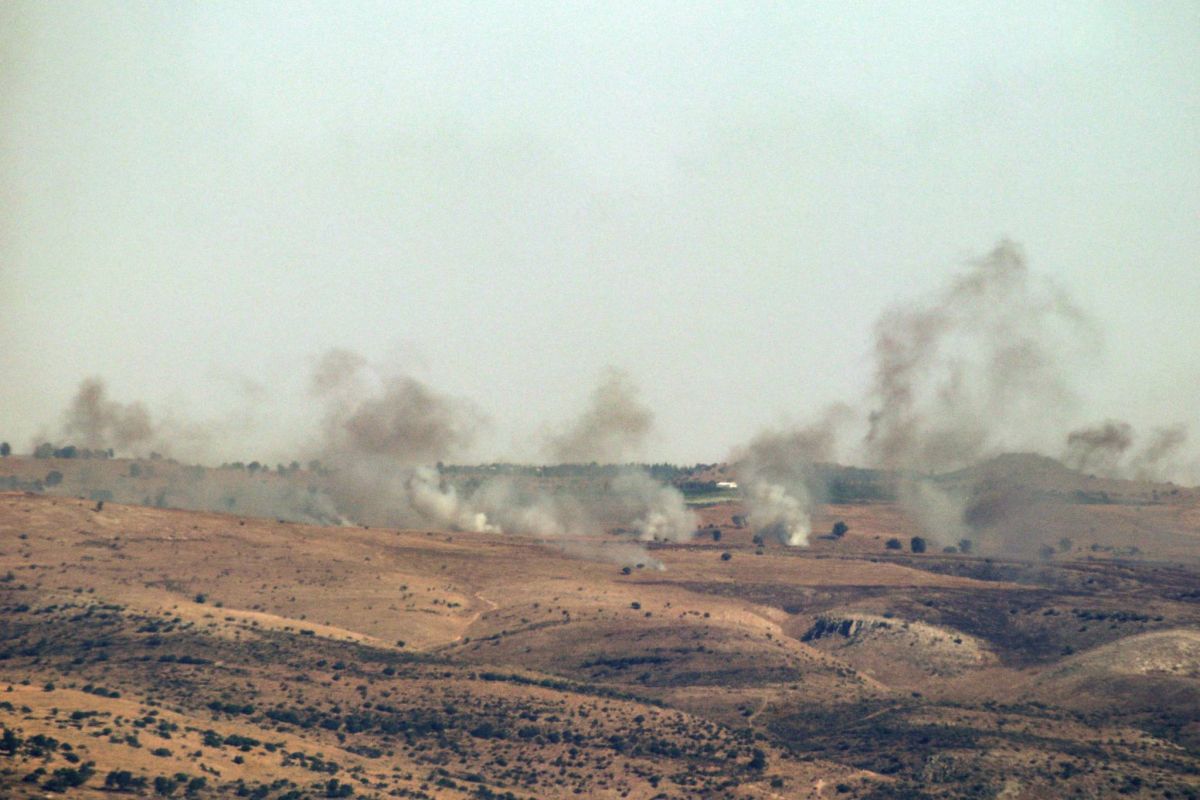
Smoke over the occupied Golan Heights, after rocket fire from South Lebanon, July 3, 2024. (Credit: Rabih Daher/AFP)






Hezbollah announced late Sunday that it targeted with "consecutive squadrons of explosive drones" a reconnaissance center on Mount Hermon in the Israeli-occupied Syrian Golan Heights, referring to the "most important operation carried out by its air forces" since the party opened its "support front" for Gaza on Oct. 8.
Claiming to support Hamas, the pro-Iranian party has been exchanging fire with the Israeli army on the border between Lebanon and Israel on an almost daily basis since the start of the war in the Gaza Strip. The exchanges of fire have cyclically increased in intensity, against a backdrop of bellicose rhetoric, raising fears of a regional escalation. Hezbollah's deputy leader, Naim Qassem, said on Friday that there would be "no wider war" in Lebanon in the near future, but that his party is "ready for all eventualities."
In the wake of the evening strike on Mount Hermon, visiting Israeli Defense Minister Yoav Gallant told soldiers that even in the event of a cease-fire in Gaza, "we continue to fight and do whatever is necessary" against Hezbollah.
Reconnaissance center on Mount Hermon
In a statement released around 8:30 p.m., Hezbollah announced that it had launched an "airstrike using consecutive squadrons of explosive drones against the long-range electronic and technical reconnaissance center" on Mount Hermon in the occupied Syrian Golan. The party said it had "hit domes" of this center as well as surveillance equipment, which were destroyed and "caused a fire."
This is the "most important operation" of the Lebanese Islamist movement's air force and the targeting of the "highest (2,230 meters)" position since Oct. 8, Hezbollah's media office announced, citing a source from the movement. According to the party, this center is used to "monitor the east, from Syria to Iraq, Jordan, up to the Iranian border." This site houses "electronic, espionage and intelligence equipment, as well as some of the most advanced technical systems."
According to Haaretz, the Israeli army said it had "intercepted a suspicious aerial object over the Golan," which came from Lebanese territory. A drone "fell in an open area near Mount Hermon, without causing any casualties," the Israeli media added.
Hezbollah said it carried out the attack in response to the killing of one of its members the previous day in the Bekaa. On Saturday night, an Israeli drone strike killed a Hezbollah fighter, Mayssam Attar, described by the Israeli military as a "major air defense expert" for the pro-Iranian group.
Injured in Israel, including an American citizen
On Sunday, Hezbollah also said it had targeted several Israeli military sites, including with guided missiles and Katyusha rockets. It notably targeted the "Raheb" site, the "Baghdadi" site, the Ayelet barracks, and the Meron base. These strikes injured four people in northern Israel, including at least three from shrapnel, according to the Galilee Medical Center in Nahariya, quoted by Haaretz. Among the injured was an "American citizen" who was severely injured and his condition "deteriorated" in the evening.
Israel carried out a series of strikes and bombings, including in Aita al-Shaab, Naqoura and several villages in the Marjayoun region. Some of these strikes caused fires, as has happened regularly in recent weeks.
Cross-border fighting has left at least 486 people dead in Lebanon, according to L'Orient-Le Jour's count, most of them fighters from Hezbollah and its allies, but there are also 75 civilians, three journalists and about 20 rescue workers. On the Israeli side, at least 16 soldiers and 11 civilians have been killed, according to the authorities. In both countries, tens of thousands of residents have been displaced by the violence on both sides of the border.
It is also to try to find a resolution to this conflict and allow the return of civilian populations that the U.N. special coordinator in Lebanon went to Israel this Sunday for a three-day visit.
This article originally appeared in French in L'Orient-Le Jour.
