






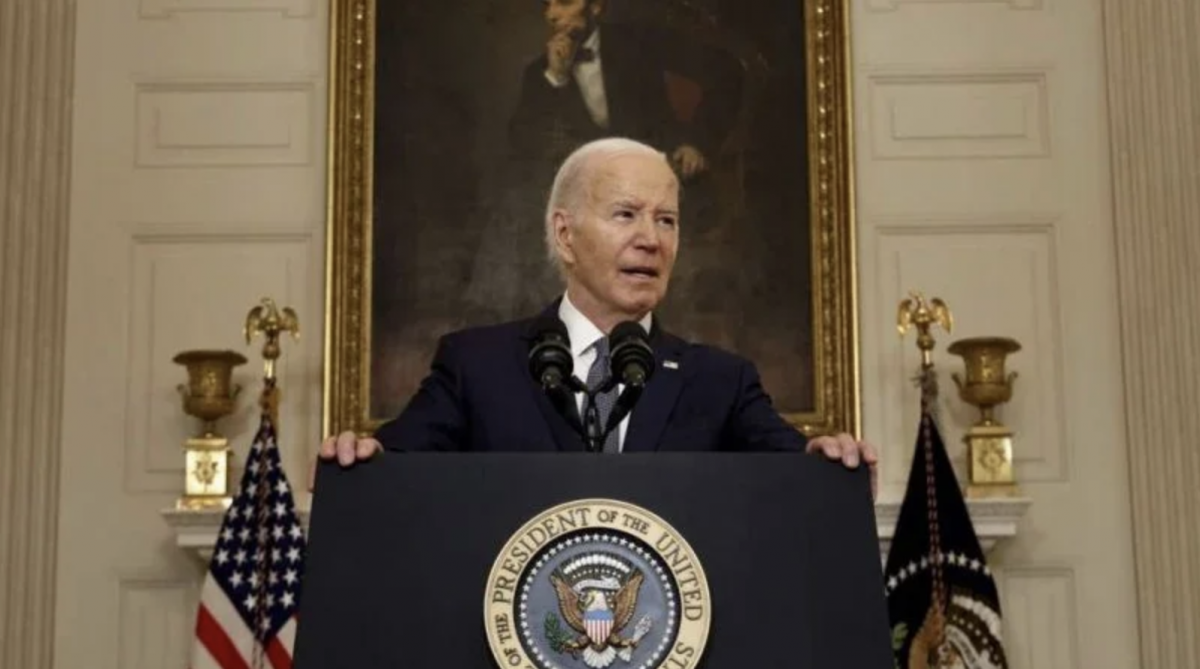
President Joe Biden announces a proposed cease-fire between Israel and Hamas in Gaza during his address at the White House, May 31, 2024 in Washington. (Credit: Chip Somodevilla/AFP)






In nearly eight months of Israel’s war in the Gaza Strip, US President Joe Biden had not previously issued such a clear call for its resolution. Never before has his credibility been so prominently on the line.
During a press conference held on Friday, Biden urged Hamas to consider a three-phase Israeli proposal aimed at halting the ongoing devastation in the Palestinian enclave.
The first phase entails a six-week comprehensive cease-fire and the withdrawal of Israeli forces from densely populated areas. Additionally, the plan proposes the release of certain Israeli civilian hostages, including women, the elderly, the wounded and the sick, with some remains to be returned to their families.
This phase includes releasing 100s of Palestinian prisoners, repatriating displaced persons to their northern enclave regions and increasing humanitarian aid, which Israel has largely obstructed.
These six weeks should also encompass negotiations to pave the way for the next phase: A definitive cessation of hostilities, the release of the remaining hostages, including soldiers and the complete withdrawal of the Israeli military from the territory.
The final stage will focus on launching an extensive reconstruction plan for the coastal enclave, with support from Washington and the international community.
During this phase, the last remains of Israeli hostages will be returned to their families. Additionally, with assistance from regional partners, every effort will be made to prevent Hamas from re-establishing its military capabilities.
Following these remarks, Hamas issued a statement on Telegram, expressing approval of the approach and endorsing the call for “a permanent cease-fire, the withdrawal of occupying forces from the Gaza Strip, reconstruction and the exchange of prisoners.”
The group also stated its readiness to respond “positively and constructively” to any proposal incorporating these measures, provided Israel “explicitly commits” to them on its side.
Divisions
The timing of the plan’s announcement held significant weight.
It arrived at a particularly delicate juncture for Biden, just months before the presidential election and mere days before the televised debate scheduled between him and his rival, Donald Trump.
Biden finds himself under heightened scrutiny, particularly from a faction within the Democratic Party who have branded him “Genocide Joe” due to the military, financial and political support he has extended to Israel since Hamas’ Oct.7 attack.
In an increasingly polarized America, where the Palestinian cause has garnered increased sympathy in recent years, Israel’s conflict in the Gaza Strip has eroded trust in Biden among significant segments of his electorate, potentially jeopardizing his re-election prospects.
Moreover, his announcement follows Hamas’ declaration that it would not engage in negotiations until a cease-fire was established.
“It also comes at a time when Israel’s political elites are deeply divided, and Israeli society itself is fractured between those advocating for a decisive victory in Gaza and those pursuing a negotiated settlement,” said Palestinian political analyst Khalil Sayegh to L’Orient-Le Jour.
The National Union party, led by Benny Gantz (center-right), a member of Israel’s war cabinet, introduced a bill on Thursday, May 30, to dissolve parliament and call for early elections. Gantz, who serves as a minister without portfolio, had joined Netanyahu’s government following the violent operation carried out by Hamas in Israel on Oct. 7.
Tensions between Gantz and Netanyahu, however, reached a boiling point.
On May 18, Gantz, the prime minister’s staunch opponent, issued an ultimatum, giving Netanyahu three weeks to devise an “action plan” for the post-war period. Failure to do so would result in his resignation.
Netanyahu accused his rival of “yielding to international pressure,” alleging that Gantz sought pretexts “to overthrow” the executive and advocated for “the establishment of a Palestinian state.”
Although Biden presented the roadmap as Israeli on Friday, there are strong indications that it originates from Washington.
Evidence of this lies in Netanyahu’s statement, where he indicated he had authorized Israel to engage in negotiations but emphasized that the conflict would persist until all of Hamas’ capabilities had been eradicated.
“Biden’s announcement represents an American endeavor to exert pressure on both Netanyahu and Hamas to broker a deal,” Sayegh said. “Washington’s objective is to safeguard Israel while also promoting the political factions it favors within Israel, whether center-right or center-left.”
The strategy, therefore, is to portray Israel as the proponent of a cease-fire proposal, leaving it to Hamas to accept. However, some analysts observed that Hamas had previously agreed to a similar cease-fire proposition presented by Egypt and Qatar on May 6, which Israel rejected.
“Biden opted to make the offer public because he also seeks to mobilize segments of Israeli society to advocate for a cease-fire,” Sayegh said.
Sacrifice
Did Biden, and especially Netanyahu, anticipate a favorable response from Hamas to the proposal? By swiftly accepting the plan, Hamas may have caught Israel off guard.
This places Israel in the dilemma of accepting or rejecting an offer it was purported to have initiated.
It seems that the deck is stacked against Netanyahu. With Hamas still holding ground in Gaza and managing to sustain actions there, agreeing to a cease-fire today could be perceived as a setback for the Israeli prime minister, who previously pledged to dismantle the group in the enclave.
However, in his address, Biden didn’t shy away from embellishing the situation by portraying Israel as triumphant, asserting that Hamas is no longer capable of organizing another Oct.7.
Despite leading the most right-wing coalition in his country’s history, Netanyahu’s current ultranationalist and far-right allies also advocate for full-scale war against Gaza, calling for either the recolonization of the enclave or the expulsion of its population.
If Netanyahu accepts the deal, he risks alienating his current allies.
“Israel has a keen interest in the plan’s first phase,” Sayegh said. “Netanyahu may succeed in securing the release of civilian hostages and then consider sacrificing the soldiers still held captive to prolong the conflict and defeat Hamas.”
At this stage, many questions arise, especially as the devil is in the details and several factors could disrupt the initial negotiations.
It remains unknown what exactly constitutes the “densely populated areas” from which Israel must withdraw during phase one.
Additionally, nothing guarantees that once Hamas has handed over most of the civilian hostages, Israel would not choose to resume the war.
Biden acknowledged the challenges in his speech, noting that it would be difficult to keep the “Israeli proposal” on track. He said “several details were to be negotiated” to move from phase one to phase two. However, in a way, the US president “put himself in danger” on Friday, according to Palestinian political analyst Nour Odeh, quoted by Al Jazeera.
“He stated that the US would guarantee that Israel would uphold its side of the bargain as long as the mediators succeeded in persuading Hamas to accept the agreement and uphold its side of the bargain,” Odeh said.
This article was originally published in L'Orient-Le Jour and translated by Sahar Ghoussoub.
