






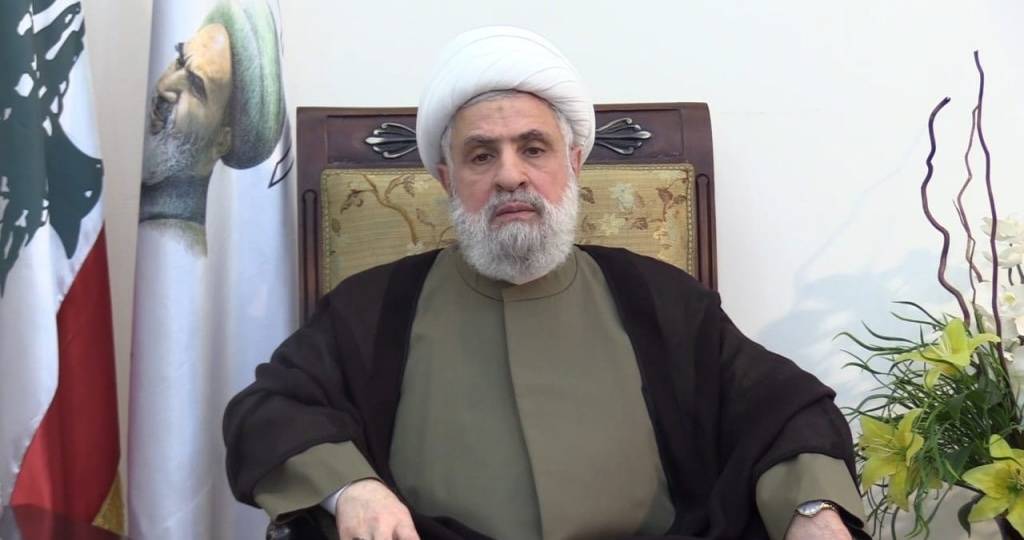
Hezbollah's deputy secretary-general, Sheikh Naim Qassem. (Credit: NNA)






Hezbollah's deputy leader, Sheikh Naim Qassem, said on Thursday evening that there was “no link” between the election of a new president, a position that has remained vacant for more than a year and a half, and the clashes between the party and Israel in southern Lebanon. Hezbollah's clarification comes at a time when, according to several sources, the presidential crisis is set to last, with no prospect of resolution until the situation in Gaza and southern Lebanon has been resolved.
“The presidential deadline has no connection with what's happening on Lebanon's southern front,” stated Qassem during a commemoration in Beirut's southern suburbs of four party members killed in Israeli strikes on Bint Jbeil. He added that if Parliamentary Speaker Nabih Berri issued an invitation for dialogue between the various parties, Hezbollah would respond, but that it was “unacceptable” for a parliamentary group to “impose its conditions on Lebanon and the Lebanese.”
Several months ago, the group of former Future Movement MPs launched an initiative aimed at bringing MPs together for a consultation session in Parliament to resolve the political crisis. The invitation was rejected by Hezbollah and its ally the Amal Movement. The two allies are backing the candidacy of Marada leader Sleiman Frangieh, while the opposition, joined by the Free Patriotic Movement (FPM), normally an ally of Hezbollah, is in favor of the candidacy of former Finance Minister and International Monetary Fund executive Jihad Azour.
Regarding the war in the south, Qassem reaffirmed that the fighting along the Lebanese-Israeli border would only stop “when the fighting ceases completely in Gaza.” He said he was not afraid of Israeli “threats” to expand the conflict but was ready to face them. “Instead of some people questioning why we opened the front” in southern Lebanon, they should “thank us a hundred times over for doing so, which has enabled us to protect their lives, their children's lives, education, culture, history, the economy and their daily lives,” he said. Many opposition parties, as well as the FPM, have criticized the party for unilaterally deciding to go to war. Earlier this week, the leader of the FPM, Gebran Bassil, criticized the fact that Hezbollah had “fired first” against Israel.
Fighting along Lebanon's southern border has claimed 434 lives since Oct. 8, the day after Hamas launched a deadly attack on Israel and Israel began its offensive in Gaza. Of these victims, the vast majority (323) were from the ranks of Hezbollah. But the Israeli bombardments also killed, in addition to members from other warring parties, more than 60 civilians, nearly 20 rescue workers and three journalists.
This article originally appeared in French in L'Orient-Le Jour.
