






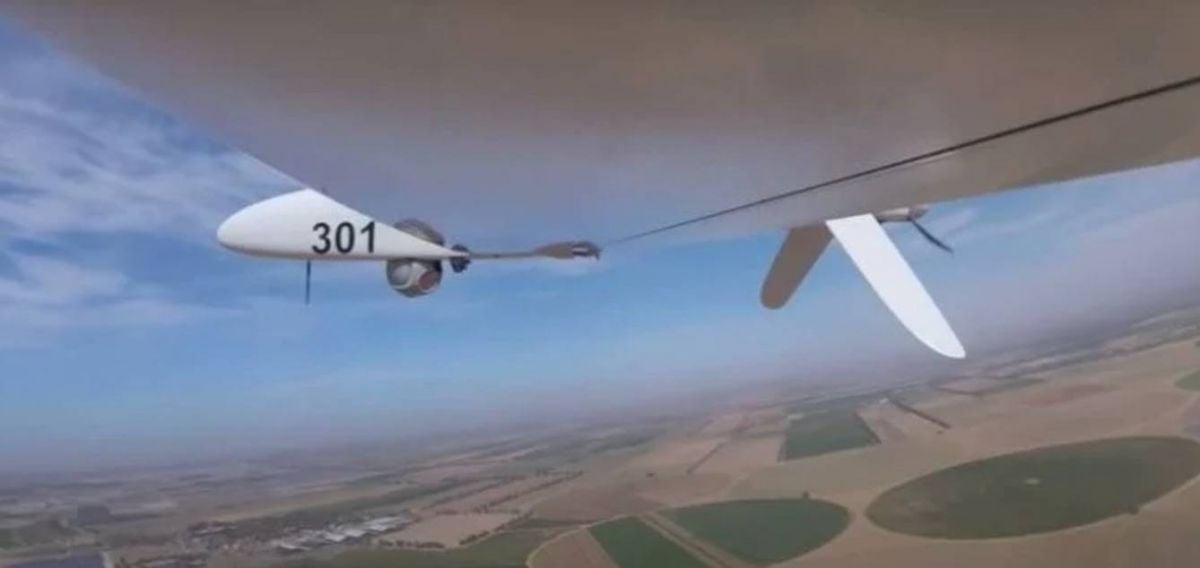
A Skylark type drone, manufactured by the Israeli company Elbit Systems, during a test flight. ( Credit: Elbit company official website)






Since the outbreak of clashes between Hezbollah and Israel on Lebanon’s southern border on Oct. 8, a day after Hamas’ Operation Al-Aqsa Flood, the party has been announcing its strikes against Israeli positions on an almost daily basis.
In a Feb. 11 statement, Hezbollah said it had “taken control of an Israeli Skylark drone, which is in good technical condition,” without specifying where the interception took place.
What are the specific features of this device and what would be the significance of such an operation for Hezbollah?
Retired Army General Khalil Helou answers L’Orient-Le Jour’s questions.
Q- What does a Skylark drone look like? What are its special features?
A- There are three models of this drone, Skylark 1, 2 and 3, manufactured by Elbit Systems, an Israeli company that also produces defense systems for Merkava tanks.
This small 45-kilogram drone is used by Israel's infantry rather than its air force because it is easy to handle and does not need a runway to take off. Older models have a range of 20 to 40 kilometers, and newer ones can venture up to 60 to 80 kilometers.
Q- What are these drones used for?
A- Surveillance cameras equipped with transmitters can be mounted on drones. Recording what the drone captures isn’t necessary since it’s typically operated in real-time by an operator who monitors its movements on a screen.
The Skylark drone operates via remote control using radio waves. If Hezbollah has indeed captured it, as announced, it suggests the party possesses the technological capability to hijack it.
Q- Do you think that Hezbollah could have used the drone to retrieve information?
A- I don’t believe Hezbollah would have gained much from retrieving the drone. It’s unlikely that this equipment records its footage, and even if it did, it wouldn’t provide the party with any new information since it was likely filming its own activities.
This operation seems to be more about a symbolic victory than anything else, as capturing the drone doesn’t offer any significant military advantage to Hezbollah. Furthermore, it’s unlikely that Hezbollah would seek to replicate its technology, as its Iranian-made drones are far more advanced.
This article was originally published in French in L'Orient-Le Jour. Translation by Sahar Ghousoub.
