


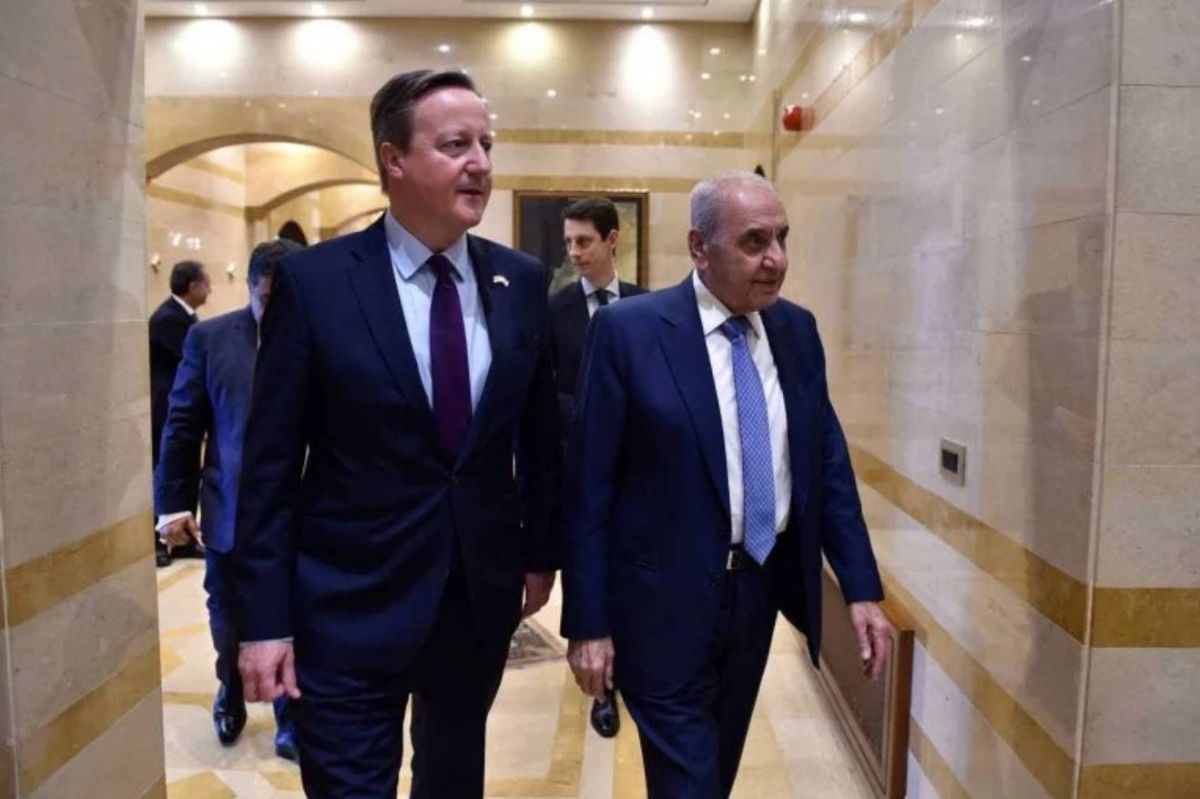
Parliament Speaker Nabih Berri received British Foreign Minister David Cameron in Ain al-Tineh on Thursday, Feb. 1, 2024. (Credit: AFP)






“If Hezbollah thinks that when there’s a pause in fighting in the south [in Gaza], we will hold fire against it, it’s sorely mistaken,” threatened Yoav Gallant on Friday afternoon.
“Until we reach a situation in which it's possible to restore security for residents of the north, we will not stop,” he added.
A few hours later, the US carried out strikes against Iran’s elite forces and Tehran-aligned groups in Iraq and Syria, in retaliation for the death of three US servicemen in Jordan a few days earlier.
On Saturday afternoon, after a relatively calm day along Lebanon’s southern border, Hezbollah carried out a series of strikes on northern Israel, the day after two Amal Movement fighters were killed in an Israeli raid in Blida, Marjayoun. Meanwhile, Israeli fighter jets pounded Lebanese border towns.
On the same day, the Israeli army claimed it attacked “more than 3,400 Hezbollah targets across south Lebanon” since the start of the war and that 200 “terrorists and commanders” had been killed.
On Sunday, Hezbollah said two of its fighters were killed in an Israeli raid on a house in Taybeh. The day was particularly tense, and the two belligerents intensified their operations.
In the evening, Gallant spoke again. “I instructed the air force to turn to the north [of Israel], and be ready for anything to happen there,” he stated during a visit to the Tel Nof Air Base, Haaretz reported.
“Every air strike in Gaza brings us closer to achieving our goals and returning the hostages (…) and every operation on the northern border [with Lebanon] brings us closer to our objective of changing the situation there. The closer we get to our military objectives [against Hezbollah], the closer we come to a situation where we would not have to go to war,” Gallant continued.
David Cameron’s proposal
While these developments have raised fears of a dangerous escalation, behind the scenes of the diplomatic arena, the reality appears to be quite different. International efforts to prevent escalation between Hezbollah and Israel have made some breakthroughs, according to corroborating sources.
Diplomatic activity in Beirut aimed to discuss ways of reducing the pace of military operations along the border to pave the way for negotiations on how to restore stability.
So far, Hezbollah has maintained that it does not want war although it is ready for it if needed. Simultaneously, Hezbollah made it clear that it is prepared to halt its operations as soon as there is a ceasefire in Gaza.
Efforts are currently underway to achieve a relatively long-term truce of six weeks or more, between Hamas and Israel. This will naturally affect Lebanon, where negotiations would intensify to reach a settlement.
All these files were on the agenda during the visits of international officials, most recently UK Foreign Secretary, David Cameron. Upon visiting Beirut, Cameron proposed that Lebanon implement a project to build surveillance towers along the Blue Line in parallel with the reinforcement of the Lebanese Army. He also called for strengthening the role of the United Nations Interim Force in Lebanon (UNIFIL).
In practical terms, Cameron has put the following equation on the table: the withdrawal of Hezbollah’s heavy weapons to the north of the Litani River in compliance with Security Council Resolution 1701, which Lebanon would respect in entirety, provided that Israel undertakes to end its land, sea and air violations of Lebanese sovereignty.
The British proposal provides for an increase in the number of Lebanese Army personnel, with the possibility of providing training and needed assistance.
Twenty-four hours after Cameron’s visit, a British military delegation discussed with Army Chief General Joseph Aoun in Yarze how to achieve a realistic and workable vision of such a proposal.
Cameron suggested proceeding in stages, the first of which would be a form of test in the west sector, particularly, Naqoura, near the UNIFIL headquarters which is a strategic point on land and sea. The aim is also to protect the maritime border demarcation agreement and avoid violations.
“Lebanon did not reject the British proposal, but made its consent conditional on the cessation of hostilities in the Gaza Strip,” said a source familiar with the negotiations. “It also insisted that the surveillance towers should be positioned along the main border or the international borders, and not along the Blue Line, as this should be linked to Israel’s withdrawal from the disputed points and to the return to the 1923 borders.”
As far as the towers are concerned, Lebanon will agree on condition that the Lebanese Army maintains full control, added the source.
Hochstein’s return
Besides Britain, France is also pursuing its efforts, starting with its proposal to revive the April 1996 agreement. The idea is to set up a quadripartite committee made up of the US, France, Israel and Lebanon to negotiate the resolution of disputes and to examine the possibility of including an Arab country on the committee.
This proposal will be on the agenda of French Foreign Minister Stéphane Séjourné, who is set to visit Beirut this week as part of a regional tour.
All these initiatives are intended to converge with US efforts, led by special envoy Amos Hochstein. The goal is to achieve a ceasefire, apply Resolution 1701, and at a later stage, demarcate the land border. In this context, a parliamentary delegation, led by the Deputy Speaker of Parliament Elias Bou Saab, who is in constant contact with Hochstein, visited the US.
According to a Western diplomatic source, Bou Saab insisted that neither Lebanon nor Hezbollah wanted a war and that it was imperative to stop the war in Gaza to end the fighting in the south and ensure the safe return of the inhabitants on both sides of the border.
Hochstein, who arrived in Tel Aviv on Sunday, will convey this message to the Israelis. He may then make a stopover in Beirut, according to the above-mentioned source, who did not mention a date.
Haaretz reported that the US envoy had begun talks with Minister Benny Gantz, who recently stated that “Lebanon is responsible for the terror activity coming from its land.” Gantz also warned that if an agreement is not reached, Israel will expand its operations against Hezbollah.
On the ground, however, there is one notable development. Over the past few days, both Hezbollah and Israel reduced their scope of action.
The party limited its action to Shebaa. This indicates a focus on the disputed area, which is considered an occupied territory that Hezbollah seeks to liberate and claim in subsequent negotiations.
At the same time, Israel is once again concentrating on artillery bombardments and drone strikes within a 10-kilometer zone and is no longer resorting to assassination operations within Lebanon.
This article was originally published in French in L'Orient-Le Jour. Translation by Joelle El Khoury.
