






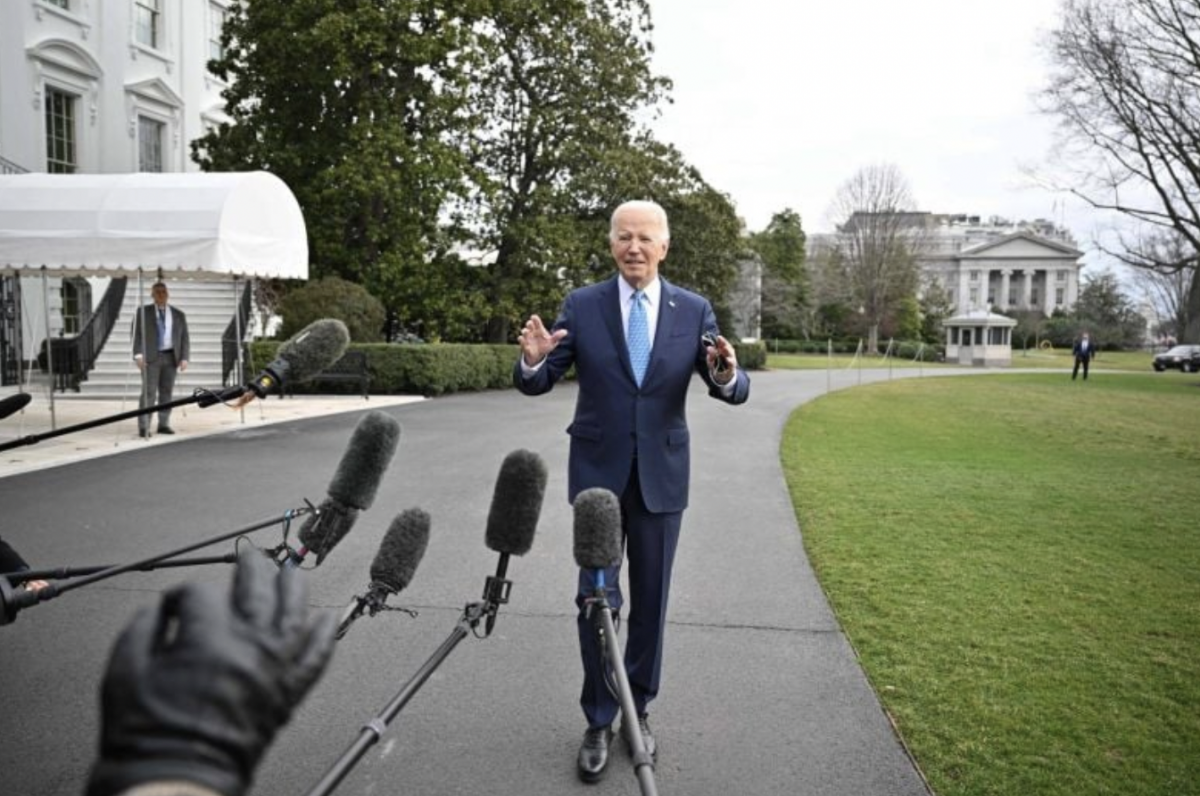
US President Joe Biden speaking to reporters as he leaves the White House in Washington, Jan. 30, 2024. (Credit: Mandel Ngan/AFP)






For Joe Biden, who is running for re-election next November, the death of three of his soldiers at Tower 22 base in Jordan (after a drone attack claimed by the Islamic Resistance group in Iraq) in the midst of the Israel-Hamas war cannot go unpunished.
While its Israeli ally could gain greater leeway to carry out retaliatory regional strikes, a response from Washington seems inevitable. Here are some of the actions that the United States could take in retaliation for the first casualties caused by enemy strikes since Oct. 7, along with their advantages and disadvantages.
Strike directly at Iran
This option is being called for by many elected representatives and politicians, often Republicans, who favor a strong military solution. In the middle of an election year, the current Democratic president's main rival, former president Donald Trump, described the attack as the "consequence of Joe Biden's weakness and capitulation.”
Despite the criticisms, this is the least likely option for the current administration. Many analysts believe that this precedent would inevitably lead to a full-scale war, which Washington wants to avoid at all costs. Iran has long made an attack on its territory a red line, even though the death of US soldiers was an American red line.
To avoid this scenario, the Islamic Republic is always striving to maintain a gray zone around the concept of "plausible deniability,” making it impossible to prove its involvement in the actions of its regional affiliates.
Following Sunday's strike on the Jordanian base, Iranian diplomatic spokesman Nasser Kanaani stated that "resistance groups in the region are responding to the war crimes and genocide of the Zionist regime,” adding that "they do not take their orders from the Islamic Republic of Iran,” according to the Islamic Republic News Agency (IRNA).
While Joe Biden highlighted Iranian support for the radical groups behind the strikes on Tower 22, his administration made it clear that it was not seeking war with Tehran.
He also said that the air defense systems failed by mistaking the hostile drones for an American drone returning to base, thus sharing responsibility for the losses inflicted.
A retaliation on Iranian soil would mark the transition to another level of retaliation from which it would be difficult to return.
Target Iranian interests in the region
This is a risky but more likely alternative. It would mark an escalation while avoiding an all-out war, reminiscent of the targeted assassination of Kassem Soleimani, head of the Revolutionary Guards' al-Quds force in Badgad.
Until now, the US has focused mainly on local targets in Syria and Iraq, linked to pro-Iranian groups in the region. Their ally Israel has done the contrary since the start of the war on Oct. 7. It has been striking Iranian targets directly in Syria, whereas previously it had bombed mainly infrastructure, arms depots and training centers in the country.
Nevertheless, Washington has more options than Tel Aviv, since it is able to reach Iranian ships thanks to its extensive maritime presence, and is engaged in the Syrian, Iraqi and Yemeni theaters, where Iranian "advisors" are present alongside the forces of the "Axis of Resistance.”
These strikes could multiply calls for the withdrawal of US forces from the region, thus serving one of the objectives of Tehran and its supporters.
The US should then probably expect retaliation from pro-Iranian groups in the countries concerned, who could step up their attacks on American interests deployed in the region.This could happen either temporarily, as in the Red Sea, or more permanently as in Iraq and Syria, as part of the coalition against the Islamic State group.
Such responses, if they do not come directly from Tehran, could allow a return to certain rules of engagement in order to avoid a regional war, which Iran has so far rejected.
The Islamic Republic could react as it did in mid-January, striking northern Syria and Erbil with ballistic missiles. This was a largely symbolic response to its main enemies, but was sufficiently demonstrative to project its striking power and silence critics demanding stronger action.
Strike local pro-Iranian groups
This is the safest option, although its effectiveness is debatable. It would perpetuate a cycle of attacks and counter-attacks that resumed with the Israel-Hamas war — over 160 strikes against US interests have been recorded since then —, after a relatively calm period.
A few months before Oct. 7, the US was in talks with Iran to free prisoners and unfreeze six billion dollars belonging to the Islamic Republic.
While Washington warned that its response could be multi-layered, phased and protracted, targeting pro-Iranian groups who continue to attack US interests in the region seems an inevitable part of the US response strategy.
Alone, however, this option does not appear sufficient to re-establish a semblance of deterrence, in the face of militias determined to use their advantage before the American elections, given Biden's refusal to embroil his troops in a new Middle East conflct.
Take retaliatory economic measures
The sanctions imposed on Iran since the implementation of Trump's "maximum pressure" policy years ago, when the US unilaterally withdrew from the nuclear deal in 2018, have severely damaged Iran’s economy.
Not all the measures taken by Washington are effectively implemented, especially secondary sanctions concerning certain countries. This gives the US some leeway to further asphyxiate the Islamic Republic, whereas it recently turned a blind eye to Iranian oil exports destined mainly for China.
The Biden administration is nonetheless limited by the Taiwan issue, where it does not wish to antagonize Beijing, and could thus incite its Western allies to impose sanctions in its place.
Re-engage in dialogue
While the various military options could lead to a cycle of uncontrolled retaliation, or could be interpreted as a lack of firmness, diplomacy — even indirect diplomacy — could prove the most effective way of calming things down.
Attacks on American interests have indeed decreased over the last year, when Washington and Tehran were engaged in dialogue on a prisoner exchange.
The Israel-Hamas war and its repercussions in the region require a political solution, for which Iran is now a key player.
In recent months, the Americans and Iranians have been sending each other messages of de-escalation through intermediaries, notably the Saudis, who normalized their relations with Tehran last March under the aegis of China. The kingdom thus joins the usual Omani and Qatari messengers, fuelling indirect communication between the two enemy countries.
The revival of diplomacy is also one of the only ways to achieve progress on the Iranian nuclear issue, as Tehran continues to enrich uranium in the current context, and Donald Trump's possible return to the White House in November would probably kill any hope of a new agreement.
This article was originally published in L'Orient-Le Jour.
