






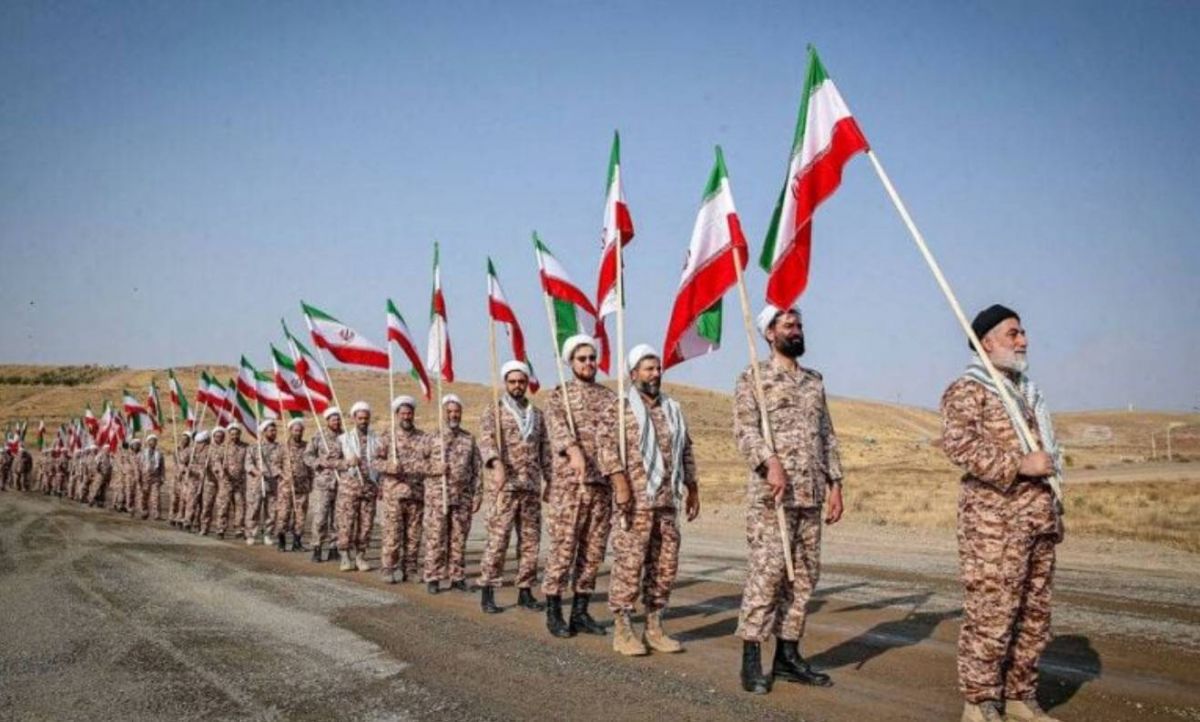
The Iranian Revolutionary Guard may be involved in the organization of Hamas' attack on Israel. (Credit: AFP/Iran's Revolutionary Guard Corps Ground Forces)






Hamas’ recent offensive against Israel has been unprecedented on many fronts, and has thrown Tel Aviv’s military dominance and strength into question.
Recent developments have turned attention to Iran, whose influence on Hamas appears prominent in the ongoing conflict.
According to the Wall Street Journal, who collected accounts from senior members of both Hamas and Hezbollah, Iranian security officials played a pivotal role in orchestrating Saturday’s surprise attack on Israel. The green light for the assault was said to have been given during a meeting in Beirut just last Monday.
Remarkably, this offensive had been meticulously planned for at least a year, as confirmed by statements from current and former Western and Middle Eastern intelligence officials.
“It was a Palestinian and Hamas decision,” insisted Mahmoud Mirdawi, a senior Hamas official.
Despite Mirdawi’s claim, Iran’s involvement in Saturday’s offensive seems likely, considering the scale of the military and logistic arsenal deployed and the motives behind the attack, which seem to align with Iranian interests.
According to the Washington Post, the assault was planned with the essential support of Iranian allies, who provided military training and logistic assistance, as well as tens of millions of dollars for the purchase of weapons.
“It’s no secret,” said Hamada Jaber, a consultant at the Ramallah-based Palestinian Center for Policy and Survey Research, in reference to the “unity of fronts” strategy espoused by Iran.
“Any attack on one front means an attack on all fronts,” is at the basis of Iran’s rhetoric.
The strategy was showcased s in May 2021, during an operation launched by Hamas and Islamic Jihad in “solidarity” with the hundreds of Palestinians injured during clashes with Israeli police on the courtyar of Jerusalem’s al-Aqsa Mosque.
Over the span of 11 days, Hamas and the Islamic Jihad fired more than 4,300 rockets toward Israel, at the rate of up to 470 missiles in 24 hours. Their output of rocket fire was twice as high compared to the conflicts of 2012 and 2014.
“Operationally, it’s roots linked to 2021 Saif al-Quds war when for first time a joint command structure was formed to coordinate info sharing, ops between Palestinian groups under supervision of Iran and Hezbollah,” said Alex Vatanka, founding director of the Iran Program at the Middle East Institute in Washington, via X.
Looking at the great number of weapons available to Hamas, cooperation between the parties appears to have increased. In fact, since Saturday, at least 5,000 rockets were fired from the Gaza Strip.
Political rupture
“This relationship has developed over time, based on a synergy between the objectives of Hamas and Iran. They both see Israel as the ultimate enemy,” said Reham Owda, a Gaza-based political analyst.
The tacit agreement between the two was sealed in 1988, following the Palestine Liberation Organization’s (PLO) indirect recognition of the Israeli state. Iran forged ties with Hamas that led to an agreement on military, financial and political support.
Despite this, both sides have disagreed on several occasions, and Hamas claimed a certain independence from Tehran.
In 2006, after Hamas’ landslide victory in the legislative elections, Iran preferred to stand alongside the Palestinian Authority (PA), whose members were driven out of the Gaza Strip.
In 2011, a deeper disagreement drove an ideological wedge between the two sides.
Amid the Arab Spring, Hamas landed its military support to the Syrian rebels against Syrian President Bashar al-Assad’s regime, under Iran’s influence. At the time, Khaled Mashaal, then Hamas leader, went so far as to brandish the Syrian opposition flag at a huge rally in the Gaza Strip.
This prompted Assad to expel senior Hamas officials from Damascus, who then relocated to Doha.
Essentially political, the dispute did not, however, translate into a complete breakdown of ties between Hamas’ military wing and Tehran.
Since 2017, relations between the two have gradually improved.
“When Yahya Sinwar assumed leadership of the Islamist group, he initiated a reconciliation process with Syria, under Hezbollah’s impetus,” said Mohannad Hage Ali, an expert on Hezbollah at the Carnegie Center.
Today, both Hezbollah and Iran view Hamas as a cornerstone of the “axis of resistance.”
Hamas’ senior members have even stated intentions to reopen the organization’s offices in Damascus.
Many observers have described this reconciliation process as an “Iranization” of Hamas, which enhanced its military and logistic capacities.
“We are aware that Iran provides technical support through highly skilled military experts to the Palestinian Islamic resistance in its struggle against Israel,” Owda said.
Iran does not give orders, only rarely
Hamas, however, appears to have maintained some independence from Tehran.
“Hamas is not the Islamic Jihad Movement,” said Ali Amin, editor-in-chief of the al-Janoubia news website. “Proof of this is that Hamas did not take part in the fighting that broke out between the Islamic Jihad and Israel, to Iran’s great displeasure.”
Amin also stressed that Hamas has been keeping a low profile for the past two years, in comparison with other Palestinian factions.
“Hamas is also keen on dealing carefully with its other allies, and above all to maintain a certain level of independence,” Amin said.
This appears to be a condition that Palestinians insist on.
“We welcome help from friendly countries,” a Hamas executive told L’Orient-Le Jour on condition of anonymity. “But that doesn’t mean we’re a tool for anyone.”
“Iran gives power, it supports, it guides, but it rarely gives orders,” Emile Hokayem, a researcher specializing in Middle East security at the International Institute for Strategic Studies, said via X.
While Iranian support for Hamas’ latest military operation, dubbed Al-Aqsa Flood, is obvious, doubts remain as to whether the decision came directly from Teheran or not.
The attack is also seen as a Palestinian reaction to repeated Israeli violations in Jerusalem and the occupied territories, and the right wing Israeli government.
As these events played out, the legitimacy of a weak PA has come into question, both in the West Bank and in Gaza Strip.
“Israel and its allies are portraying the ‘Al-Aqsa Flood’ operation as an Iranian plan to discredit the Palestinian resistance and boost international sympathy for Israel,” Amin said.
“In truth, the offensive was planned in Palestine and was known only to the most senior members of the resistance movement,” he added, dismissing the theory of close cooperation between Iran, Hamas and Hezbollah.
This is particularly true since Hamas and Hezbollah each have very different ties with Iran.
“Teheran and Hamas are ideologically opposed, while Hassan Nasrallah’s party serves as Iran’s arm in Lebanon,” said Hilal Khachan, a professor at the American University of Beirut (AUB) focused on the Arab-Israeli conflict.
Hezbollah adheres to the Shiite doctrine of wilayat al-faqih — meaning “guardianship of the Islamic jurist” (which calls for the establishment of an Islamic state) — according to which Iran’s Supreme Leader serves as both a political and religious reference.
This vision is rejected by the Sunni Muslim Brotherhood, which Hamas is affiliated with.
“Hezbollah has an organic, ideological and religious link with Iran, while Hamas and the Islamic Republic meet mainly to discuss resistance against Israel,” Kassir explained.
This article was originally published in French in L'Orient-Le Jour. Translation by Sahar Ghoussoub.
