







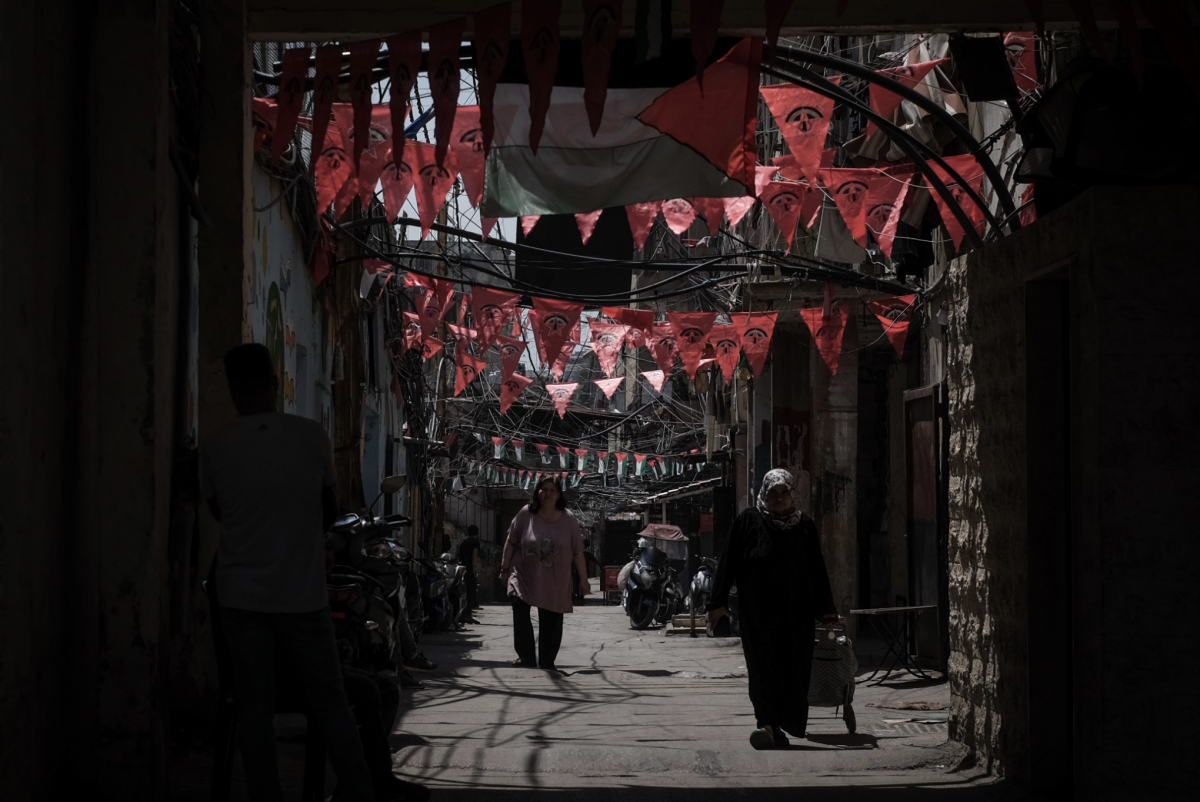
Flags bearing the logo of the Democratic Front for the Liberation of Palestine, a Marxist group, adorn a side street in the Shatila camp. May 10, 2023. (Credit: João Sousa/L’Orient Today)






Want to get the Morning Brief by email? Click here to sign up.
The Finance Ministry increased the exchange rate used to calculate customs duties from LL60,000 to LL86,000, converging with the central bank’s Sayrafa rate. This is the fourth increase to the “customs dollar,” which first rose tenfold to LL15,000 last December, matching the new official exchange rate. The increase to LL60,000 in April followed the stabilization of the parallel market exchange rate at around LL100,000 to the dollar after a sharp drop in the currency’s value in March. The latest increase to the customs dollars is expected to influence the exchange rate used to calculate value-added tax, which was recently set at different rates for imports, InterTrader sales and retail. Sales between traders and imports incur a VAT at a rate expected to be aligned to the customs dollar and the Sayrafa rate, respectively — which with the latest increase, will be aligned. Car imports, which had been exempt from the rises to the customs dollars, are expected to incur a tax 60 times higher this month.
The Energy Ministry authorized gas stations to set prices in dollars as long as they use the exchange rate adopted in the ministry’s fuel price lists. The ministry noted that customers have the option of paying either in dollars or lira, according to the exchange rate used in the ministry’s new fuel price mobile application “Lebanon Fuel Price.” Gas station owners had repeatedly demanded the right to dollarize fuel prices — during periods of high parallel market exchange rate volatility prior to the launch of the ministry’s application — and often shuttered their pumps to avoid losses from a difference between ministry-set prices and the new parallel market exchange rate.
The Court of Appeal upheld a controversial decision by the Beirut Bar Association barring its members from making media appearances without obtaining prior approval. The Court of Appeal reiterated the bar association’s arguments that the decision aimed to prevent disputes between members during their media appearances and disincentivize lawyers from making media appearances for publicity purposes. In March, the association’s decision was doubly appealed by detractors designating it as an attempt to stifle free speech. The first appeal was filed by lawyer and director of advocacy NGO Legal Agenda, Nizar Saghieh, who refused to abide by the new restrictions. In April, The Beirut Bar Association’s council summoned Saghieh and threatened to disbar him, which pushed dozens of his supporters to hold a sit-in outside the Beirut Justice Palace. Last month, caretaker Justice Minister Henri Khoury imposed a rule that judges obtain authorizations before appearing in the media and before traveling to attend seminars or conferences.
Hundreds of people in the Shatila Palestinian refugee camp on Saturday commemorated the 75th anniversary of the Nakba (“catastrophe“)— when the founding of Israel on May 15, 1948, drove 750,000 Palestinians from their homes. The commemoration followed a cease-fire ending five days of deadly bombardments between Gaza and Israel after an Israeli strike on Tuesday killed three Islamic Jihad commanders and 10 civilians, including several children. Hanan Farhat, present during Saturday’s commemoration, told L’Orient Today, “We’re doing this to tell the [people in Gaza] ‘We’re with you … We’re watching what’s happening.’”
Hezbollah Secretary-General Hassan Nasrallah and Lebanese Forces leader Samir Geagea disagreed on the future of Banque du Liban’s leadership, amid the executive vacuum and the looming end of embattled governor Riad Salameh’s mandate. In a Friday speech, Nasrallah called for a Parliament capable of legislating, despite the vacuum, while citing the cabinet’s caretaker status as incompatible with the appointment of a new governor. “It is urgent that the cabinet appoints a new governor,” Geagea countered on Saturday. The powers held by Parliament and the caretaker cabinet amid the presidential vacuum have repeatedly caused controversy. Most recently, MPs from the Lebanese Forces, Kataeb and Forces of Change appealed a law extending the mandates of municipal councils and mukhtars, passed during a Parliament session boycotted by the LF — which, among other things, contends that Parliament can act only as an electoral college until the presidential vacancy is filled. Lebanon has been without a president since Michel Aoun’s term in office ended on Oct. 31.
In case you missed it, here’s our must-read story from over the weekend: Hidden in a Shatila alleyway, a one-room museum preserves Palestinian history
Compiled by Abbas Mahfouz