






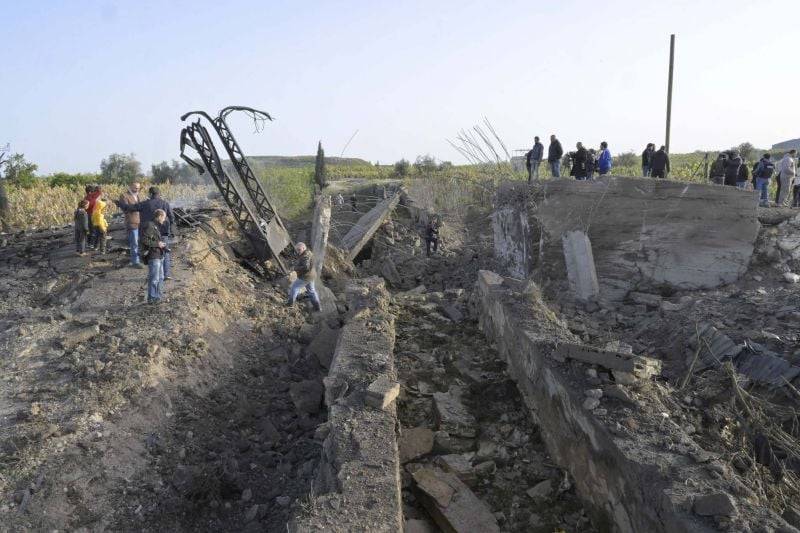
Traces of the Israeli bombardment of April 6 in Qlayleh, in the south of Lebanon. (Credit: Nabil Ismail)






Mutapha shuffles his feet as he drags on his cigarette in the area that was bombed by Israeli forces on April 6, in Qlayleh, South Lebanon. It is now April 12, and the debris has just been cleared.
“They destroyed the bridge. For hours, we were afraid that a war would break out … But the next day, everything was back to normal,” says the young man, in his 20s. The bridge he refers to was a small structure, connecting two areas of land.
Burnt trees, oranges strewn on the ground, piles of stones overturned on the field, a damaged irrigation system: this is the scene L’Orient-Le Jour first encountered when visiting the area on April 12. It was here that the Israeli army retaliated on April 6 at 4 a.m. after dozens of rockets were fired from Lebanon toward Israeli-controlled territory a day earlier.
No strikes of this magnitude had taken place from Lebanon into the neighboring territory since the 2006 war. The Israeli army later said it targeted three “infrastructures” belonging to Hamas, which it accused of being responsible for the rocket attacks.
“We will not allow terrorist Hamas to establish itself in Lebanon,” Israeli Prime Minister Benjamin Netanyahu said at a press conference on Monday, April 10.
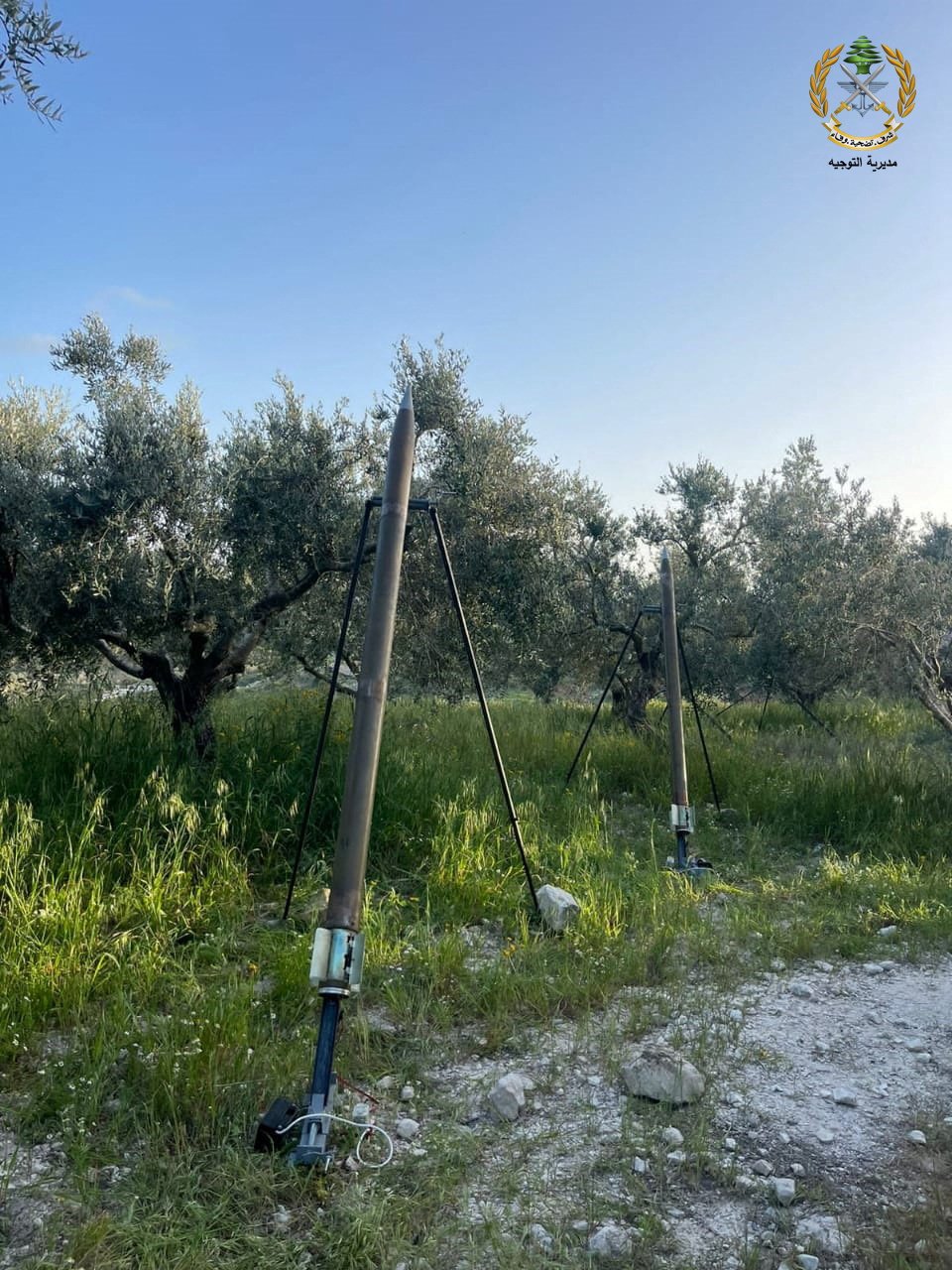 Two of the rockets discovered by the army near the villages of Qlayleh and Zebqine, following the attack. (Credit: Lebanese Army photo via Reuters)
In recent years, the Palestinian armed faction appears to be growing in South Lebanon, according to many observers.
In December 2021, the explosion of an arms depot — allegedly belonging to the Palestinian movement — in the Burj al-Shemali camp near Sour left one person dead among Hamas’ ranks.
While Hamas has denied its involvement in the recent rocket attacks, the resulting tensions have brought back decades-old memories of “Fatahland” among the Lebanese.
The term refers to the time when the Palestinian fedayeen conducted their operations against Israel from South Lebanon, where they had built a real state within a state, causing conflicts with the locals, especially the Shiite community.
But for the people of South Lebanon, this scenario is long in the past.
“That’s all in the past. Hezbollah is the real state on the ground,” says Mustapha.
Driving through the mountainous villages of South Lebanon, Issam*, a farmer, points at deserted areas.
Here, the sites bombed by Israel during the various wars are local tourist attractions. In Issam’s friend Wael’s garden in Zebqine, a nearby village, the two farmers say that they do not fear the expansion of Palestinian armed factions.
“They stay in their camps. We don’t even see them,” says Issam, from Yater. “I don’t think Hamas is more present in the south, but its members are more organized than Fatah, that’s all,” he adds.
Both men believe the Palestinians launched the rockets without Hezbollah necessarily being aware of it, although the party maintains a hold on the area.
“Between the Palestinian refugee camp of Rashidieh [near Sour] and the field where the rockets were fired, you just have to cross the street,” Wael, who is in his 40s, says. “Any well-trained individual can launch a rocket from an empty place and get away without being caught.”
‘Hezbollah always knows what to do’
For other Hezbollah and Amal supporters, the rocket fire is “an example of the unity of the fronts,” mentioned repeatedly by Hezbollah leader Hassan Nasrallah during his recent speeches, says Mohsen*, who is in his 60s, in his village of Kherbet Slim.
He and his friends are delighted with the attack on the “enemy,” which they say “was long overdue.”
In a statement issued on April 9, Hezbollah said that Nasrallah and Hamas leader Ismail Haniyeh, who had been visiting Lebanon at the time, discussed the “readiness of the axis of resistance” against Israel.
After a decade of tensions due to the Syrian war, relations between Hamas and Hezbollah appear to be back on track.
“The Palestinian cause brings people together, it is our compass,” says Mansour*, a shopkeeper in Nabatieh.
“What happened at Al-Aqsa is a red line that must not be crossed,” he adds, quoting Nasrallah’s words, in reference to a violent raid by Israeli police on the holy site in annexed East Jerusalem earlier in April.
However, he downplays the attack from South Lebanon, which he says was carried out with “very old weapons,” as well as the ostensible expansion of armed Palestinian factions in that part of the country.
“Today, it is impossible that their influence extends further than that. The sayyed [Nasrallah] and the rais [Parliament Speaker Nabih Berri] have unified the fronts,” he adds.
Karim, a student originally from Khiam and living in Beirut’s southern suburbs, who says he is close to the Hezbollah and Amal political line, seems to concur.
“Before, there was no organization to speak for the Shiites. We supported the Palestinian cause, but we were against the way the Palestinians behaved during the war [in the 70s and 80s],” he says.
“Now, with the presence of the Amal Movement and Hezbollah, it is unimaginable that they will gain ground.”
For Karim’s friend Ahmad, from Doueir, a village in Nabatieh, “it would be a problem if Hezbollah was not informed of the operation.”
“Such uncontrolled actions could then harm us, like when the Palestinians and Syrians took over the country,” Ahmad adds.
Fatme*, who is in her 60s, sits on her balcony in Zebqine and speaks of the years when the villagers “suffered from the Palestinian presence,” but she says she is not afraid of a new war.
“Now we have something to defend ourselves,” she says. “When the sayyed speaks, the enemy retreats.”
*First names have been changed.
This article was originally published in French by L'Orient-Le Jour. Translation by Sahar Ghoussoub.