






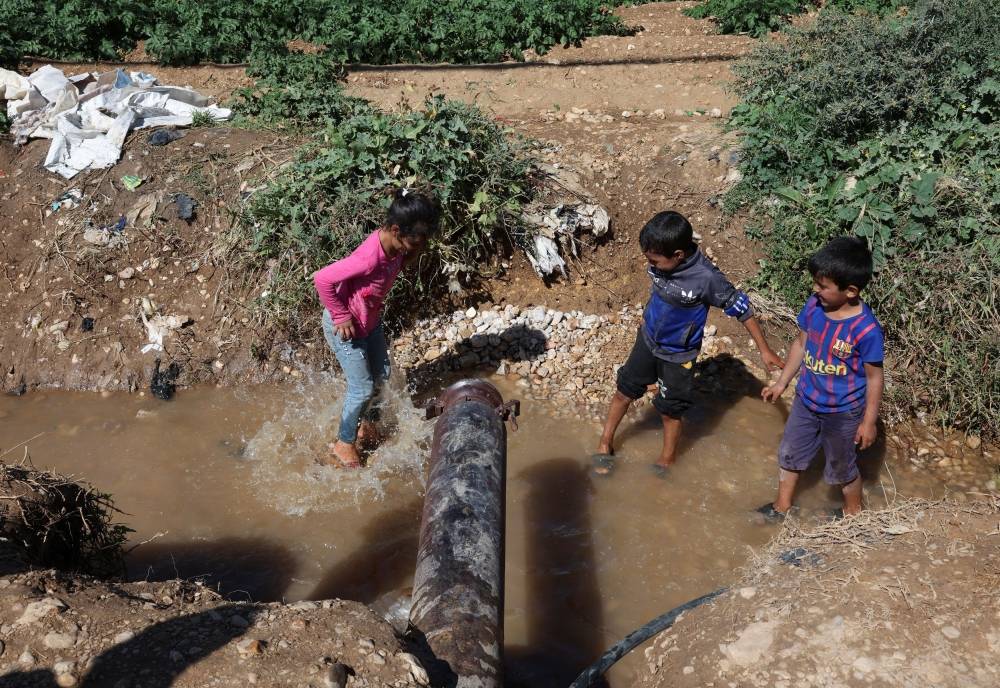
Syrian refugee children play in muddy water in Qubb Elias, in Lebanon's Bekaa Valley on Oct. 18, 2022. (Credit: Mohamed Azakir/Reuters)






Want to get the Morning Brief by email? Click here to sign up.
Parliament is scheduled to convene today for the first in a series of “consecutive sessions” to elect a president, with just a week to go before the end of President Michel Aoun’s term. Parliament Speaker Nabih Berri, prior to Thursday’s presidential election session, said that if the session failed, he would repeatedly convene Parliament until a new head of state is elected. Thursday’s third attempt to elect a president failed as 76 of the 119 MPs present — out of Parliament’s 128 —- cast protest votes. The session then ended after a number of MPs left following the first round of voting, causing it to lose quorum. The MPs’ exit was interpreted by their opponents as an attempt to prevent a second round of voting during which only support from a simple majority, instead of two-thirds, would be needed to elect a president. No consensus has yet emerged among MPs on a candidate for the presidency. On Sunday, Maronite Patriarch Bechara al-Rai and Hezbollah official Nabil Kaouk described the election process so far as a “play” and a “farce,” respectively. The former decried attempts to “lose quorum” and what he saw as a “bargaining market for settlements among MPs” while the latter criticized perceived foreign intervention in the elections and the holding of electoral sessions without first achieving consensus.
The lira suddenly gained value yesterday evening on the parallel market after an announcement from Banque du Liban’s governor, Riad Salameh. Although Lebanon’s currency held a steady parallel market rate of LL40,000-LL40,500 to the dollar last week, the lira appreciated to LL36,000 yesterday after Salameh’s announcement that Banque du Liban will no longer be purchasing dollars at the market rate from money transfer companies. Salameh added that BDL will continue to sell dollars through its Sayrafa exchange platform, which as of Friday, stood at LL30,100. The statement also noted that this will not affect depositors’ transactions (including those made through circulars No. 151 and 158) or the payment of civil servants’ salaries. Lebanon is in the brink of a potentially tumultuous political week as President Michel Aoun’s mandate ends on Oct. 31, leaving open the possibility of an executive-level vacuum with no consensus on a presidential candidate and while the government is still serving a caretaker capacity.
The cholera death toll rose to 10 over the weekend while the total number of confirmed cases reached 239 amid reports of disease detection in water sources in Tripoli and sewage water in Beirut and Mount Lebanon. According to the World Health Organization, cholera transmission is linked to inadequate access to clean water and sanitation facilities, prompting efforts from local and international authorities to power water infrastructure and provide clean water. Lebanon recorded its first cholera case in almost three decades on Oct. 6, which authorities linked to the porous northern border with Syria — where a cholera epidemic has infected more than 13,000 people and killed over 60. “Unfortunately, refugees are forced to use unclean water,” caretaker Health Minister Firass Abiad said while noting “an increase in cases among Lebanese.” The WHO’s report of cholera traces in sewage water in Beirut and Mount Lebanon is additionally indicative of the disease’s spread. "Everything is still under control," Beirut and Mount Lebanon Water Establishment Director-General Jean Gibran said Saturday, recalling quality assurance measures undertaken by the establishment on the tap water it supplies. Experts previously reassured L’Orient Today that the risk of cholera spreading to public water infrastructure is “low,” while advising citizens to take precautions to avoid contaminated fruits and vegetables and unreliable water sources. Abiad announced measures to ensure “the cleanliness of water trucks,” assuring that a plan is being rolled out to fight the outbreak. An increase in contagions risks overwhelming Lebanon’s already devastated medical sector, while the health minister linked mortality to lack of hospitalization and urged all symptomatic people to seek medical care.
President Michel Aoun on Saturday expressed eagerness to his Syrian counterpart "to begin negotiations with Syria to delineate its northern maritime boundary," while US envoy Amos Hochstein is expected to visit Lebanon this week for a meeting concluding the indirect southern border negotiations. Deputy Parliament Speaker Elias Bou Saab, who on Saturday was awarded the National Order of the Cedar for his role in the indirect negotiations with Israel, is expected to head a delegation visiting Damascus next week. Syria last year initiated exploration efforts in a contested zone north of Lebanon’s exclusive economic zone. A similar dispute in June preceded the demarcation of Lebanon’s southern maritime border with Israel, which contracted a vessel to the then-contested Karish field. Karish will fall under Israeli sovereignty while Lebanon will claim the entirety of the Qana field after the final agreement is signed this week, after which each side will register their modified border claim with the United Nations.
Independent student groups won majorities in student elections at the American University of Beirut and the Saint Joseph University (USJ). Earlier in the month, the outcome of elections at the Lebanese American University and Notre Dame University favored student groups associated with traditional political parties. Independents secured 16 of 20 seats on AUB’s student faculty council, with one group campaigner telling L’Orient Today that the club aims to implement measures alleviating the impacts of the economic crisis on tuition. The secular club and independents won by a narrower margin at USJ with a majority of seats in 12 of 23 faculties, while the university administration’s praised a high voter turnout after around three-quarters of students participated. The Lebanese Forces, however, considered USJ elections a victory, securing a majority of seats in nine faculties.
In case you missed it, here's our must-read story from this weekend: “LGBTQI+ in Lebanon: An ‘alarming and shocking picture’ of virtually erased lives.”
Compiled by Abbas Mahfouz

 7 p.m. recap: Iran warns Egypt, Israeli soldiers vote in south Lebanon, Haret Hreik responds to Kataeb